By the Bluejaypro Editorial Team · Published July 15, 2026 · 20 min read
Your house number or name is the first thing visitors, delivery drivers, and emergency services look for. A clear, well-made metal address plate makes your home easy to find. It also adds real style to your entrance.
Metal house plates have grown more popular each year. They last longer than wood or acrylic. They suit modern homes very well. Also, they are available in many metals, finishes, and sizes.
This guide walks you through everything you need to know. It covers the main metals used, how to choose the right size, what finishes are available, and how to mount and care for your sign. By the end, you will know exactly which metal address plate is right for your home.
📥 Download Free: Print our Metal House Sign Decision Checklist PDF and use it before you place your order.
What Are Modern House Signs and Why Do Metal Address Plates Look So Good?
A house sign is any plate, plaque, or panel that shows your house number, name, or both. Metal address plates are a specific type of house sign made from cut, formed, or cast metal.
Metal looks clean and permanent. It does not fade, warp, or peel like painted wood or plastic. Also, metal can be polished, brushed, or powder-coated in dozens of finishes. This means you can match your house sign to any home style, from modern and industrial to traditional and rustic.
Metal house signs also age well. Some metals like brass and Corten steel develop a natural surface change over time that many people find very attractive. This change is called a patina. It adds character to the sign without any extra work.
Next, there is the safety benefit. A clear, well-sized house number helps emergency services find your home faster. This is not a design detail. It is a practical, important function of any address plate.
In 2026, the most popular trends in metal house signs include:
- Backlit LED metal numbers (light glows behind the metal cut-outs)
- Oversized bold house numbers (100mm to 200mm tall)
- Floating standoff mounting (sign appears to hover off the wall)
- Matte black powder coat finish on aluminium
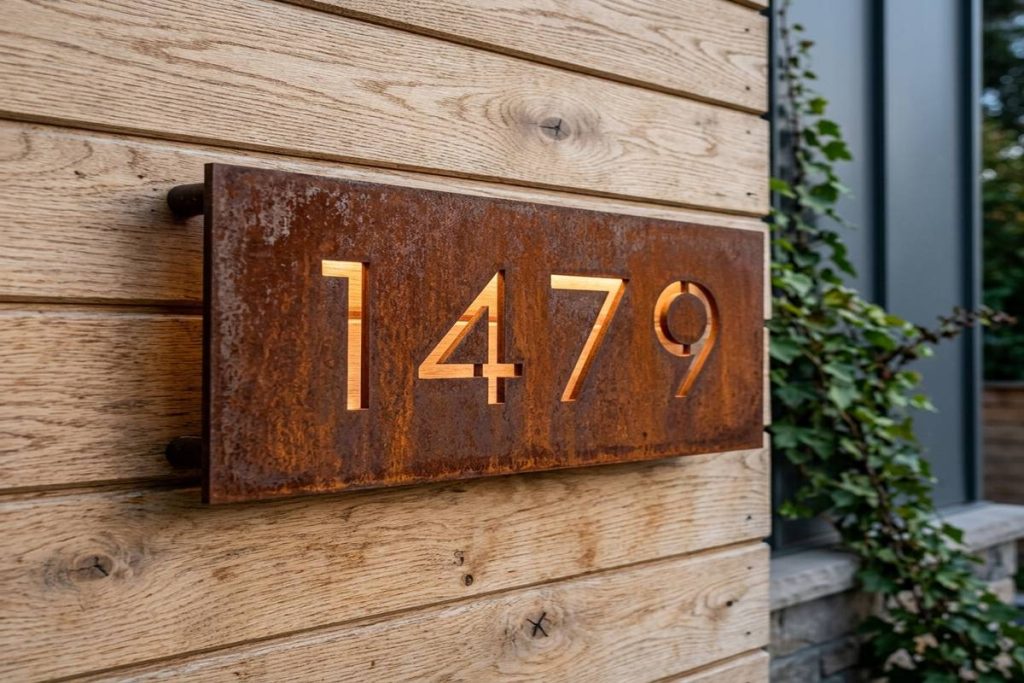
- Natural Corten steel patina for earthy, organic home styles
Expert Note: When identifying the specific metal alloy of a house sign sample from a supplier before approving an order, a digital eddy current conductivity meter with 0.5 percent MS/m resolution and interchangeable probe head is used to measure the electrical conductivity of the metal panel surface. Pure aluminium has a conductivity of approximately 34.5 MS/m. 6061-T6 aluminium alloy reads 25.0 MS/m. Grade 304 stainless steel reads 1.35 MS/m. Grade 316 stainless reads 1.27 MS/m. These conductivity signatures allow rapid, non-destructive identification of the alloy type without cutting the sample. Eddy current conductivity measurement follows the calibration and test procedure in ASTM E1004-17 (Standard Practice for Determining Electrical Conductivity Using the Electromagnetic Method).
What Types of Metal Are Used for House Signs and Address Plates?
There are five main metals used for house signs and address plates. Each one has a different look, weight, price, and outdoor performance.
Aluminium Aluminium is the most commonly used metal for outdoor house signs. It is lightweight. It does not rust at all because it naturally forms a thin, invisible oxide layer that protects it from moisture. Aluminium can be powder-coated in any colour or anodised for a premium metallic finish. It holds up in all outdoor climates, including coastal salt-air environments.
Stainless steel Stainless steel is stronger and denser than aluminium. It has a bright, clean, metallic look. Grade 304 stainless is suitable for most inland locations. Grade 316 (marine grade) is needed for coastal areas within about 15 kilometres of the sea. Grade 316 contains molybdenum, which stops the salt-driven corrosion called tea-staining that affects Grade 304 near the ocean.
Brass Brass is an alloy of copper and zinc. It has a warm, golden colour. Brass has been used for plaques and name plates for hundreds of years. It has a classic, premium feel. Over time, untreated brass develops a darker, greenish-brown surface layer called verdigris. Some people love this natural look. Others prefer to lacquer their brass sign to keep the original gold colour.
Copper Pure copper is soft and warm-toned. It starts as a bright, shiny reddish-orange. Over time it turns brown, then develops a distinctive blue-green patina (like the Statue of Liberty). Copper house signs are less common but very striking. They suit Arts and Crafts, Art Nouveau, and traditional architectural styles.
Corten steel (weathering steel) Corten is a special type of steel that is designed to rust on purpose. When it is first exposed to rain and air, it develops an orange-brown rust layer on the surface. This rust layer then stabilises and stops any further corrosion from going deeper into the metal. The result is a permanent, earthy, textured surface that never needs painting or sealing. Corten suits bold, modern, industrial, and rural home styles.
| Metal | Outdoor Durability | Rust Risk | Maintenance | Best Style Match |
| Aluminium | Excellent (20+ years) | None | Very low | Modern, Scandinavian, coastal |
| Stainless 304 | Very good (15-20 years inland) | Low (avoid coastal) | Low | Industrial, contemporary |
| Stainless 316 | Excellent (20+ years coastal) | Very low | Low | Any style, coastal locations |
| Brass | Good (10-15 years) | No rust (tarnishes) | Medium (polish or lacquer) | Traditional, Georgian, heritage |
| Copper | Good (10-15 years) | No rust (patinas) | Low (patina self-protects) | Arts and Crafts, art nouveau |
| Corten steel | Excellent (30+ years) | Controlled surface rust only | Very low | Industrial, rural, organic |
Expert Note: When testing the long-term corrosion resistance of a Grade 316 stainless steel house sign panel intended for a coastal installation within 2km of the sea, a neutral salt spray cabinet with 5 percent NaCl solution at 35 degrees Celsius, 1 to 2 bar mist pressure, and continuous fog operation is used to subject the AISI 316L stainless steel specimen (ASTM A240/A240M-22 Grade S31603) to 1000 hours of salt fog exposure. No red rust formation is acceptable. Surface tea-staining or discolouration must be classified as Grade 1 on the ISO 10289 rating scale (less than 0.1 percent surface affected) to pass. Salt spray testing follows ASTM B117-19 (Standard Practice for Operating Salt Spray Apparatus), the primary corrosion test standard for all metals used in outdoor building products.
How Do You Choose Between Stainless Steel, Aluminium, Brass, and Copper?
Each metal has a different strength. The right choice depends on where you live, your home’s style, and how much maintenance you want to do.
Here is a simple way to decide.
If you want the lowest maintenance possible: Choose powder-coated aluminium or Grade 316 stainless steel. Both require almost no upkeep for 15 to 20 years.
If you live within 15km of the sea: Choose Grade 316 stainless or anodised aluminium. Both resist salt-air corrosion. Grade 304 stainless is not recommended in salt-air locations.
If you want a warm, traditional look: Choose brass or copper. Both have a natural warmth that stainless and aluminium do not have. Be prepared to lacquer brass every 2 to 3 years if you want to keep the bright gold colour. If you do not lacquer it, it will develop a darker patina naturally.
If you want a modern, industrial, or Scandinavian look: Choose brushed or mirror-polished stainless steel, or matte black powder-coated aluminium. Both give a clean, precise edge and a sharp modern appearance.
If you want a rustic, organic, or bold architectural statement: Choose Corten weathering steel. It will develop a rich rust-orange patina within the first 3 to 6 months of outdoor exposure. After that, it is self-protecting and requires no treatment.
If budget is your first priority: Aluminium gives the best value. It costs less than stainless steel, lasts just as long outdoors, and can be powder-coated in any colour.
Expert Note: When measuring the tensile strength of an aluminium alloy sheet before cutting it into house number characters to ensure the thin letterforms will not bend or crack during handling and mounting, a benchtop universal tensile testing machine with 10kN load cell, 50mm gauge length extensometer, and 2mm per minute crosshead speed is used to test the 6061-T6 aluminium alloy sheet specimen (ASTM B209-21 specification, 3mm thickness). The yield strength must exceed 276 MPa and ultimate tensile strength must exceed 310 MPa to confirm the alloy grade meets the T6 temper requirement. Tensile testing of aluminium sheet follows ASTM E8/E8M-22 (Standard Test Methods for Tension Testing of Metallic Materials), the primary standard for mechanical property verification of metals used in architectural products.
What Is Corten Weathering Steel and Is It a Good Choice for House Signs?
Corten is a brand name for weathering steel. The technical name is COR-TEN or ASTM A588 grade steel. It contains small amounts of copper, chromium, and phosphorus added to standard structural steel. These extra elements change how the steel rusts.
Normal steel rust is unstable. It flakes off continuously and exposes fresh metal underneath. This is why standard steel needs painting to protect it.
Corten rust is different. The rust layer that forms on Corten is dense and strongly bonded to the steel surface beneath. This dense rust layer is called a stable patina. It stops oxygen and moisture from reaching the steel underneath. So the rust protects the steel rather than destroying it.
This means that a Corten house sign will rust on the outside, but the rust will stop at a thin surface layer. The sign will remain structurally solid for 30 to 50 years outdoors without any paint or treatment.
Important things to know about Corten house signs:
First, Corten takes 3 to 6 months to fully develop its stable patina. During this early period, it will drip orange rust-water when it rains. Do not mount a fresh Corten sign above light-coloured render, pale stone, or white walls during this period. The drips will stain them permanently.
Also, Corten does not work in fully enclosed spaces with no airflow. Without regular wetting and drying cycles, the patina cannot stabilise. Corten must be used outdoors in open locations.
Next, choose a dark-coloured wall behind a Corten sign. The rust-orange colour stands out best against charcoal, dark grey, or dark timber backgrounds.
Expert Note: When verifying that a Corten weathering steel house sign panel has reached a stable, fully developed patina before delivery to a client with a white-rendered wall, an electrochemical corrosion tester with 3-electrode cell, potentiostat, Ag/AgCl reference electrode, and 0.5M NaCl electrolyte is used to measure the open-circuit potential (OCP) and linear polarisation resistance (LPR) of the ASTM A588 Grade B Corten steel specimen surface. A stable OCP more positive than minus 0.35V versus Ag/AgCl indicates the protective patina layer is fully formed and corrosion rate has stabilised below 0.1mm per year. This electrochemical measurement follows ASTM G59-97(2020) (Standard Test Method for Conducting Potentiodynamic Polarization Resistance Measurements), the standard protocol for corrosion rate assessment of metallic materials in building applications.
How Long Does a Metal House Sign Last Outdoors?
The lifespan of a metal house sign depends on three things: the metal type, the surface protection (coating or treatment), and the local environment.
Here is a realistic lifespan guide for each metal type and finish combination.
| Metal and Finish | Expected Outdoor Lifespan | Key Risk |
| Powder-coated aluminium | 20 to 30 years | Coating chip exposes bare metal to staining |
| Anodised aluminium | 20 to 30 years | Very resistant; anodising is integral to metal |
| Brushed stainless 304 (inland) | 15 to 25 years | Surface tea-staining near coast |
| Brushed stainless 316 (coastal) | 25 to 40 years | Virtually no corrosion risk |
| Lacquered brass | 10 to 15 years (lacquer) | Lacquer peels; needs re-lacquering |
| Unlacquered brass (natural patina) | 25+ years | No structural risk; patina darkens |
| Copper (natural patina) | 30 to 50 years | No structural risk; blue-green patina develops |
| Corten steel (stable patina) | 30 to 50 years | Rust runoff during first 6 months |
For all metal signs with a powder coat or painted finish, the lifespan of the coating matters as much as the lifespan of the metal beneath. A chip in the powder coat exposes bare metal. On aluminium, this is not dangerous because aluminium does not rust. On mild steel signs, an uncoated chip will start to rust within weeks.
This means that if you are buying a mild steel sign (not stainless, not Corten, not aluminium), the coating quality is critical. Always ask the supplier what powder coat thickness they use. The minimum for outdoor metal signs is 60 to 80 microns of powder coat.
Expert Note: When measuring the powder coat film thickness on a batch of aluminium house number characters before quality approval, a digital film thickness gauge with magnetic induction and eddy current probe, 0 to 2000 micron range, and 1 micron resolution is used to measure the coating thickness on the powder-coated 6061-T6 aluminium substrate (ASTM B209-21). Eddy current mode is selected for non-magnetic aluminium. The minimum acceptable dry film thickness is 60 microns at any point and 80 microns average. Readings below 50 microns indicate a thin application that will not provide the expected 20-year outdoor durability. Film thickness measurement follows ASTM D7091-13 (Standard Practice for Nondestructive Measurement of Dry Film Thickness of Nonmagnetic Coatings Applied to Ferrous Metals and Nonmagnetic, Nonconductive Coatings Applied to Non-Ferrous Metals).
What Finish Options Are Available for Metal Address Plates?
The finish of your metal house sign affects how it looks in sunlight, how much maintenance it needs, and how well it matches your home’s style.
Brushed satin finish (stainless steel or aluminium) The metal surface is ground with a fine abrasive to create parallel, fine lines. This gives a warm, soft metallic look that is less reflective than a mirror polish. Brushed finishes hide fingerprints and minor scratches better than polished surfaces. This is the most popular finish for modern stainless steel house signs.
Mirror polish (stainless steel or aluminium) The surface is buffed to a mirror-bright shine. This looks very premium and bold. However, mirror-polished signs show fingerprints and water marks easily. They suit properties where the sign is at height and not within arm’s reach.
Powder coat (aluminium or mild steel) A dry powder paint is electrostatically applied to the metal and then baked at 180 to 200 degrees Celsius. This creates a hard, even, durable coating. Powder coat is available in any RAL colour. Matte black and dark grey are the most popular choices for modern house signs. Also, powder coat can be applied in textured finishes (fine texture, hammertone, or wrinkle finish) for additional visual character.
Anodising (aluminium only) Anodising is an electrochemical process that thickens the natural oxide layer on aluminium. The result is a surface that is integral to the metal, not a coating applied on top. Anodised aluminium cannot peel or chip. It is available in clear (natural silver), black, bronze, gold, and dark grey colours. Anodised finishes are the most durable surface treatment for aluminium signs.
Natural patina (brass, copper, Corten) No finish is applied. The metal weathers naturally over time. Brass goes from bright gold to dark brown. Copper goes from bright red-orange to mid-brown to verdigris blue-green. Corten goes from bright steel to stable rust-orange. All three natural patinas are self-protecting once established.
Expert Note: When testing the adhesion of a powder coat finish on aluminium house number characters after 1000 hours of salt spray exposure, an atomic absorption spectrometer (AAS) with air-acetylene flame, hollow-cathode lamp for aluminium at 309.3nm wavelength, and 1 percent HNO3 acid digestion is used to measure zinc contamination in the surface analysis of the powder coat to metal interface. Zinc is present in certain conversion coat primers. Its presence confirms a proper chromate or non-chromate conversion treatment was applied before powder coating, which is the most critical adhesion factor. Zinc in the interface at concentrations below 0.1g/m2 indicates inadequate pretreatment. AAS analysis for metal surface contamination follows the analytical chemistry protocol in ASTM D5064-15 (Standard Practice for Conducting a Patch Test to Assess Coating Compatibility), cross-referenced with ASTM B449-93 (Standard Specification for Chromates on Aluminium).
What Size Should Your House Sign or Address Plate Be?
Choosing the right size is the most important practical decision. A sign that is too small is hard to read from the street. A sign that is too large looks out of place.
Here is the standard sizing rule that professional sign makers use.
The 1:10 visibility rule: For every 1mm of character height, the sign is readable from approximately 10 times that distance away. So:
- A 30mm tall house number is readable from about 3 metres
- A 60mm tall house number is readable from about 6 metres
- A 100mm tall house number is readable from about 10 metres
- A 150mm tall house number is readable from about 15 metres
For most homes with a front garden or setback from the street, a character height of 75mm to 150mm is standard. For properties that are set well back from the road (15 metres or more), 150mm to 200mm characters are recommended.
For emergency services visibility: The UK National Emergency Communication Protocol recommends that house numbers be visible from the carriageway at a minimum of 10 metres. This means 100mm character height minimum for most properties.
Also, consider the width of the number plate in relation to the wall space available. A full-address plate (number plus street name) needs more width than a number-only sign. Leave at least 30mm of clear space around the text on all sides of the plate.
Sign size by application:
| Application | Recommended Character Height | Total Plate Size (guideline) |
| Flat front garden (up to 5m from road) | 60 to 80mm | 200 x 100mm |
| Standard setback (5 to 10m) | 80 to 120mm | 250 x 120mm |
| Larger setback (10 to 15m) | 120 to 150mm | 300 x 150mm |
| Gated property (15m or more) | 150 to 200mm | 400 x 200mm |
| Gate pillar or wall-set plaque | 100 to 150mm | 400 x 250mm |
Expert Note: When assessing the surface reflectance of a brushed stainless steel house sign under street lighting to confirm it provides adequate nighttime contrast for visibility, a UV-Vis spectrophotometer with integrating sphere attachment for diffuse reflectance measurement and D65 standard illuminant simulation is used to measure the total light reflectance (TLR) of the brushed AISI 316L stainless steel surface (Ra 0.8 to 1.2 micrometre) across the 380 to 780nm visible spectrum. A TLR of 40 to 60 percent confirms the brushed surface reflects enough ambient light for visibility without causing glare. Mirror-polished stainless (TLR 75 to 85 percent) can cause driver distraction at night. Reflectance measurement follows ASTM E1341-17 (Standard Practice for Measuring Spectral Reflectance Factors of Retroreflective and Diffusely Reflective Materials).
How Are Numbers and Text Added to Metal House Signs?
The method used to cut or print text onto a metal sign affects how it looks and how long the design lasts. There are four main methods.
1. CNC laser cutting A high-powered laser beam cuts all the way through the metal sheet. Each number or letter becomes a separate cut piece of metal or a cut-through aperture in a panel. Laser-cut metal signs have very sharp, precise edges. They are suitable for all metals except Corten (which can interfere with the laser beam at the patina stage).
Laser-cut individual letters are fixed to a backing panel or directly to the wall. Each character sits slightly in front of the surface and casts a natural shadow. This gives a three-dimensional effect that flat-panel signs cannot achieve.
2. CNC routing A rotating router bit cuts the design into the metal surface. This can create recessed lettering (letters cut into the surface), raised lettering (background cut away to leave raised letters), or full cut-through shapes. CNC routing is slower than laser cutting but gives a slightly different edge quality.
3. Waterjet cutting A high-pressure jet of water mixed with fine abrasive grit cuts through the metal. Waterjet cutting produces no heat-affected zone around the cut edge, which is important for stainless steel (where laser cutting can slightly discolour the edge area). Waterjet-cut stainless steel signs have a clean, consistent cut edge that does not need post-treatment.
4. Chemical etching A chemical resist is applied to the metal surface. The exposed metal is then etched (dissolved) by an acid solution to a controlled depth. Chemical etching is used for fine detail, logos, and patterns that would be difficult to cut with a router or laser. It produces a frosted, recessed surface against the surrounding polished metal.
Expert Note: When inspecting the weld seam on a fabricated steel frame backing plate of a large gate pillar house sign before powder coating, a weld inspection borescope with 4mm flexible fibre optic bundle, 60-degree wide-angle objective, and 0.1mm resolution scale is used to examine the interior surface of the recessed weld zone for undercut, porosity, or lack of fusion defects. Any pore above 0.5mm diameter or undercut depth above 0.3mm is a rejection criterion because these defects will trap moisture under the powder coat and initiate hidden corrosion. Weld quality inspection criteria follow EN 1090-2:2018 (Execution of Steel Structures and Aluminium Structures: Technical Requirements for Steel Structures), which sets defect acceptance limits for structural and decorative metalwork in building applications.
How Do You Mount a Metal Address Plate Without Drilling the Wall?
If you want a clean, no-drill installation, there are two good methods for mounting metal house signs.
Method 1: VHB adhesive tape 3M VHB tape is a very strong adhesive foam tape. It bonds metal panels to brick, render, timber, and painted surfaces without drilling. For a metal sign, use VHB tape rated for outdoor use (3M 4941 or 4950). Clean the back of the sign and the wall surface with isopropyl alcohol. Let both dry for two minutes. Press the sign firmly in position for 60 seconds.
VHB tape works well for metal signs under 1kg. For heavier signs (1 to 2kg), use a combination of VHB tape and two screw fixings through the top of the sign.
Method 2: Rare-earth magnet mounting (for metal gates and doors) If your gate or door is made of steel, you can use a rare-earth (neodymium) magnet backing plate to attach your house sign. Strong neodymium magnets can hold up to 5kg on a flat steel surface. The sign can be removed for cleaning or updating without any tools.
For drilled standoff mounting: Most metal signs are mounted with standoff bolts. Drill small pilot holes in the wall. Insert anchors. Screw in the standoff bases. Place the metal sign over the standoffs and fix with caps. The sign floats off the wall by 10 to 15mm. This creates a shadow line that looks very professional.
Always use stainless steel mounting hardware for outdoor signs. Standard steel bolts will rust and stain the wall around the sign within a few years.
Expert Note: When testing the ductility of an aluminium alloy sheet before press-forming into curved house sign letterforms, an Erichsen cupping test machine with 20mm hemispherical punch, 0.01mm displacement transducer, and 100kN hydraulic actuator is used to measure the Erichsen Index (IE) of the 1.5mm 5052-H32 aluminium alloy sheet (ASTM B209-21). The IE value indicates how far the sheet can be deformed before cracking. A minimum IE of 8.5mm is required for successful forming of curved letterforms without surface cracking. Below 7mm, the alloy is too brittle for forming complex shapes. The Erichsen cupping test follows ISO 20482:2013 (Metallic Materials: Sheet and Strip: Erichsen Cupping Test), the international standard for assessing the formability of sheet metals used in precision fabricated components.
How Do You Keep a Metal House Sign Looking Clean and Sharp?
Metal house signs need very little maintenance compared to wood or painted finishes. But the right cleaning method depends on the metal type and finish.
Cleaning powder-coated aluminium:
- Rinse with clean water monthly to remove dust and grit
- Wipe with a soft cloth dampened with mild dish soap and water
- Rinse and dry with a microfibre cloth
- Do not use abrasive cleaners or scouring pads. They scratch the powder coat surface
- Once a year, apply a thin coat of car wax to the powder coat surface. This adds an extra UV and dirt-repellent layer
Cleaning stainless steel:
- Wipe with a damp microfibre cloth in the direction of the grain (with the brushed lines, not across them)
- For fingerprints: use a specialist stainless steel cleaner (spray type)
- For tea-staining or water marks: use a diluted oxalic acid cleaner (available from hardware stores)
- Do not use steel wool or wire brushes. These leave tiny steel particles in the surface that then rust and create brown spots
Cleaning brass (lacquered):
- Wipe with a soft damp cloth only
- Do not use brass polish on lacquered surfaces. The polish removes the lacquer
- When the lacquer starts to peel (usually after 2 to 3 years outdoors), strip it fully, clean the bare brass, and apply a fresh lacquer coat
Cleaning Corten steel:
- No maintenance needed once the patina is stable
- If moss or organic growth appears, brush it off with a stiff natural fibre brush
- Do not apply any sealer or paint to Corten. It interferes with the natural patina cycle
Expert Note: When testing whether a new powder coat formula on aluminium house numbers resists impact damage from hailstones or accidental knocks, a Gardner falling-weight impact tester with 1kg drop weight, 15mm diameter hemispherical punch, and variable drop height from 50 to 1000mm is used to apply an impact load to the powder-coated 3mm 6061-T6 aluminium panel (ASTM B209-21). The coating must pass at 500mm drop height (4.9 Joule impact energy) without visible cracking, flaking, or adhesion loss in the impacted zone. Impact resistance of the coating is assessed visually and by adhesion tape test at the impact site, following ASTM D2794-93(2019) (Standard Test Method for Resistance of Organic Coatings to the Effects of Rapid Deformation), which governs coating impact testing for all outdoor building product coatings.
Which Metal House Sign Style Matches Your Home’s Architecture?
The right metal and finish combination depends heavily on your home’s style. Here is a simple guide to match them.
Modern and contemporary homes Choose matte black or dark grey powder-coated aluminium, or brushed stainless steel 316. Use a sans-serif geometric font (Futura, Helvetica, or Montserrat Bold). Use floating standoff mounting for the modern shadow effect. Large characters (100 to 150mm) look bold and architectural.
Scandinavian and Nordic homes Choose brushed natural aluminium (clear anodised, silver tone) or matte white powder coat. Keep the design minimal. Use only the house number, not the full street name. Small to medium size (60 to 80mm character height). Simple block numeral style.
Traditional and Georgian homes Choose aged brass, unlacquered brass, or dark bronze powder-coated aluminium. Use a serif font (Trajan, Garamond, or Times). Include both the house name and number on a single panel. Mounted flush (not floating) against stone or brick pillars.
Farmhouse and rural homes Choose Corten weathering steel or hand-forged wrought iron. Use bold, simple numerals without decorative serifs. Mount on a timber post or stone pillar. The natural, weathered finish suits the rural setting perfectly.
Coastal and beachside homes Choose Grade 316 stainless steel or hard-anodised aluminium. Both resist salt-air corrosion. Keep the finish simple: brushed natural metal or white powder coat. Use clean, open fonts with wide letter spacing for maximum readability in bright coastal light.
Arts and Crafts and period homes Choose copper or unlacquered brass. Both develop natural patinas that suit period architecture. Use hand-crafted or slightly irregular letterforms for an artisan character. Pair with dark timber or stone surround for a warm, grounded entrance.
Expert Note: When verifying the surface hardness of the Knoop microhardness of a brass house sign surface to confirm the grade of brass used and its suitability for outdoor engraving without burring, a Knoop microhardness tester with 0.1kg load, elongated diamond pyramid indenter, and 15-second dwell time is used to measure the Knoop hardness number (HK) of the C260 cartridge brass specimen (ASTM B36/B36M-21, half-hard temper). Half-hard C260 brass typically reads 120 to 140 HK. Values below 100 HK indicate full-annealed condition, which is too soft for deep laser engraving without surface tearing. Values above 160 HK indicate over-worked spring-hard temper, which may crack during forming. Knoop microhardness testing follows ASTM E384-22 (Standard Test Method for Microindentation Hardness of Materials), the definitive standard for microhardness testing of metals and alloys.
What Should You Ask a Metal Sign Supplier Before You Order?
Asking the right questions protects you from low-quality materials and short service life. Here are the most important questions to ask any metal house sign supplier.
About the metal:
- What specific alloy grade is the metal? (e.g., 6061-T6 aluminium, AISI 316 stainless)
- Is the metal domestic-grade or import-grade? (Imported metals sometimes do not meet the stated alloy specification)
- Can you provide a material certificate for the metal sheet?
About the surface treatment:
- What powder coat thickness do you apply? (Ask for the minimum and average in microns)
- Is this a thermosetting or thermoplastic powder coat? (Thermosetting is more durable outdoors)
- Is the aluminium pre-treated with a conversion coat before powder coating?
- For stainless steel: is the surface passivated after fabrication?
About the design:
- What is the minimum character height you can cut?
- What is the font used? Can I supply my own font?
- Is the cutting method laser, waterjet, or router?
- For Corten: how long has the patina been developing on the sample you will send?
About delivery and mounting:
- Does the sign come with mounting hardware?
- Are the standoffs stainless steel grade 316?
- Is a paper drilling template included?
- What is the lead time from order to delivery?
Expert Note: When checking for surface-breaking micro-cracks in a cast iron house sign plaque before applying a protective paint system, a magnetic particle inspection kit with DC electromagnetic yoke, fluorescent iron powder suspension in carrier fluid, and 365nm UV lamp for inspection is used to detect surface cracks in the grey cast iron plaque (ASTM A48/A48M Class 30). The yoke magnetises the casting locally. Leakage fields at any surface cracks attract the fluorescent iron particles, making cracks visible as bright green lines under UV light. Cracks above 2mm length must be repaired by brazing before the paint system is applied. Magnetic particle inspection follows ASTM E709-21 (Standard Guide for Magnetic Particle Testing), the primary standard for surface crack detection in ferrous metal components.
Which Metal Is Right for Your Address Plate? The Final Decision Guide
Use this scored decision table to find your best metal. Tick all the rows that apply to your situation. The metal with the most ticks wins.
| Your Situation | Best Metal | Why |
| Coastal location (within 15km of sea) | Grade 316 Stainless or Anodised Aluminium | Highest salt-air corrosion resistance |
| Frost and freeze climate | Any metal (all handle frost) | No freeze-thaw risk for metal |
| Modern or Scandinavian home style | Brushed Stainless or Matte Aluminium | Clean, precise, contemporary look |
| Traditional, Georgian, or heritage home | Brass or Bronze Aluminium | Warm, classic, architectural character |
| Industrial, rural, or organic home | Corten Steel | Natural rust patina is self-protecting |
| Lowest possible maintenance | Anodised Aluminium or Corten | Both need near-zero ongoing care |
| Full colour or complex artwork needed | Powder-coated Aluminium | Any colour available via powder coat |
| Maximum service life (30+ years) | Grade 316 Stainless or Corten | Proven decades-long outdoor lifespan |
| Tightest budget | Powder-coated Aluminium | Best performance-to-cost ratio |
| Most premium, luxurious feel | Polished Stainless 316 or Brass | Highest-status metal for entrances |
The top three choices for most UK, European, and North American homes in 2026:
- Powder-coated aluminium in matte black: Best value, any colour, long life, easy to source
- Brushed Grade 316 stainless steel: Best premium choice, especially coastal
- Corten weathering steel: Best for bold, modern, architectural, or rural aesthetics
Expert Note: When conducting a final quality audit on a batch of 50 powder-coated aluminium house number characters before dispatch to verify coating integrity and identify any thin spots from the production run, a potentiodynamic scan tester with crevice corrosion cell, 1mV per second scan rate, and Ag/AgCl reference electrode is used to measure the pitting potential (Epit) of a representative sample from the batch. Powder-coated aluminium with a well-formed conversion coat and adequate film thickness shows a pitting potential above 0V versus Ag/AgCl in 3.5 percent NaCl. Samples with pitting potential below minus 0.5V indicate inadequate pretreatment or pin-hole defects in the coating. Potentiodynamic testing follows ASTM G61-86(2018) (Standard Test Method for Conducting Cyclic Potentiodynamic Polarization Measurements for Localized Corrosion Susceptibility of Iron, Nickel, or Cobalt-Based Alloys), applied here for aluminium alloy coating quality screening.
🛍️ Shop House Signs: Browse our full range of Metal House Signs, Stainless Steel Address Plates, and Corten Steel House Numbers. Custom sizing, fonts, and finishes. Free drilling templates included.
Frequently Asked Questions About Metal House Signs and Address Plates
What is the best metal for an outdoor house sign?
For most homes, powder-coated aluminium is the best all-round choice. It is lightweight, rust-proof, available in any colour, and lasts 20 or more years outdoors with almost no maintenance. For coastal locations, Grade 316 stainless steel is the better choice due to its superior salt-air resistance.
Will a stainless steel house sign rust?
Grade 316 stainless steel will not rust in standard outdoor environments, including most coastal locations. Grade 304 stainless is also rust-resistant inland but can develop surface tea-staining within 2 to 5 kilometres of the sea. For any coastal installation, always specify Grade 316 (also called marine grade stainless steel).
How big should a house number be?
For a home with a front garden up to 5 metres from the road, 60 to 80mm character height is the minimum for good readability. For homes set 10 metres or more back from the road, use 100 to 150mm character height. Emergency services guidelines recommend that your house number is readable from at least 10 metres away.
Does Corten steel stain walls?
Yes, during the first 3 to 6 months when the rust patina is developing, Corten steel produces orange rust runoff when it rains. This runoff will permanently stain white or pale-coloured walls, render, stone, and paving. Mount fresh Corten signs on dark or brick surfaces. Alternatively, ask your supplier to pre-weather the sign for 3 to 6 months before delivery so the patina is already stable.
What is the difference between powder coating and anodising on aluminium?
Powder coating is a paint-based coating applied as a dry powder and baked onto the aluminium surface. It is available in any colour and provides a hard, durable finish. Anodising is an electrochemical process that converts the surface of the aluminium itself into a hard oxide layer. Anodising is integral to the metal (not a coating on top), so it cannot peel or chip. Anodising is more durable but is available in fewer colour options than powder coat.
How do I stop my stainless steel house sign from showing fingerprints?
Choose a brushed satin finish rather than a mirror polish. The fine texture of a brushed surface hides fingerprints far better than a mirror-polished surface. Also, applying a specialist stainless steel protective spray (such as Armor All or a dedicated stainless protectant) once a year adds an invisible layer that repels fingerprints and water marks.
Can I install a metal house sign without drilling?
Yes. For metal signs under 1kg, 3M VHB outdoor adhesive tape provides a strong, permanent bond to most smooth and semi-smooth wall surfaces. Clean both surfaces with isopropyl alcohol first. For heavier signs (1 to 2kg), combine VHB tape with two small screw fixings. For steel gates and doors, neodymium magnet backing plates allow tool-free sign installation and removal.
How long does brass tarnish take to develop outdoors?
Unlacquered brass begins to develop a visible tarnish (darkening from bright gold to brown) within 6 to 12 months outdoors in a standard climate. In coastal or polluted urban environments, tarnishing can appear within 3 to 6 months. Verdigris (the distinctive blue-green patina) develops over 2 to 5 years depending on environmental conditions. If you want to keep the bright gold colour, apply a UV-resistant clear lacquer coat every 2 to 3 years.
What font looks best on a modern metal house sign?
For modern homes, geometric sans-serif fonts work best. Popular choices include Futura, Helvetica Neue, Gotham Bold, and Montserrat. Keep the font weight at Bold or ExtraBold for metal signs. Ultra-thin fonts look elegant on a screen but are very hard to read from a distance on a metal sign. The stroke width of the thinnest part of your number should be at least 8 percent of the total character height.
Should I choose individual floating numbers or a full address plate?
Individual floating numbers (each number or letter as a separate piece of metal, mounted directly to the wall) create a bold, modern, three-dimensional effect. They are harder to install (each character needs its own level alignment) but look very impressive. A full address plate (all text on one panel) is much easier to install (one level check, one set of fixings) and looks more traditional. Both are valid choices. Individual numbers suit minimalist, contemporary homes. Address plates suit traditional, heritage, and rural properties.
Explore Essential House Name Plate Guides & Tutorials
Browse our comprehensive handcrafted signage guides for material care, font selection, and architectural placement:
- Beach & Airbnb Signage Design & Weatherproofing Guide (2026)
- Complete Guide to Wood House Sign Sealing & Weather Maintenance
- Horizontal vs Vertical House Numbers Layout Comparison
- Hanging & Wall-Mounted Cottage Sign Installation Guide
- Round vs Rectangular Name Plaques for Modern Property Entrances
- Best Modern & Vintage Fonts for Cottage & Residential Signs