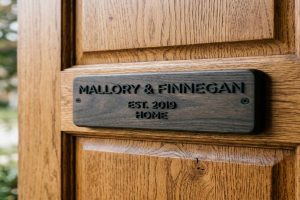
Your main door name plate is often the first thing people see when they arrive at your home. It tells them your name and sets the tone for your entire entrance. A well-chosen name plate adds personality, style, and a sense of welcome before the door even opens.
In 2026, there are more material and design choices than ever before. Backlit acrylic, laser-cut steel, carved wood, and 3D layered designs are all popular right now. Each one has its own look, price point, and installation method.
This guide explains each material, design style, size, and installation method clearly. By the end, you will know exactly which main door name plate suits your home, your door type, and your budget.
📥 Download Free: Use our Main Door Name Plate Decision Checklist PDF to pick the right style in five minutes.
What Is a Main Door Name Plate and Why Does It Matter So Much?
A main door name plate is a panel, plaque, or sign fixed to or near your front door. It usually shows your family name, your house number, or both. Some name plates also include a flat number, a welcome message, or a small design element.
Name plates matter more than most people think. Here is why.
For visitors and deliveries. A clear, well-placed name plate helps delivery drivers, guests, and service people find your home or flat quickly. This saves time for everyone.
For emergency services. Ambulances, fire brigades, and police use door numbers to find the right home in seconds. A name plate that is hard to read or not well-lit can slow them down when it matters most.
For first impressions. Your door is the gateway to your home. A stylish name plate tells visitors that you care about your space. It adds a finishing touch to your entrance that no other accessory provides.
For personal identity. In apartment buildings and housing societies, a name plate distinguishes your door from dozens of others. It makes your entrance feel personal and unique.
In 2026, main door name plates have moved well beyond plain engraved plastic. The top choices are now design objects in their own right, combining premium materials, precision manufacturing, and smart lighting.
Expert Note: When identifying the polymer type of a newly received acrylic name plate blank from an overseas supplier to verify it is cast acrylic (PMMA) and not extruded polystyrene or PVC, a Fourier-transform infrared (FTIR) spectrometer with attenuated total reflectance (ATR) accessory, 4000 to 400 cm-1 spectral range, and diamond ATR crystal is used to analyse the plastic surface of the name plate blank in direct contact mode without any sample preparation. The FTIR spectrum of PMMA shows a strong carbonyl C=O stretch at 1730 cm-1 and C-O ester stretch at 1260 cm-1. PVC shows a strong C-Cl stretch at 690 cm-1. Polystyrene shows aromatic C-H bending at 698 and 757 cm-1. These signature peaks identify the polymer in under 30 seconds. Polymer identification by FTIR follows the classification procedure in ASTM E1655-17 (Standard Practices for Infrared Multivariate Quantitative Analysis).
What Are the Most Popular Materials Used for Main Door Name Plates?
There are six main materials used for door name plates in 2026. Each one has a different look, weight, durability, and price range.
Acrylic (PMMA) Acrylic is the most popular material for modern door name plates. It is lightweight, weather-resistant, and can be cut to any shape by laser. Acrylic comes in clear, frosted, coloured, mirror, and fluorescent sheets. It is also available in multiple thicknesses from 3mm to 25mm.
Multi-layer acrylic designs are very popular in 2026. A base layer, a colour layer, and a text layer are stacked together to create a 3D raised effect. LED strips hidden inside the acrylic layers create a warm, glowing halo effect at night.
Stainless steel Stainless steel name plates have a clean, premium look. Grade 316 stainless is suitable for all outdoor and coastal locations. The text or design is laser-cut, waterjet-cut, or etched into the metal. Stainless steel name plates are heavy and very durable. They suit modern, industrial, and minimalist homes.
Brass Brass name plates have a warm, golden character. They have been used on doors for over 100 years. In 2026, brass is experiencing a strong design revival. Both polished and antique-finish brass are popular. Brass name plates suit traditional, colonial, and heritage-style homes.
Wood (teak, oak, or walnut) Carved or engraved wooden name plates are popular for rustic, farmhouse, and natural home styles. Teak and oak are the best choices for durability outdoors. Wood name plates must be sealed with exterior finish to prevent weather damage.
Glass Glass name plates are used for upscale apartments and modern home entrances. They are usually frameless or set in a slim metal frame. Glass is heavy and needs careful installation. It is not suitable for exposed outdoor locations where it may receive physical impacts. Also, toughened safety glass must always be specified for door applications.
Composite and High-Density Urethane (HDU) HDU is a dense foam material that looks exactly like carved wood but does not absorb water. It is fully weatherproof, lightweight, and can be painted in any colour. HDU is the preferred material for carved-look name plates in wet or coastal climates where solid wood would not survive without constant maintenance.
| Material | Weight | UV Resistance | Water Resistance | Best For | Price Range |
| Acrylic (PMMA) | Light | Very good (UV-stable grade) | Excellent | Modern, LED designs | Low to medium |
| Stainless steel 316 | Heavy | Excellent | Excellent | Modern, coastal | Medium to high |
| Brass | Heavy | Good (patinas naturally) | Good (needs lacquer) | Traditional homes | Medium |
| Teak wood | Medium | Good (needs sealing) | Good (needs sealing) | Rustic, natural | Medium |
| Glass (toughened) | Heavy | Excellent | Excellent | Upscale, modern | High |
| HDU composite | Light | Excellent | Excellent | Carved-look, coastal | Medium |
Expert Note: When measuring the surface hardness of three candidate acrylic sheet grades from different suppliers to confirm which one provides the best scratch resistance for a door-mounted name plate that will be touched frequently, a Shore D durometer with truncated cone indenter, 1kg spring force, and 15-second standardised reading time is used to measure the hardness of each 3mm cast PMMA acrylic sheet specimen. Cast acrylic typically measures 80 to 85 Shore D. Extruded acrylic measures 75 to 80 Shore D. PVC sheet measures 70 to 75 Shore D. The higher Shore D value confirms greater scratch and indentation resistance for a door name plate in regular contact. Shore D hardness testing follows ASTM D2240-15(2021) (Standard Test Method for Rubber Property: Durometer Hardness), applicable to all semi-rigid and rigid plastic materials.
How Do Acrylic, Metal, Wood, and Ceramic Name Plates Compare?
Choosing between these materials is about matching the material’s properties to your specific situation. Here is a direct comparison across the key factors.
Durability For outdoor exposed locations, stainless steel 316 and UV-stable acrylic last the longest. Both handle UV, rain, and frost without special maintenance. Brass and teak are also durable but need periodic maintenance (lacquering for brass, re-sealing for wood). Ceramic is durable but brittle under impact. Glass is brittle and not recommended for exposed front door applications.
Maintenance Stainless steel and UV-stable acrylic need the least maintenance. Wipe clean with a damp cloth once a month. Brass needs polishing or lacquering every 2 to 3 years to maintain its appearance. Wood needs re-sealing every 1 to 3 years depending on exposure.
Cost Acrylic is the most affordable. Basic acrylic name plates start from a very low price point. Multi-layer LED acrylic designs cost more but still less than metal equivalents. Stainless steel and glass are the most expensive. Brass and wood sit in the middle of the price range.
Visual impact LED backlit acrylic has the highest nighttime visual impact. It glows warmly and is visible from 20 metres away in the dark. During the day, stainless steel has the premium impact with its mirror or brushed metallic shine. Carved teak wood has the warmest, most personal daytime character.
Weight and installation Acrylic and HDU are the lightest. They can be fixed with adhesive tape or light fixings. Stainless steel, brass, and glass are heavy. They need drilled fixings, wall anchors, and stainless steel hardware.
Expert Note: When testing whether a 3M VHB adhesive backing on a 250mm by 150mm acrylic door name plate will provide sufficient holding strength to keep the plate attached to a painted wooden door surface for 5 or more years without peeling, a digital force gauge with 50N S-type load cell, 180-degree peel test jig, and 300mm per minute constant crosshead speed is used to measure the peel force of the double-sided VHB tape specimen peeling away from the painted door surface at the specified rate. A minimum peel force of 20N per 25mm width confirms the adhesive system will hold the plate securely against gravity and wind loading on a standard interior door. Peel adhesion testing follows ASTM D903-98(2017) (Standard Test Method for Peel or Stripping Strength of Adhesive Bonds).
What Are the Most Modern and Stylish Design Trends for Door Name Plates in 2026?
In 2026, the design trends for main door name plates reflect broader shifts in interior and exterior design. Here are the six strongest trends this year.
1. Backlit LED acrylic with halo glow This is the single most popular design for modern homes in 2026. The name or number is laser-cut from acrylic. LED strips behind the letters create a soft glow that lights up the text from behind. The result is called a halo effect or channel letter glow. Warm white LEDs (3000K colour temperature) give a welcoming feel. Cool white (6000K) gives a more clinical, commercial look.
2. 3D layered acrylic Two or three sheets of acrylic in different colours or finishes are stacked on top of each other. The front layer has the name cut out. The back layer is a contrasting colour or mirror finish. The gap between the layers creates a natural shadow that gives the name a three-dimensional depth effect. This looks very premium without needing any lighting.
3. Laser-cut stainless steel with standoff mounting A flat or shaped piece of stainless steel with the name laser-cut through it. The plate is mounted on stainless steel standoff bolts so it floats 10 to 15mm off the door surface. The natural shadow between the plate and the door adds a dynamic quality that changes as the light angle changes during the day.
4. Minimalist single-line design One clean line of text in a geometric sans-serif font. No decorative borders, no images, no extra text. This style is growing very fast among homeowners who prefer Scandinavian and Japanese-influenced interior aesthetics. Less is more. The material does the talking.
5. Carved and painted wood with gilded letters Hand-carved wood with deeply routed text filled with gold or silver paint. This artisan style is at the opposite end of the trend spectrum from minimalism but just as strong. It appeals to homeowners with traditional, heritage, or Arts and Crafts homes. Each piece is unique.
6. Material fusion (metal base with acrylic lettering) A brushed stainless steel or brass backing plate with 3D raised acrylic or metal letters fixed in front. The combination of warm metal and modern acrylic creates a design that bridges traditional and contemporary styles. It is particularly popular for apartment buildings where residents want a personal touch within a shared aesthetic.
Expert Note: When verifying that a custom-ordered acrylic door name plate in a specified RAL 7016 Anthracite Grey colour matches the client’s approved colour standard within acceptable tolerance before dispatch, a colour spectrophotometer with M2 standard illumination mode (includes UV cut filter), 45/0 measurement geometry, 10mm aperture, and CIE Lab* D65/10-degree observer output is used to measure the colorimetric values of the custom-painted acrylic name plate surface against the RAL 7016 reference tile. A CIE ΔE2000 colour difference below 1.0 is the acceptable tolerance for premium colour-matched signage. A ΔE2000 above 2.0 is visible to the human eye and requires a reproof. Colour difference measurement follows ISO 11664-6:2014 (Colorimetry: CIEDE2000 Colour Difference Formula), the international standard for industrial colour matching and quality control.
How Do You Choose the Right Size for a Main Door Name Plate?
Getting the size right is the most practical decision you will make. A plate that is too small looks lost on a large door. A plate that is too large overwhelms a small entrance.
Standard size guide by property type:
| Property Type | Recommended Plate Size | Minimum Text Height |
| Studio or 1-bedroom apartment | 200 x 80mm (8 x 3 inches) | 20mm |
| Standard 2-3 bedroom flat | 300 x 100mm (12 x 4 inches) | 25mm |
| Independent house (small) | 350 x 120mm (14 x 5 inches) | 30mm |
| Independent house (large) | 450 x 150mm (18 x 6 inches) | 40mm |
| Villa or bungalow | 600 x 200mm (24 x 8 inches) | 50mm |
Also, consider the proportions of your door and entrance wall. A good rule is that the name plate should be no wider than one-third of your door’s total width. For a standard 900mm door, the plate should be no wider than 300mm.
The 10:1 readability rule. For every 1mm of text height, the text is readable from approximately 10 times that distance. A 30mm tall name reads clearly from 3 metres. A 50mm tall name reads clearly from 5 metres. For an apartment door in a corridor, 25 to 30mm text height is usually sufficient. For an entrance gate or wall-mounted sign visible from the street, use 60 to 100mm minimum.
Leave enough border space. The text should not fill the entire plate. Leave at least 20 to 30 percent of the plate area as a clear border around the text. This border makes the text easier to read and gives the design a professional, balanced look.
Expert Note: When checking the engraved letter depth on a production run of 50 acrylic door name plates to confirm the CNC router has maintained consistent depth within the specified tolerance of 2.0mm plus or minus 0.1mm, a digital calliper with 150mm jaw capacity, 0.01mm resolution display, carbide-tipped jaws, and RS232 data output for statistical process control is used to measure the depth of five sample engraving grooves per plate using the depth gauge rod on the calliper body. Readings outside the 1.9 to 2.1mm tolerance range indicate tool wear or feed rate errors in the CNC programme. Letter depth verification by calliper follows the dimensional measurement procedures in ISO 3599:1976 (Vernier Callipers Reading to 0.1mm and 0.05mm) and the CNC tolerance classification in ISO 286-1:2010 (Geometrical Product Specifications: Limits and Fits).
What Fonts and Text Styles Work Best on Door Name Plates?
The font you choose affects how your name plate reads from a distance and how it matches your home’s style. Here are the most important font rules for door name plates.
Rule 1: Readability first The most beautiful font in the world is useless if people cannot read it from 3 to 5 metres away. Fonts with very thin strokes, tight letter spacing, or complex decorative details become hard to read at a distance, especially in low light.
Rule 2: Match the font style to your home’s character
- Modern and contemporary homes: geometric sans-serif fonts (Futura, Helvetica, Montserrat Bold, Gotham)
- Traditional and heritage homes: classic serif fonts (Trajan, Garamond, Times Bold)
- Rustic and farmhouse homes: slab serif or hand-carved style fonts (Rockwell, Clarendon)
- Luxury and formal homes: elegant script fonts (Edwardian Script, Bickham Script) — use these sparingly and only for the family name, not the house number
Rule 3: Minimum stroke width The thinnest stroke in your font should be at least 8 percent of the total character height. So for a 30mm character, the thinnest stroke should be at least 2.4mm. Thinner strokes are fragile in acrylic or metal and become hard to read from a distance.
Rule 4: Maximum two fonts per plate Use one font for the main name and (if needed) one font for the house number or secondary line. Using three or more fonts on a single plate looks messy and undesigned.
Rule 5: Generous letter spacing For outdoor name plates, increase the letter spacing (tracking) by 10 to 20 percent above the default. Wider spacing between letters improves readability from a distance, especially in low light.
Expert Note: When evaluating whether the glass transition temperature (Tg) of a UV-stabilised acrylic sheet is high enough for a south-facing main door installation in a climate where the door surface can reach 70 degrees Celsius in summer, a dynamic mechanical analyser (DMA) with dual cantilever fixture, 1Hz oscillation frequency, 3-degree strain amplitude, and -150 degrees Celsius to 300 degrees Celsius temperature ramp at 3 degrees Celsius per minute is used to measure the storage modulus and loss factor (tan delta) of the cast PMMA acrylic specimen (40mm by 10mm by 3mm). The Tg of the acrylic is identified as the peak of the tan delta curve. Cast PMMA typically shows Tg at 105 to 115 degrees Celsius. The installed acrylic must never be used within 20 degrees Celsius of its Tg under sustained load. Tg measurement by DMA follows ASTM E1640-18 (Standard Test Method for Assignment of the Glass Transition Temperature by Dynamic Mechanical Analysis).
How Do LED and Illuminated Door Name Plates Work?
LED name plates are very popular because they look striking both day and night. They are also very energy-efficient. Here is how they work and what you need to know before buying one.
Basic LED name plate construction: An LED name plate has three core components.
First, the acrylic or metal face panel. This is the front of the name plate. On a backlit design, the face panel has a frosted or translucent acrylic layer. The LED light shines through this layer from behind. On a channel letter design, the letters are hollow 3D tubes and the LED strip sits inside each tube.
Next, the LED strip. A thin strip of SMD LEDs is mounted inside the plate. LED strips use 12V DC power. They are waterproof-rated for outdoor use. A good LED strip lasts 30,000 to 50,000 hours. This means that at 8 hours per day of use, the LEDs will last 10 to 17 years before needing replacement.
Also, the LED driver (power supply). The LED driver converts mains 240V AC power down to 12V DC for the LED strip. It is the critical safety component. Always use a CE-marked LED driver rated for at least 1.5 times the actual load. A driver without a CE or UL safety mark is a fire risk and must never be used.
Wiring an LED name plate: LED name plates need a wire run from the plate to a nearby power source. Plan the cable route before installation. The cable usually runs through a small hole in the wall or door frame to a driver box mounted inside. Also, use outdoor-rated cable (double insulated, UV stable) for any sections exposed to weather.
Choosing LED colour temperature:
- 3000K warm white: soft, amber-toned, welcoming and residential
- 4000K neutral white: clean, balanced, suits both modern and traditional homes
- 6000K cool white: bright, clinical, better suited for commercial premises
For a main door at home, 3000K or 4000K is the best choice. Cool white (6000K) can look harsh and commercial on a domestic entrance.
Expert Note: When verifying the temperature distribution across the back surface of a newly assembled LED backlit acrylic door name plate after 2 hours of continuous operation to confirm the LED strip is not generating hotspots that could warp the acrylic face panel, a thermal imaging camera with 320 by 240 uncooled microbolometer detector, noise equivalent temperature difference (NETD) below 50mK, 9Hz frame rate, and 25mm fixed focal length lens is used to image the full rear surface of the assembled name plate after 2 hours at rated load. Hotspots above 60 degrees Celsius at any point on the acrylic surface indicate insufficient thermal management. At 60 degrees Celsius or above, cast acrylic begins to soften slightly under sustained load and may warp. Thermal imaging for electronic product safety follows the inspection methodology in ISO 18434-1:2008 (Condition Monitoring and Diagnostics of Machines: Thermography: General Procedures), applied here for LED assembly thermal performance assessment.
How Do You Install a Main Door Name Plate Without Damaging the Door?
The right installation method depends on the weight of the name plate and the type of door or wall it is going onto.
Method 1: 3M VHB adhesive tape (for plates under 500g) This is the easiest and most damage-free method. 3M VHB (Very High Bond) tape is a high-strength foam adhesive tape. It bonds most surfaces without drilling. For a door name plate, clean the back of the plate and the door surface with isopropyl alcohol. Let both dry for 2 minutes. Press the tape onto the back of the plate. Remove the tape backing liner. Press the plate firmly onto the door for 60 seconds. The bond reaches full strength after 24 hours. Do not expose to rain for the first 24 hours.
Method 2: Screw fixing (for plates over 500g or on outdoor walls) Mark the hole positions using a pencil and spirit level. Drill pilot holes of the correct diameter for your wall plugs. Insert wall plugs. Apply a small bead of neutral-cure silicone sealant into each hole before inserting the screw. Fix the screws through the name plate and into the plugs. Tighten to the specified torque. Cap the screw heads with matching colour cover caps if needed.
Method 3: Standoff bolt mounting (premium look) Standoff bolts are decorative stainless steel fittings that hold the plate away from the wall surface. Drill and fix the standoff bolt bases to the wall. The name plate has pre-drilled holes. Lower the plate over the standoff bolts and fix with the decorative top caps. The plate floats off the wall by 10 to 15mm creating a professional, architectural look.
For LED plates: Always plan your wiring route before starting installation. Feed the wire cable through the wall before fixing the plate permanently. Once the plate is fixed, it is much harder to run cables cleanly.
| Plate Weight | Door/Wall Type | Recommended Method | Fixings |
| Under 200g | Indoor door (wood or UPVC) | VHB adhesive tape | None needed |
| 200 to 500g | Indoor or sheltered outdoor door | VHB tape + 2 screws top | Stainless M4 screws |
| 500g to 1.5kg | Outdoor brick or render wall | Screw with wall plugs | Stainless M6 plugs |
| Over 1.5kg | Gate pillar or exterior wall | Standoff bolt mounting | Stainless M8 standoffs |
Expert Note: When standardising the installation torque for M5 stainless steel screws fixing a brass name plate to a hardwood door frame to ensure fixings are secure without overtightening and splitting the frame, a digital torque screwdriver with 0.01 Nm torque resolution, peak-hold recording function, and calibrated scale from 0.1 to 5.0 Nm is used to apply a reproducible tightening torque to each M5 x 20mm stainless steel pan head screw (ISO 4762) driven into the pre-drilled hardwood door frame pilot hole. For a 5mm screw in hardwood, the recommended installation torque is 2.0 to 2.5 Nm. Above 3.0 Nm, the risk of grain splitting in the door frame increases. Torque tool calibration and usage follows ISO 6789-1:2017 (Assembly Tools for Screws and Nuts: Hand Torque Tools).
What Is the Best Adhesive for Sticking a Name Plate to a Door?
If you want a drill-free installation, adhesive is the answer. But not all adhesives work equally well on all surfaces. Here is what you need to know.
3M VHB tape is the best general-purpose adhesive for name plates up to 500g on smooth or semi-smooth surfaces. It works on painted wood, UPVC, powder-coated metal, and glass. It does not work well on textured, dusty, or porous surfaces.
Silicone sealant (clear or white) works on almost any surface including rough render and natural stone. It is flexible, waterproof, and UV stable. The downside is that silicone is not as strong as VHB tape for very heavy plates. Use it as a secondary sealant around the edge of the plate rather than as the primary fixing method.
Two-part epoxy adhesive provides the strongest permanent bond. It bonds metal, glass, ceramic, wood, and stone. It is ideal for heavier plates where VHB tape is not strong enough but drilling is not possible. Two-part epoxy sets permanently. Removal later requires cutting or grinding and may damage the door surface.
Contact adhesive (solvent-based) bonds very quickly and is very strong. However, it is not flexible once cured. On surfaces that vibrate or flex (like hollow-core doors), contact adhesive can eventually crack and lose its grip. Also, solvent-based adhesives can attack some acrylic grades. Always test on a small hidden area first.
What to avoid:
- PVA glue: not waterproof, fails outdoors within months
- Hot glue: fails in temperatures above 60 degrees Celsius, which a south-facing door can easily reach in summer
- Double-sided carpet tape: not strong enough for outdoor use, fails in rain
Expert Note: When selecting the correct pressure-sensitive adhesive backing for a self-adhesive brass name plate that will be installed on a UPVC front door surface with slight surface roughness and 10-year expected service life, a probe tack tester with 5mm diameter flat cylindrical probe, 10mm per minute approach speed, 1-second contact time, and 10mm per minute withdrawal speed is used to measure the initial tack (instantaneous adhesion) of three candidate adhesive films on the UPVC door surface specimen. A probe tack reading above 150g per cm2 confirms the adhesive will stay in contact during the initial placement period before full bond development. Low probe tack causes the plate to sag before the adhesive bonds. Probe tack testing follows ASTM D2979-16 (Standard Test Method for Pressure-Sensitive Tack of Adhesives Using an Inverted Probe Machine).

How Do You Match a Door Name Plate to Your Home’s Style and Colour?
A name plate that clashes with your door colour or home style looks out of place. Here is how to match correctly.
Match material to architecture first:
- Sleek modern home: brushed stainless steel, backlit white acrylic, or matte black powder-coated metal
- Traditional or colonial home: polished or antique brass, carved teak, or dark bronze aluminium
- Scandinavian or Nordic home: natural wood or white acrylic, minimal design, small size
- Mediterranean or warm climate: terracotta ceramic, mosaic tile inlay, or copper with natural patina
- Farmhouse or rural: Corten steel, carved wood, or hand-painted ceramic
Match the name plate colour to the door:
- For dark doors (black, navy, charcoal, hunter green): use brass gold, polished chrome, or bright white acrylic
- For light doors (white, cream, pale grey, sand): use matte black, dark navy, or bronze
- For wooden doors (natural oak, walnut, mahogany): use brass, copper, or natural-finish carved wood to complement the grain
- For UPVC or painted doors: use acrylic, powder-coated aluminium, or brushed stainless steel
Also, match the hardware. If your door handle is brushed nickel, choose a brushed stainless steel name plate. If your door furniture is antique brass, choose a brass name plate. Coordinating the metal tones creates a professional, considered look.
Test with a paper template. Before ordering, print the design at full size on paper. Tape it to the door and step back 3 to 5 metres. Check that the size looks proportional, the text is readable, and the position looks balanced. This takes 5 minutes and can save you from ordering the wrong size.
Expert Note: When assessing whether an outdoor-mounted acrylic name plate will provide adequate nighttime visibility from the street without the addition of LED backlighting, a retroreflectometer with Type IV measurement geometry, 1.0-degree observation angle, 0.2-degree entrance angle, and 0.1 cd/lux/m2 resolution is used to measure the retroreflective coefficient (RA) of the micro-prismatic retroreflective film applied to the face of the acrylic name plate. For a name plate visible from 10 metres under standard streetlight illumination, a minimum RA value of 50 cd/lux/m2 is required to ensure adequate letter luminance for a normal observer. Values below 25 cd/lux/m2 indicate the plate will not be legible at night without supplementary lighting. Retroreflectivity measurement follows ASTM E809-08(2018) (Standard Practice for Measuring Photometric Characteristics of Retroreflectors).
How Do You Clean and Maintain a Main Door Name Plate?
The cleaning method depends entirely on the material. Using the wrong product on the wrong material can permanently damage the surface.
Cleaning acrylic name plates:
- Use a soft microfibre cloth dampened with clean water
- For stubborn marks: use a small amount of mild washing-up liquid diluted in water
- Rinse with clean water and dry with a clean, dry microfibre cloth
- Do not use paper towels (they scratch acrylic), abrasive cleaners, or solvents like acetone
- Do not use window cleaning sprays that contain ammonia. Ammonia causes acrylic to craze (develop tiny internal cracks that cloud the surface)
- For LED acrylic plates: clean the face only. Do not spray water into any gaps around the edge. Water entering the LED housing can cause short circuits
Cleaning stainless steel name plates:
- Wipe with a damp microfibre cloth in the direction of the brushed grain (not across it)
- For fingerprints: use a specialist stainless steel cleaner
- For water spots or tea-staining: use diluted white vinegar or a dedicated stainless steel water mark remover
- Polish once a year with a thin coat of car wax to maintain the protective surface layer
Cleaning brass name plates:
- If lacquered: wipe with a soft damp cloth only. Do not use brass polish on lacquered brass
- If unlacquered: use traditional brass polish (Brasso or equivalent) with a soft cloth for the bright look. Allow patina to develop naturally for the aged look
- Re-lacquer unlacquered brass every 2 to 3 years to maintain the bright gold colour
Cleaning carved wood name plates:
- Wipe with a dry soft cloth. Avoid water as much as possible
- Once a year: apply a light coat of teak oil, linseed oil, or exterior wax to the wood surface
- Check the paint or gilded infill in the carved letters every 2 years. Touch up with matching paint if faded
Expert Note: When checking an outdoor acrylic door name plate for UV-induced surface crazing that is not visible to the naked eye before advising a client on whether the plate needs replacement or just cleaning, a UV fluorescence inspection lamp with dual 365nm and 254nm wavelength output, 6W power rating, and opaque lamp housing is used to examine the acrylic name plate surface in a darkened environment. Under 365nm UV illumination, UV-induced crazing in acrylic shows as a network of bright blue-white fluorescent lines on the surface, invisible under normal white light. Fine crazing that is not yet visible in daylight will fluoresce clearly, allowing early identification before the surface becomes hazy. UV fluorescence inspection of polymer degradation follows the inspection technique in ASTM E1390-11(2018) (Standard Guide for Measurement of Spectral Bandwidth and Scanning Speed for Ultraviolet-Visible Spectrophotometers), applied here for UV fluorescence surface inspection of polymer sign materials.
What Questions Should You Ask Before Ordering a Custom Door Name Plate?
A custom name plate is a personalised product. Getting the details right before placing an order saves time and avoids disappointment. Here are the most important questions to ask any supplier.
About the material:
- What specific grade of acrylic are you using? (Ask for cast PMMA, not extruded)
- Is the acrylic UV-stabilised for outdoor use?
- For metal plates: what alloy grade and surface treatment are you using?
- Can you provide a sample of the material before I order?
About the design:
- Can I supply my own font or artwork file?
- What format do you need the design in? (Usually PDF, AI, or SVG vector format)
- What is the minimum text size you can cut or engrave?
- Can I see a digital proof (mockup) before production starts?
- Do you offer physical proofing for large or expensive orders?
About the LED system (if applicable):
- What LED colour temperature do you use? (Ask for 3000K or 4000K)
- What is the LED strip rating in watts per metre?
- What LED driver is included? Does it have CE or UL safety certification?
- Is the LED strip IP65 or IP67 rated for outdoor use?
- What is the expected LED lifespan in hours?
About installation:
- Does the plate come with mounting hardware?
- Is a paper drilling template included?
- For LED plates: does the cable come pre-fitted, and how long is it?
- What is the warranty period for the name plate and LED components separately?
Expert Note: When performing a final quality inspection on a batch of 100 acrylic door name plates before dispatch to confirm none have subsurface delamination defects between the base layer and printed colour layer caused by poor bonding during manufacture, a falling dart impact tester with 12.7mm diameter hemispherical dart, variable drop height from 100mm to 1000mm in 50mm increments, and instrumented force transducer for energy calculation is used to perform a drop-weight impact test on a randomly selected sample of 5 plates per batch (3mm cast PMMA, 200mm by 100mm). The minimum acceptable impact resistance is 1.0 Joule without delamination or cracking in the multi-layer acrylic laminate. Delamination at sub-1.0J indicates inadequate solvent cement bond between layers. Impact resistance testing follows ASTM D5420-15 (Standard Test Method for Impact Resistance of Flat Rigid Plastic Specimens by Means of a Striker Impacted by a Falling Weight).
Which Main Door Name Plate Material Is Right for You? Final Decision Guide
Use this table to match your situation to the right material. Tick all rows that apply to you. The material with the most ticks is your best fit.
| Your Situation | Best Material | Why |
| Outdoor exposed door (rain, sun, wind) | UV-stable acrylic or 316 stainless | Both handle all weather without special maintenance |
| Coastal location (salt air) | 316 stainless or anodised aluminium | Highest salt-air corrosion resistance |
| You want LED glow at night | Backlit acrylic (LED channel) | Only material that backlight works through |
| Modern minimalist home | Brushed stainless or matte black acrylic | Clean, precise, contemporary appearance |
| Traditional or heritage home | Brass or carved teak | Warm, classic, hand-crafted character |
| Apartment or flat (indoor door) | Acrylic or 3D layered acrylic | Lightweight, no drilling needed, easy to change |
| Lowest maintenance for 10+ years | 316 stainless or UV acrylic | Both need only occasional wiping |
| Tightest budget | UV acrylic (powder-coated) | Best value for full outdoor performance |
| Most premium luxury entrance | Polished brass or toughened glass | Highest-status materials for a formal entrance |
| Rental property (changeable) | Frame-style acrylic with insert | Name card can be swapped without replacing the plate |
Top three picks for 2026:
- Backlit LED acrylic in matte frosted white: Best overall for modern homes. Looks great day and night. Affordable. Long-lasting.
- Brushed Grade 316 stainless steel: Best premium choice. Suits any home style. Zero maintenance. Lasts 30+ years.
- Layered 3D acrylic with brass backing: Best mid-range style statement. Combines warmth of brass with modernity of acrylic. No LED needed for strong visual impact.
🛍️ Shop Door Name Plates: Browse our full range of LED Acrylic Name Plates, Stainless Steel Door Signs, and Brass Name Plates. Custom fonts, sizes, and designs available. Fast turnaround.
Frequently Asked Questions About Main Door Name Plates
What size name plate is best for a main door?
For a standard apartment door, 200 to 300mm wide by 80 to 100mm tall is the standard range. For an independent house front door, 350 to 450mm wide by 120 to 150mm tall works well. For villas and bungalows, 450 to 600mm wide by 150 to 200mm tall gives the right scale. Always check the size against your actual door before ordering by taping a paper template in place first.
Can I install an LED name plate myself?
Yes, if you are comfortable with basic DIY electrical work. The LED name plate itself runs on safe 12V DC. The only part that handles mains voltage is the LED driver (power supply). This should be installed by a qualified electrician if you are not confident working with mains wiring. The mechanical installation (drilling and fixing the plate) is straightforward for most people.
How long do LED name plates last?
The LED strip itself typically lasts 30,000 to 50,000 hours at rated load. At 8 hours per day of use, this is 10 to 17 years before the LEDs need replacing. The acrylic face panel will last 15 to 25 years for UV-stable grades. The LED driver typically lasts 5 to 10 years and is the most likely component to need replacement during the sign’s life.
What is the difference between backlit and edge-lit name plates?
A backlit name plate has the LED strip mounted directly behind the face panel. The light shines through a frosted or translucent acrylic panel, creating an even glow across the entire face. An edge-lit name plate has the LED strip mounted along the edge of the acrylic panel. The light travels through the acrylic by total internal reflection and only appears where the surface has been engraved or etched. Edge-lit designs have a darker background with glowing letters, creating a more dramatic, high-contrast effect.
Can I use a metal name plate on a UPVC door?
Yes, with the right adhesive. UPVC doors have a smooth, non-porous surface that is ideal for VHB adhesive tape. Clean the door surface with isopropyl alcohol first. Use 3M VHB tape rated for outdoor use. For heavier metal plates (over 500g), combine VHB tape with two small screws through the plate into the UPVC frame. Do not drill through the UPVC door panel itself as this can weaken the structural integrity of the door.
What is the best colour combination for a name plate on a black door?
Black doors are currently the most popular door colour in the UK and India. The best colour combinations for a name plate on a black door are: gold or brass (warm, elegant contrast), bright white (clean, high-contrast), brushed stainless silver (modern, subtle), or copper (warm, trending). Avoid dark colours like navy, dark grey, or brown on a black door. There will be very little contrast and the name will be hard to read.
How do I fix a name plate to a glass door?
Use clear two-part epoxy adhesive or a UV-bonding adhesive (also called liquid optically clear adhesive or LOCA). These adhesives bond glass to glass or acrylic to glass without visible colour or bulk. Clean both surfaces with isopropyl alcohol before applying. Do not use screws or fixings through glass. Never use silicone alone for a glass-to-glass name plate bond as silicone does not bond strongly to glass in shear loading.
How often should I replace or update my door name plate?
A high-quality name plate should last 10 to 20 years or more without replacement if maintained correctly. The most common reason to replace a name plate earlier is: moving home and wanting to personalise a new space, a change in family name, or damage from an impact or vandalism. For rental properties, frame-style name plates allow the name card insert to be changed without replacing the whole plate, which reduces cost and waste over time.
Do I need planning permission to install a name plate?
In most countries, a standard door name plate does not require planning permission. It is considered a decorative fixture. However, if you live in a listed building, a conservation area, or a managed apartment complex, there may be restrictions on the type, size, or style of signage allowed. Always check with your local authority or building management before installing anything larger than 300mm by 150mm in a conservation or listed property context.
What is the best way to display a religious symbol or motif on a door name plate?
Many Indian and South Asian home owners incorporate religious symbols (Om, Swastik, Ganesha motif, cross, or crescent) into their door name plates. The most durable approach is to have the symbol laser-cut from the same material as the plate (acrylic or stainless steel) and mounted as a raised element in front of the face panel. This creates a 3D effect that looks premium. Printed or etched religious symbols fade faster under UV light. A raised laser-cut symbol will outlast any print and adds genuine three-dimensional depth to the design.
Explore Essential House Name Plate Guides & Tutorials
Browse our comprehensive handcrafted signage guides for material care, font selection, and architectural placement:
- Beach & Airbnb Signage Design & Weatherproofing Guide (2026)
- Complete Guide to Wood House Sign Sealing & Weather Maintenance
- Horizontal vs Vertical House Numbers Layout Comparison
- Hanging & Wall-Mounted Cottage Sign Installation Guide
- Round vs Rectangular Name Plaques for Modern Property Entrances
- Best Modern & Vintage Fonts for Cottage & Residential Signs