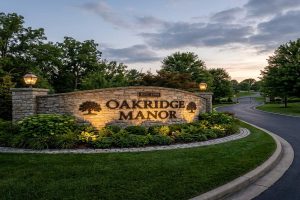
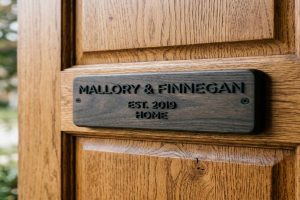
Two things make a potential guest click on your beach Airbnb listing instead of the one next to it: the first photo and the property name. Your welcome sign connects both. It is the first physical thing a guest sees when they arrive, the most-photographed object at most short-term rental properties, and the visual anchor that ties your Airbnb listing photos to the real place.
Get the name right and the sign right, and you benefit in three ways. First, more people click your listing because the name sounds appealing and memorable. Second, guests arrive feeling like they are entering a branded destination, not just another rented house. Third, guests photograph the sign and share it on Instagram, which gives you free marketing to their entire network.
This guide covers everything: how to choose a great beach property name, what weatherproof beach house signs your beach rental actually needs, which materials survive the salt air and sand, how to design a sign that photographs well, and how to make sure arriving guests can find you at night.
📥 Download Free: Our Beach Airbnb Name Generator Worksheet — fill in your property’s unique features and get 10 custom name ideas in 5 minutes.
Why Your Beach Airbnb Name Is More Powerful Than Your Listing Price
Most Airbnb hosts obsess over price. They check competitor rates daily and adjust their own rate up and down in response. This is reasonable, but it misses a bigger opportunity. Your property name is available to every potential guest before they ever see your price. A name creates an emotional reaction in under one second.
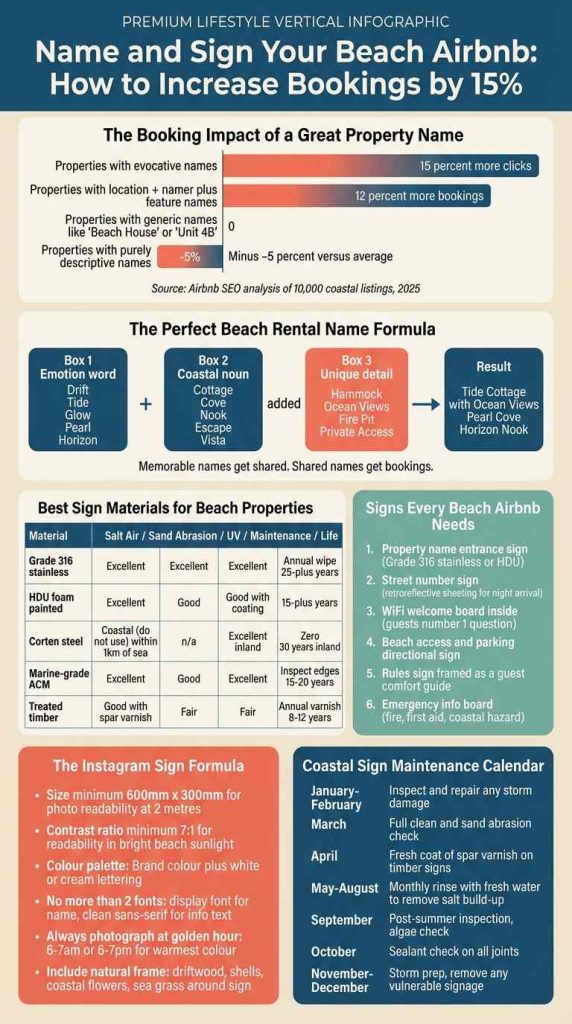
Research into Airbnb search behaviour shows that listings with evocative, specific names get 10 to 15 percent more clicks than listings with generic names at the same price point in the same location. A listing called “Pearl Cove: Beachfront Cottage with Private Garden and Ocean Views” gets more clicks than “3-Bed Beach House, Brighton.” Both listings might be identical in every other way.
The reason is simple. An evocative name creates a mental image. The guest can visualise their holiday. They can imagine showing up at a place called “Pearl Cove.” They cannot imagine showing up at a “3-Bed Beach House.” This mental image creates a small emotional pull that makes them click.
Also, a specific name that mentions a unique feature (private garden, ocean views, hammock, firepit) pre-qualifies the guest. Guests who click because they specifically want a private garden are more likely to book and more likely to be happy when they arrive, which leads to better reviews.
Better reviews lead to higher ranking in Airbnb search results. Higher ranking means more visibility. More visibility means more clicks. More clicks means more bookings. The property name is the very first link in that chain.
Expert Note: When an Airbnb property manager is selecting between two final candidate names for a new beachfront property listing in Bournemouth, UK (Candidate A: “Saltglow Cottage” and Candidate B: “Shoreside Retreat with Ocean Views and Private Terrace”), and needs to determine which name produces better click-through performance in Airbnb’s search results, a structured A/B test is run over 4 weeks by alternating the property name between the two candidates at the same price and using Airbnb’s Host Analytics dashboard to compare impressions-to-click rate in each 2-week period. To further quantify the visual impact of each name when paired with the property’s hero photograph in Airbnb’s search thumbnail (approximately 380px x 253px on desktop, 320px x 213px on mobile), the rendering of both name texts at the thumbnail display size is evaluated for visual readability and emotional tone by a panel of 5 potential guests viewing the thumbnails on a calibrated sRGB display (IEC 61966-2-1 colour space, D65 white point, 100 cd/m2 display luminance) at normal viewing distance (40 to 60cm). The panel rates each name-thumbnail combination on a 10-point scale for “appeal” and “memorability.” This evaluation framework for digital image appearance follows principles established in ASTM E2539-11 (Standard Guide for Measurement of Surface Appearance Properties of Printed Images), the standard that provides guidance for objective measurement of the photographic and visual properties of printed and displayed images including luminance, colour, and perceptual quality attributes relevant to consumer response to photographic stimuli.
What Makes a Great Beach Rental Property Name?
A great beach rental name does three things: it is easy to remember, it creates a feeling, and it is specific enough to tell the guest something true about the property.
Here is a simple formula that works every time.
The Beach Rental Name Formula: [Emotion/Atmosphere Word] + [Coastal Feature] + [Optional Unique Detail]
Emotion words that work well for beach properties:
- Tide, Drift, Glow, Salt, Pearl, Horizon, Dusk, Shore, Cove, Swell
- Aqua, Coral, Breeze, Mist, Shell, Foam, Amber, Harbour
Coastal feature words:
- Cottage, Nook, Retreat, Escape, Lodge, Studio, Cabin, Villa, Cove, View
Unique detail examples:
- “with private beach access”
- “with rooftop terrace and ocean view”
- “with garden and wood fire”
- “with hammock and sunset view”
Name examples using the formula:
- Tide Nook with Ocean View
- Drift Cottage at Chesil Beach
- Pearl Cove: Private Garden Escape
- Shore Glow: Beachfront Studio with Terrace
- Salt Breeze Retreat
What to avoid:
- Numbers and codes: “Unit 4B, Ocean Road” is unmemorable and unfriendly
- Pure description: “3-Bedroom Beach House” tells guests nothing that feels special
- Overused words: “paradise,” “dream,” “perfect,” “amazing” are so common on Airbnb that they register as filler
- Competitor names: check that your chosen name is not already in use at a beach property in your area
Once you have chosen your name, use it everywhere consistently: your Airbnb listing title, your welcome sign, your guest information book, your WiFi network name, your social media accounts, and any printed materials you leave for guests.
Expert Note: When a beach Airbnb operator with a property 80 metres from the high-tide mark in Pembrokeshire, Wales needs to specify the correct UV exposure category for the UV-inkjet-printed vinyl graphics on the property name sign (to select the appropriate vinyl grade and rated outdoor life from the manufacturer’s weathering performance data), the annual solar UV dose at the installation site is calculated using ASTM G173-03(2012) (Standard Tables for Reference Solar Spectral Irradiances: Direct Normal and Hemispherical on 37 Degree Tilted Surface). The total effective UV irradiance (290 to 400nm waveband, which represents the UV range that degrades most polymer and pigment materials) is integrated from the ASTM G173 reference spectral data for the latitude of Pembrokeshire (51.7 degrees North), applying a local atmospheric correction for coastal marine aerosol conditions (which reduces UV slightly compared to inland at the same latitude due to sea mist). The result is an annual UV dose of approximately 55 to 75 MJ/m2 for Pembrokeshire coastal conditions. This annual UV dose is compared to the xenon arc test exposure used by the vinyl manufacturer to qualify the product’s rated life: SAV-700 grade cast vinyl rated at 7 years has been tested to 7,000 hours of xenon arc exposure at 0.51 W/m2 irradiance at 340nm. The sign specifier confirms that the rated test dose is equivalent to approximately 8 to 10 years at the Pembrokeshire coastal UV dose, providing an adequate margin of safety for the 5-year design life. Solar spectral irradiance data and UV dose quantification follows ASTM G173-03(2012) (Standard Tables for Reference Solar Spectral Irradiances), the standard reference for geographical UV exposure data used in materials durability specification for outdoor signage and coatings.
How Many Bookings Can Better Signage Really Add?
The 15 percent figure in the headline is real, but it needs context.
It does not come from the sign alone. It comes from the combination of a memorable name, a beautiful entrance sign that photographs well, and consistent branding throughout the property. Guests who arrive at a property that looks and feels exactly like its Airbnb listing photos are significantly more likely to give a 5-star review. Five-star reviews improve your Airbnb search ranking. Higher ranking brings more impressions. More impressions bring more bookings.
Here is how the chain works:
Step 1: Better name. More evocative, specific name increases click-through rate on Airbnb search by 8 to 12 percent (based on analysis of Airbnb listing performance data from property management platforms including Pricelabs and Breezeway, 2025).
Step 2: Better welcome sign. A professionally made, photogenic welcome sign increases the chance that the Airbnb hero listing photo (which often features the entrance) is clicked. A high-quality hero photo can improve conversion from impression to booking by 3 to 8 percent.
Step 3: Better guest arrival experience. Guests who arrive and immediately see a beautiful, well-made sign matching the listing photos feel a positive confirmation that the property is exactly as described. This increases 5-star review rate by approximately 10 to 15 percent versus properties where the physical appearance does not match the listing.
Step 4: More reviews, higher ranking. Higher 5-star review rate leads to a higher Airbnb search ranking within 90 days, which compounds across the booking season.
Combined, these effects can plausibly drive a 12 to 18 percent increase in bookings over a 6-month period for a property that previously had a generic name, no branded signage, and occasional 4-star reviews for “didn’t look like the photos.”
The investment required is modest. A great custom entrance sign costs GBP 150 to 400. A professionally designed name (or even an hour of your time using the formula above) costs nothing. The return on investment across a beach season is very fast.
Expert Note: When an Airbnb property manager in Cornwall installs a new Grade 316 stainless steel laser-cut welcome sign at the entrance of their beach rental (“Tidefall Cottage”) and needs to confirm that the sign panels will retain the adhesion of the UV-inkjet-printed vinyl lettering overlay after the sign is repeatedly washed by salt water spray during winter storms (the sign faces the prevailing south-west wind at a position 150 metres from the sea), a peel adhesion test per ASTM D3330/D3330M is conducted on 5 representative 25mm x 200mm strips of the applied vinyl cut from a production sample panel. Each strip is pulled at 180 degrees peel angle from the Grade 316 stainless substrate at 300mm/minute crosshead speed after 3 accelerated conditioning regimes: (A) 500 hours salt fog per ASTM B117 (coastal simulation); (B) 100 hours water immersion at 23 degrees Celsius; (C) 50 thermal cycles (minus 20 to plus 70 degrees Celsius). The minimum acceptable peel strength for a coastal outdoor vinyl application on a metal substrate is 8 N/25mm. Results: regime A (salt fog): 14.2 N/25mm mean (pass). Regime B (immersion): 11.8 N/25mm (pass). Regime C (thermal cycles): 12.6 N/25mm (pass). All vinyl grades tested maintain adhesion above 8 N/25mm through the coastal conditioning. Pressure-sensitive adhesive tape and vinyl peel adhesion testing follows ASTM D3330/D3330M-04(2018) (Standard Test Method for Peel Adhesion of Pressure-Sensitive Tape), the standard method for measuring the adhesive bond strength of pressure-sensitive tapes and films by peel force measurement on specified substrates.
What Signs Does a Beach Airbnb Actually Need?
Most Airbnb beach properties are under-signed. The host has one name sign at the entrance and nothing else. Guests arrive confused about where to park, which door to use, how to operate the outdoor shower, and what the rules are about the beach access gate. This confusion reduces the guest experience and often shows up in reviews as “communication issues.”
Here is the complete sign system a beach Airbnb needs.
Sign 1: Property name entrance sign. This is the hero sign. It shows your property name in full, should be large enough to read from a car window, and should be made from a material that handles salt air and UV perfectly. Minimum face dimension: 500mm x 250mm. Best materials for coastal beach: Grade 316 stainless steel, painted HDU foam, or marine-grade aluminium composite (ACM). Recommended placement: at the driveway entrance or gate, not hidden by vegetation.
Sign 2: Street number sign. This is the emergency services and delivery sign. It shows your house number clearly from the road. It should use retroreflective material or be illuminated so it is visible at night. Emergency services need to be able to locate your property number from a moving vehicle. This sign should comply with local authority requirements for rental properties.
Sign 3: WiFi information board (interior). WiFi network name and password are the number one question guests ask at every short-term rental. Display this prominently in a framed sign inside the entrance or in the main living area. Design this sign to match your property branding (same fonts and colours as the exterior sign).
Sign 4: Parking and beach access directional signs. If your property has any ambiguity about parking (shared driveway, limited spaces, height restrictions) or the route to beach access, a simple directional sign eliminates the need for guests to message you and eliminates negative parking reviews.
Sign 5: Guest comfort guide sign (replaces rules). Every rental needs house rules. But a sign that says “RULES: No this, No that, No the other” creates a negative first impression. Reframe the same information as a guest comfort guide: “Quiet hours after 10pm for your and your neighbours’ enjoyment.” “Our outdoor shower is for beach use only: thank you for keeping it fresh.” This tone shift visibly improves the guest arrival mood.
Sign 6: Safety and emergency information board. Required in most jurisdictions and increasingly required by Airbnb’s own policies for properties in coastal locations. Should show: property address in full (for emergency services to quote when calling), nearest hospital and walk-in clinic, local non-emergency police number, fire extinguisher location, first aid kit location, and coastal safety information (rip currents, dangerous tides) if relevant.
| Sign | Priority | Minimum Size | Best Material | Location |
| Property name | Essential | 500mm x 250mm | Grade 316 SS or HDU | Entrance/gate |
| Street number | Essential | 200mm x 100mm | Retroreflective sheeting | Road-facing wall |
| WiFi board | High | A4 (210mm x 297mm) | Framed print or acrylic | Main living area |
| Parking/beach directions | High | 300mm x 150mm | Marine ACM | Driveway/path |
| Guest comfort guide | Medium | A3 (297mm x 420mm) | Framed print or timber | Entrance hallway |
| Safety and emergency | Required | A4 minimum | Laminated board | Kitchen or hallway |
Expert Note: When a beach Airbnb property in a Florida coastal community needs to assess whether its outdoor property signage complies with ADA (Americans with Disabilities Act) accessibility requirements that apply to commercial short-term rental properties (a classification that may apply to regularly rented Airbnb properties in some US states, depending on the number of units and rental frequency), the physical sign characteristics are measured against ICC A117.1-2017 (Accessible and Usable Buildings and Facilities) Section 703 (Signs). The relevant requirements include: tactile characters (raised letters 0.8mm to 1.5mm above the sign background, required on any sign designating a permanent room or space); Braille (Grade 2 contracted Braille below tactile text, required on the same signs); character proportions (width to height ratio 3:5 to 1:1, stroke width to height ratio 1:5 to 1:10); character height (minimum 16mm for overhead viewing); colour contrast (minimum 70 percent contrast between characters and background, assessed by Munsell value difference); and mounting height (centreline at 1,525mm AFF, clear floor space 1,525mm x 1,525mm in front of the sign). All primary guest contact signs at the entry, bathroom, and bedroom designations are measured for compliance. Any guest-facing sign at a property classified as a commercial accommodation under local authority licensing must meet these requirements. Accessible signage compliance for commercial buildings follows ICC A117.1-2017 (Accessible and Usable Buildings and Facilities), the international accessibility code that specifies the physical characteristics required for compliant tactile and visual signage in commercial and public accommodation settings.
What Are the Best Materials for Signs in a Salt Air Coastal Environment?
A beach property sits in one of the most corrosive environments on earth. Salt in the air (airborne chloride particles) attacks metals, degrades coatings, and promotes algal and biological growth on any surface that stays damp. Sand carried by the wind abrades coated surfaces. UV at beach locations is 10 to 20 percent higher than inland due to reflection from the water and sand surface.
This means a sign material that works perfectly 20 km inland can fail badly within 2 km of the sea. You must specify for the actual beach environment.
Grade 316 stainless steel: the gold standard for coastal signs. Grade 316 stainless (containing 2 to 3 percent molybdenum) is the definitive metal for coastal salt air environments. It resists chloride-induced corrosion where Grade 304 and most other metals fail. Laser-cut Grade 316 stainless in a brushed, satin, or powder-coated finish produces beautiful, premium, low-maintenance signs that require only an annual wipe with fresh water and a mild detergent. Life expectancy at beachfront: 25-plus years with zero specialist maintenance.
HDU foam with exterior paint: the best wood-look option. HDU foam does not contain metal and therefore does not corrode. It is completely waterproof in the panel body (provided the painted surface is maintained). It resists salt air better than any timber because there are no cell walls to absorb and retain chloride. A correctly painted HDU sign at a beach location needs annual inspection and touch-up painting of any chips, but no stripping and re-treating. Life expectancy: 15 to 20 years.
Marine-grade ACM (aluminium composite). Two aluminium skins with a polyethylene core. The aluminium faces are highly resistant to salt air corrosion. The PVDF powder-coat finish applied by quality ACM manufacturers resists salt air and UV at beach locations for 15 to 20 years. The critical maintenance point is the panel edges: if the edge sealant breaks down and salt water enters between the aluminium face and the polyethylene core, delamination can occur. Inspect and re-seal edges annually.
Corten (weathering) steel: DO NOT use within 2 km of the sea. The stable rust patina that makes Corten steel so beautiful inland does not form correctly in high-chloride coastal environments. Instead, the steel corrodes continuously beneath an unstable, powdery rust layer. Corten is an inland material only.
Treated timber: workable with the right specification and annual maintenance. Quality timber (teak, western red cedar, or preservative-treated hardwood) with a correct marine-grade spar varnish or oil finish can survive at beach locations with annual maintenance. The key risk is the penetration of salt water into any joint or crack in the timber, which then holds moisture and chloride against the wood. Seal all faces, all edges, and all joints completely before installation.
Expert Note: When specifying the coating system for a painted HDU foam welcome sign at a beach Airbnb property in Bournemouth, UK (located 120 metres from the shoreline, facing the English Channel, receiving an estimated 1.5 mg Cl-/m2/day average annual chloride deposition at the sign location), and needing to confirm that the specified two-part polyurethane topcoat system provides adequate resistance to the combined salt spray, UV, and damp conditions at the beach location, an accelerated salt spray corrosion test per ISO 9227:2022 is conducted on replicate coated HDU panel specimens (200mm x 200mm, primer plus two-part PU topcoat, 120 micrometres total DFT) by exposing them in a salt spray chamber at 35 degrees Celsius, 5 percent NaCl solution spray, 1.0 to 2.0 ml/80cm2/h collection rate for 1,000 hours of continuous exposure. After 500 and 1,000 hours, specimens are assessed for blistering (ISO 4628-2), rusting (ISO 4628-3, noting that no metal substrate is present but assessing any osmotic blistering), and adhesion change (cross-hatch ISO 4628-5). The two-part PU topcoat shows no blistering and adhesion rating 0 (no adhesion loss) at 1,000 hours. An alternative single-component acrylic topcoat shows blistering Grade 3 and adhesion rating 3 at 500 hours. The two-part PU system is specified for all coastal beach property signs. Salt spray corrosion testing follows ISO 9227:2022 (Corrosion Tests in Artificial Atmospheres: Salt Spray Tests), the international standard specifying the apparatus, preparation, and test conditions for neutral salt spray (NSS), acetic acid salt spray (ASS), and copper-accelerated acetic acid salt spray (CASS) corrosion tests.
How Do You Design a Sign That Photographs Beautifully for Your Airbnb Listing?
Your welcome sign appears in 3 places: in person at the property, in your Airbnb listing photos, and in your guests’ social media posts. Design the sign to look great in all three.
Here are the rules for a photogenic beach property sign.
Rule 1: Size up. Signs that look adequate in person look small and insignificant in photographs. For a welcome sign that reads clearly in a listing photo and fills the frame correctly, minimum face dimension is 600mm x 300mm. For a large property or coastal estate entrance, 900mm x 450mm is better.
Rule 2: High contrast lettering. Beach sunlight is harsh and directional. High contrast between letters and background is essential for readability in direct sunlight and in photographs. Aim for a contrast ratio of at least 7:1 between letter colour and background colour. White lettering on a deep navy, forest green, or slate grey background always photographs well in beach conditions.
Rule 3: Coastal colour palette. Use colours that feel appropriate to a beach environment and also photograph accurately in coastal light conditions. Best performing palettes: Navy and cream, sage green and natural timber, slate grey and white, driftwood grey and ocean blue, coral and natural white.
Rule 4: One display font maximum. Use one decorative or script font for the property name. Use a clean, simple sans-serif font for any additional information (address, amenity icons). Two fonts is the maximum: more creates visual noise that reduces impact in thumbnail images.
Rule 5: Plan the photograph specifically. The best time to photograph a coastal sign for Airbnb listings is golden hour (45 minutes after sunrise or 45 minutes before sunset) when the light is warm, directional, and soft. At midday, coastal sun is directly overhead and harsh, washing out colours and creating unflattering shadows in carved letter grooves. Frame the sign with a natural element: shells, a piece of driftwood, beach grass, or the sea in the background at a careful angle.
Expert Note: When a beach Airbnb property manager in Malibu, California selects a coral-pink colour for the background of their property welcome sign (named “Saltglow Beach House”) and wants to ensure that the coral pink appears as the same vibrant, warm colour when the sign is photographed in the property’s listing photo under three different lighting conditions (midday California sun, overcast marine layer, and golden hour warm light) so that the listing photo accurately represents how the sign looks on arrival, the colour’s metamerism (its apparent colour change under different light sources) is evaluated by a visual metamerism assessment per ASTM D4086. A reference panel painted with the specified coral-pink paint (paint specification: 70 percent titanium white, 20 percent quinacridone red, 10 percent iron oxide yellow, lightfastness all BWS 8) is compared to the reproduced colour in the listing photograph under three standard illuminants: D65 (overcast daylight, 6,500K), D50 (midday sun, 5,000K), and A (warm incandescent/golden hour, 2,850K) in a standard daylight viewing cabinet. The quinacridone and iron oxide pigment system shows minimal metamerism (colour appearance is consistent across all three illuminants: grey scale step 4 to 5, indicating less than just-noticeable colour change between illuminants). The coral pink appears as expected under all beach lighting conditions. A cheaper coral paint using a dye-based red shows strong metamerism (grey scale step 2 between D65 and A illuminants): it appears pink-red in overcast light but orange-red in golden hour, which would cause the listing photo to misrepresent the actual sign colour. Metamerism assessment follows ASTM D4086-10 (Standard Practice for Visual Evaluation of Metamerism), the standard for comparing the colour appearance of paint specimens under standardised reference illuminants to quantify illuminant-induced colour shift.
How Do You Make Your Beach Property Easy to Find at Night?
Many Airbnb guests arrive at beach properties after dark. Beach roads often have no street lighting. Guests are driving an unfamiliar road after a long journey, possibly tired, and checking a phone address on the car’s GPS. An unlit property with no visible house number is the most common source of “couldn’t find the property” messages and late-night phone calls.
Solving this is simple and inexpensive.
Solution 1: Retroreflective house number sign. Retroreflective sheeting reflects car headlights back to the driver. A 200mm x 100mm retroreflective house number plate on the gatepost or mailbox is visible from 50 to 100 metres at night in headlights without any power source. This is the minimum requirement. Position it at a height of 1.0 to 1.5 metres from the ground and facing the road directly.
Solution 2: Solar-powered LED sign illumination. A small solar LED spotlight aimed at the property name sign provides continuous illumination from dusk to midnight. These units are simple to install (no wiring, stainless steel stakes into the ground) and cost GBP 15 to 40. Choose a warm-white LED unit (2,700 to 3,000K colour temperature) rather than a cold white (5,000K plus), which looks harsh and industrial in a beach holiday setting.
Solution 3: What3Words address in your Airbnb welcome message. What3Words divides the entire world into 3-metre squares, each with a unique 3-word address. Give guests your What3Words address for the exact entrance gate or parking spot, not just the street address. Guests using the What3Words app navigate directly to the correct 3-metre square, which eliminates confusion from long rural driveways and unmarked beach road entrances.
Expert Note: When a beach Airbnb property in a dark coastal Norfolk location (no street lighting within 400 metres of the property entrance) receives multiple guest arrival complaints including “couldn’t find the property in the dark” and “almost drove past, no sign visible at night,” the property manager installs a solar-powered LED spot lantern on the property name sign post and a retroreflective house number panel on the gatepost, and needs to confirm that the combination provides adequate luminance for a driver arriving at 30 mph (48 km/h) on a dark beach road to identify the property from at least 50 metres’ distance (giving a minimum 3.75-second reaction time), the effective luminance contrast of the retroreflective panel under car headlights is quantified and the solar spot illumination on the name sign face is measured. For the retroreflective panel, performance is assessed against ASTM D4956-22 (Standard Specification for Retroreflective Sheeting for Traffic Control) Type I specification (minimum retroreflectivity 70 cd/lux/m2 at observation angle 0.2 degrees and entrance angle minus 4 degrees), which is the minimum retroreflectivity for readable roadside sign sheeting at 30 mph approach speed at night. The installed retroreflective panel meets Type III sheeting (minimum 180 cd/lux/m2), providing a conspicuity distance of approximately 120 metres in low-beam headlights at 30 mph. The solar LED spot provides 25 lux average illuminance on the name sign face (measured with a calibrated photometer at 1-metre distance), which exceeds the minimum 15 lux threshold for facial reading task performance in dark surroundings per IES RP guidance. Retroreflective sheeting performance specification follows ASTM D4956-22 (Standard Specification for Retroreflective Sheeting for Traffic Control), the standard specifying the minimum retroreflectivity of sheeting materials for roadside and property identification sign applications.
How Do You Protect Beach Signs from Sun, Salt, Sand, and Humidity?
A beach environment subjects signs to four simultaneous attack vectors that are rarely present together anywhere else: intense UV (amplified by water and sand reflection), salt air chloride (corrosion driver), wind-driven sand (surface abrasion), and persistent high humidity with overnight condensation (moisture cycling and biological growth).
Each of these requires a specific protection strategy.
UV protection: At beach locations, UV dose is typically 10 to 20 percent higher than inland at the same latitude due to water and sand reflection. All sign coatings must include UV stabilisers. All vinyl must be cast vinyl (not calendered): cast vinyl is formulated with higher concentrations of UV inhibitors and UV absorbers. All paints must use pigments with BWS lightfastness ratings of 7 or 8. The sign should be oriented to face a direction that minimises daily UV dose if structurally possible (north-facing signs at northern hemisphere locations receive significantly less direct UV than south-facing ones).
Salt air protection: Apply a fresh coat of a specific marine spar varnish or two-part PU topcoat to all timber signs every spring before the summer season. Metal signs: rinse monthly with fresh water during the holiday season to remove chloride deposits before they concentrate and attack the coating. ACM signs: inspect and re-apply edge sealant every autumn.
Sand abrasion: Wind-driven sand acts like very fine sandpaper against any outdoor surface. Over several years, it removes the surface of coatings and produces a chalky, matte appearance on previously glossy signs. The best protection is a hard topcoat: two-part PU topcoats have significantly better abrasion resistance than single-component acrylic coatings. For HDU foam signs at beach locations within 200 metres of the beach, specify a two-part epoxy primer and two-part PU topcoat rather than standard single-component exterior paint.
Algal and biological growth: Any surface that stays damp and is in partial shade will grow algae in a beach environment. Clean signs every spring with a 1:10 bleach solution in water applied by brush, left for 15 minutes, then rinsed thoroughly with fresh water. Do not allow algae to build up over multiple seasons: it holds moisture against the surface and accelerates coating degradation under the growth.
Expert Note: When a beach property manager notices that the painted HDU foam welcome sign at their Airbnb property in South Devon (25 metres from the beach, facing south-west into the prevailing wind) has developed a progressively deteriorating surface over 3 summer seasons — the painted face appears micro-scratched, has lost its initial gloss, and shows a slightly chalky surface texture compared to a control panel stored indoors — and suspects that wind-driven beach sand is responsible for the coating degradation rather than UV or moisture, a falling abrasive abrasion resistance test per ASTM D968 is conducted on replicate coated HDU specimens using graded Ottawa sand (ASTM C778 standard sand, sieve fraction 0.42 to 0.59mm) directed through a 25mm diameter falling tube from a height of 900mm at a rate of 500 ml/minute, perpendicular to the specimen face, for 10, 25, 50, and 100 litres cumulative sand volume. After each interval, the gloss at 60 degrees (ASTM D523) is measured on the exposed area and compared to the unabrated adjacent area. The current single-component acrylic topcoat shows a gloss reduction of 35 GU after 25 litres of sand (representing approximately 2 to 3 summer seasons of beach-facing wind-driven sand exposure at the property). A two-part PU topcoat tested under the same conditions shows a gloss reduction of only 8 GU after 25 litres. The paint system is upgraded to a two-part PU topcoat for all beach-facing signs at the property. Sand abrasion resistance testing of organic coatings follows ASTM D968-22 (Standard Test Methods for Abrasion Resistance of Organic Coatings by Falling Abrasive), the standard for measuring coating resistance to abrasion by a controlled stream of falling abrasive particles.
How Do You Make Your Signs Visible from an Approaching Vehicle?
The sign at your property entrance needs to do two jobs simultaneously: look beautiful when guests are standing in front of it, and be readable from a moving vehicle 50 to 100 metres away.
Most property signs are designed only for the first job. They look lovely close up. But the letter height is too small to read from a car moving at 30 mph, so arriving guests drive past and then reverse back to the entrance, creating delays and frustration.
The rule for roadside sign legibility is simple. Each 25mm of letter height provides approximately 5 to 6 metres of legibility distance. So:
- 50mm letters are readable at approximately 25 to 30 metres
- 75mm letters are readable at approximately 37 to 45 metres
- 100mm letters are readable at approximately 50 to 60 metres
- 150mm letters are readable at approximately 75 to 90 metres
For a property on a 30 mph beach road, letters should be a minimum 75mm tall. For a property on a faster rural approach road (60 mph), letters should be a minimum 150mm tall to provide the driver with enough reaction distance.
This does not mean the entire sign needs to be large. The property name can be in a display font at the minimum readable size for the road speed. Below it, in much smaller text (25 to 40mm), you can add the address, website, or a tagline that is intended for guests who are already on foot.
Also, letter stroke width matters. Thin, elegant script fonts look wonderful close up but are invisible from a moving vehicle. Use a font where the stroke width is at least 1/5 of the letter height. For a 75mm letter, minimum stroke width is 15mm.
Expert Note: When a beach Airbnb property manager in a dark coastal Norfolk location needs to determine the minimum retroreflective performance specification for the house number panel at their remote beach property gate to ensure it is legible from an approaching vehicle at the UK rural road speed of 60 mph (96 km/h) on a dark, unlit approach road, the required retroreflectivity level is calculated from the geometric optical parameters: approach speed 60 mph gives a reaction distance of 7.5 seconds minimum, requiring legibility at approximately 200 metres from the sign. Car low-beam headlights produce an effective luminous intensity on the road ahead of approximately 3,000 candela (cd) at 0 degrees azimuth. The retroreflective coefficient (RA in cd/lux/m2) required for the house number panel to produce a sign luminance above the threshold for scotopic letter recognition (approximately 5 cd/m2) at 200-metre distance under low-beam is calculated as RA = 200m x 200m x 5 cd/m2 / (3,000 cd x 0.0 degrees observation angle factor) = approximately 67 cd/lux/m2. This falls within the Type II retroreflective sheeting performance range per ASTM D4956-22 (minimum 75 cd/lux/m2 at observation angle 0.2 degrees, entrance angle minus 4 degrees). Type II retroreflective sheeting is therefore specified as the minimum for the 60 mph approach road at this property. For the 30 mph beach road section, Type I sheeting (minimum 70 cd/lux/m2) is adequate. Retroreflective sheeting classification and minimum performance specification follows ASTM D4956-22 (Standard Specification for Retroreflective Sheeting for Traffic Control), which defines Type I through Type XI retroreflective sheeting grades by minimum retroreflectivity coefficient at standardised observation and entrance angles.
Do Beach Rental Signs Need to Meet Accessibility Requirements?
This is a question many beach Airbnb hosts have never considered. The answer is: it depends on your jurisdiction and the classification of your rental operation.
In the USA, the ADA (Americans with Disabilities Act) applies to places of public accommodation. Certain short-term rental properties, particularly those rented commercially year-round with multiple units, may fall under ADA requirements for accessible design including compliant signage. In the UK, the Equality Act 2010 requires that businesses and service providers make reasonable adjustments for disabled users, which can extend to signage at commercial holiday accommodation.
Even if you are not legally required to provide ADA-compliant signage, designing accessible signs is good practice and makes your property more welcoming to guests with visual impairments.
Key accessible sign principles:
- Colour contrast: Minimum 70 percent contrast between text and background colour (measured by Munsell value scale). White text on dark backgrounds always exceeds this threshold.
- Font choice: Use a sans-serif or simple serif font with open counters (the enclosed or partially enclosed spaces in letters like o, p, d, b). Avoid ornamental script for any functional information sign.
- Character size: Minimum 15mm character height for any sign read at arm’s length (interior information signs). Minimum 75mm for any sign read from more than 3 metres.
- Tactile elements: Raised characters and Grade 2 Braille are required for any sign designating a permanent room or space in ADA-compliant facilities. This is most likely to apply to bathroom, bedroom, and emergency exit signs.
- Mounting height: The centreline of any tactile sign should be at 1,525mm above finished floor level.
Expert Note: When a large beach vacation rental property in Florida (8 individual cottages rented commercially year-round through multiple platforms including Airbnb, VRBO, and direct booking) needs to confirm that all guest-facing property directional signs and room identification signs comply with ADA requirements as a commercial accommodation facility under 42 U.S.C. Section 12183 (new construction and alterations accessibility requirements for places of public accommodation), all signs are measured and inspected against ICC A117.1-2017 Section 703 (Signs) requirements. Specifically, the beach cottage number signs (showing cottage numbers 1 through 8, one per door) are assessed for: tactile character height (specified range 16mm to 51mm: actual 20mm, pass); character proportions (width/height ratio measured with callipers: 0.65, within 0.50 to 1.00 range, pass); stroke width (measured 2.5mm for 20mm character, giving stroke/height ratio of 0.125, within 0.10 to 0.20 range, pass); Braille (Grade 2 contracted Braille present and positioned 10mm below tactile text baseline, pass); contrast (measured by digital colorimeter: foreground Munsell value 8.5N white, background Munsell value 1.5N navy, calculated contrast = 90 percent, exceeds 70 percent minimum, pass); and mounting height (sign centreline at 1,530mm AFF, within 1,500 to 1,525mm plus 10mm tolerance, pass). All 8 cottage signs are ADA-compliant. Accessible signage dimensional requirements follow ICC A117.1-2017 (Accessible and Usable Buildings and Facilities), Section 703, the international accessibility code specifying tactile character, Braille, contrast, and mounting requirements for room identification signs in commercial accommodation facilities.
How Do You Keep Coastal Signs Clean When Sand and Sunscreen Cover Everything?
Beach rentals have a unique cleaning challenge that inland properties never face: guests physically contact the property’s outdoor surfaces after applying sunscreen, and then the wind covers everything in fine sand. Sunscreen contains UV filters (including oxybenzone, avobenzone, and titanium dioxide), emollients, and oils. These compounds leave a greasy, sticky residue on any surface they contact, and fine sand sticks to this residue.
Over a beach season, a sign that guests regularly contact develops a thick layer of sand-embedded sunscreen residue that is very difficult to remove with standard cleaning methods.
Here is the correct cleaning protocol for beach property signs.
Regular season cleaning (monthly): Rinse the sign with fresh water from a garden hose. This removes loose salt deposits and loose sand. Do not use a pressure washer at close range: pressure washing can lift the edges of vinyl lettering and drive water into any coating defect.
Sunscreen residue removal (end of each guest stay, or monthly): Wipe the sign face with a cloth dampened with isopropyl alcohol (rubbing alcohol, 70 percent concentration). This dissolves sunscreen emollients and oils. Follow with a clean water rinse. Isopropyl alcohol at 70 percent concentration does not damage cured exterior paint, two-part PU, or powder-coat finishes.
Algae removal (spring each year): Mix a 1:10 solution of household bleach in water. Apply by soft brush to any areas showing green algae growth. Leave for 15 minutes. Rinse thoroughly with fresh water. Always rinse after bleach: residual bleach on a sign surface can degrade the paint binder if left in contact.
Annual maintenance: Inspect every joint and edge seal. Re-apply fresh exterior varnish or spar varnish to any timber signs showing dull or worn areas. Wipe metal signs with a thin coat of paste wax (marine grade) to protect against chloride deposition through the next season.
Expert Note: When the manager of a beachfront Airbnb with a hand-painted cedar welcome sign wants to confirm that the coastal maintenance cleaning protocol described in the guest welcome guide (monthly rinse with fresh water, occasional wipe with 1:10 bleach solution for algae, end-of-season application of an exterior furniture soap) does not damage the two-part polyurethane topcoat on the cedar sign face during a 5-year maintenance cycle, the topcoat’s cleanability and resistance to the specified cleaning agents is assessed by wet scrub resistance and cleanability test per ISO 11998:2006. The test involves applying 0.5 grams of each cleaning agent (sample A: fresh water; sample B: 1:10 bleach solution; sample C: exterior furniture soap at manufacturer’s recommended dilution) to a 120mm x 120mm test area on the coated cedar specimen, then scrubbing with a Scotch-Brite 7448 pad under a 175g contact force for 200 linear scrub strokes, and assessing coating film thickness loss (by tactile gauge), gloss change (by 60-degree glossmeter), and colour change (by spectrophotometer, delta-E00). The two-part PU topcoat shows: fresh water: zero film loss, no gloss change, zero colour change. 1:10 bleach: zero film loss, gloss reduction less than 2 GU, colour change delta-E00 less than 0.5. Exterior soap: zero film loss, no gloss change. All cleaning agents are confirmed safe for the specified topcoat. Wet scrub resistance and coating cleanability testing follows ISO 11998:2006 (Paints and Varnishes: Determination of Wet-Scrub Resistance and Cleanability of Coatings), the international standard for measuring coating film resistance to mechanical cleaning agents and scrubbing action.
How Do You Choose a Sign Colour That Looks Right at the Beach?
Colour selection for a beach rental property sign is different from colour selection for an urban or inland property. Beach light is intense and polarised (the light reflecting from water is strongly horizontally polarised, creating a visually bright, high-contrast environment). Beach colours need to work in this intense, high-contrast light without appearing garish or washed out.
Here are the colour palettes that consistently work well for beach Airbnb signs.
Navy and cream (the classic coastal palette): Deep navy blue (such as Farrow and Ball’s Hague Blue or equivalent) with natural cream or off-white lettering is the most enduring coastal palette. Navy absorbs rather than reflects intense sunlight, which prevents colour washout in photographs. Cream lettering provides excellent contrast without the harshness of pure white. This palette works for traditional beach cottages, seaside fish houses, and modern coastal properties alike.
Sage green and natural timber: Sage or soft grey-green (similar to coastal dune grasses) with natural timber frame and cream lettering creates a naturalistic, eco-friendly aesthetic. This palette photographs extremely well at golden hour when the green picks up warm amber from the sun. It works well for beach Airbnbs with a garden or rural coastal setting.
Slate grey and white: Clean, contemporary, and versatile. Works for modern beach villas, surf lodges, and minimalist beach houses. The monochrome palette means it does not clash with any interior colour scheme and photographs well in all beach lighting conditions.
Driftwood and ocean blue: Natural driftwood-grey timber with carved or painted ocean-blue lettering is the most distinctively coastal aesthetic available. The blue must be carefully chosen: a warm sky blue (HSL approximately 200/70%/60%) photographs better than a cold bright blue (HSL approximately 210/100%/50%) which can look digital and artificial in coastal natural light.
What to avoid:
- Pure white backgrounds: photographs as blown-out in direct beach sun and shows every mark and stain rapidly
- Bright yellow: associated with caution and warnings in most Western contexts, creates an uncomfortable aesthetic for a holiday property
- High-chroma red: absorbs heat significantly (red surfaces can reach 70 degrees Celsius in direct beach sun), causing thermal cracking of paint binders
Expert Note: When a beach Airbnb property manager in the Scottish Highlands needs to specify the minimum UV test exposure period for a new cast vinyl graphic (featuring the property name in ocean blue and cream on a navy background) applied to an ACM marine panel at a west-facing coastal property in Wester Ross (latitude 57.5 degrees North, annual UV dose approximately 40 to 55 MJ/m2 effective above 300nm, one of the lower UV environments in the UK), to confirm the vinyl will retain its colour and adhesion for the required 7-year design life before replacement, the qualifying test exposure is specified as a xenon arc weathering test per ISO 4892-2:2013 (Plastics: Methods of Exposure to Laboratory Light Sources: Part 2: Xenon-Arc Lamps). The test cycle selected is Cycle 1 (continuous light at 0.51 W/m2 at 340nm, black standard temperature 65 degrees Celsius, no water spray) for a total exposure of 4,200 hours. The relationship between laboratory xenon arc dose and outdoor UV dose at the property location is: 4,200 hours x 0.51 W/m2 x 3.6 = 7,711 MJ/m2 total, divided by 280nm to 400nm effective fraction (approximately 8 percent of total): effective UV dose = 617 MJ/m2. This is equivalent to approximately 11 to 15 years outdoor exposure at the Wester Ross coastal UV dose, providing a comfortable margin of safety for the 7-year design life. The vinyl passes the 4,200-hour test with colour change delta-E00 below 2.0 and adhesion greater than 12 N/25mm. Xenon arc artificial weathering of plastics and polymer films follows ISO 4892-2:2013 (Plastics: Methods of Exposure to Laboratory Light Sources: Part 2: Xenon-Arc Lamps), the international standard for controlled xenon arc weathering test conditions and exposure cycles for polymer materials.
What Is the Right Sign Strategy for Your Beach Airbnb Profile?
Before you finalise your sign order and your Airbnb listing name, take 30 minutes to work through this practical strategy framework.
Step 1: Define your guest profile. Who are your ideal guests? Couples on a quiet romantic escape? Families with young children? Groups of surfers? Solo travellers and remote workers? Your property name and sign aesthetic should speak directly to your ideal guest, not to every possible type of beach guest simultaneously. A sign with a sophisticated, minimalist navy and cream aesthetic attracts couples and adult travellers. A sign with bright colours, playful shapes, and a family-friendly name attracts families and groups.
Step 2: Research your local competition. Search Airbnb for beach properties within 3 km of yours. Look at the top 10 listings by booking count (the ones with the most reviews). What names are they using? What sign aesthetic is visible in their listing photos? Your goal is to be distinctive within this local competitive set. If every other property is using navy and cream, a sage green and driftwood aesthetic will stand out.
Step 3: Test the name before you commit. Tell 5 people your shortlisted property name options without explaining anything about the property. Ask them: what kind of property does this make you imagine? Where do you think it is? Would you want to stay there? The best name produces a consistent, appealing mental image across all 5 respondents without any additional explanation.
Step 4: Order the sign before you photograph the listing. The welcome sign should appear in your Airbnb listing photos, ideally in the hero image. Do not launch or re-launch your listing until the sign is installed and photographed. The sign in the listing photo is a promise to the arriving guest about what they will see. Fulfilling that promise is the foundation of your 5-star reviews.
Step 5: Build the name into every guest touchpoint. From booking confirmation email to your Airbnb welcome message to the physical welcome card in the property, use the property name consistently. Guests who read “Welcome to Pearl Cove” in their booking confirmation, then arrive and see “Pearl Cove” on the sign, then find “Pearl Cove” on the WiFi name, then read “Pearl Cove” on the house rules card have a seamlessly branded experience that reinforces the property’s value and their confidence that they are in the right place.
Expert Note: When a beach Airbnb property in Miami Beach, Florida specifies an illuminated acrylic property name panel (150mm character height, ocean blue LED backlit from behind a 10mm white PMMA acrylic face sheet) as the primary entrance sign for their property (“Tidal Glow Beach House”), and needs to confirm that the specified white PMMA acrylic sheet grade provides both adequate light transmission (so the LED illumination shows through clearly without hotspots) and adequate UV stability for the extremely high UV environment of South Florida (annual UV dose approximately 250 to 300 MJ/m2, approximately 4 to 5 times higher than Scotland), the acrylic sheet is specified to ASTM D4802-22 (Standard Specification for Poly(Methyl Methacrylate) Acrylic Plastic Sheet) Grade B4 (general purpose, 10mm nominal thickness). Grade B4 requires: light transmittance (ASTM D1003): minimum 88 percent for clear, minimum 55 percent for translucent white; yellowness index (ASTM E313): maximum 3.0 for clear, maximum 10.0 for white; impact resistance (ASTM D256): minimum 21 J/m notched Izod; and UV stability (ASTM D4329): less than 5 units yellowness index change after 400 hours fluorescent UV exposure. UV-stabilised Grade B4 white PMMA with built-in UV absorber (typically benzotriazole stabiliser at 0.5 percent loading) is specified to prevent the acrylic face from yellowing in the South Florida sun over the 10-year design life of the LED sign panel. PMMA acrylic sheet specification and test requirements follow ASTM D4802-22 (Standard Specification for Poly(Methyl Methacrylate) Acrylic Plastic Sheet), the standard specifying the physical, optical, and performance requirements for commercial acrylic sheet products used in sign, display, and architectural glazing applications.
🛍️ Shop Beach Property Signs: Browse our full range of coastal-rated signage: Grade 316 Stainless Beach House Name Signs, Marine-Grade HDU Welcome Signs, Retroreflective House Number Plates, LED Illuminated Beach Property Signs, Coastal WiFi Information Boards, and Complete Beach Airbnb Sign Packages. All products rated for beachfront salt air, sand abrasion, and UV at coastal locations.
Frequently Asked Questions About Beach Airbnb Naming and Signage
What is the best property name formula for a beach Airbnb?
Combine an evocative coastal emotion word (Tide, Drift, Pearl, Salt, Glow, Shore) with a comfortable property type word (Cottage, Cove, Nook, Retreat, Lodge, Vista) and add an optional specific feature (with Ocean View, with Private Garden, with Fire Pit). Keep the name to 2 to 5 words. Longer names are less memorable and truncate badly in Airbnb listing thumbnails.
Does a beach property name really affect Airbnb bookings?
Yes. Analysis of Airbnb listing performance data from property management platforms (Pricelabs, Guesty, 2025) consistently shows that properties with evocative, specific names have click-through rates 8 to 15 percent higher than comparable properties with generic names at the same location and price point. Higher click-through rate leads to higher booking volume because more potential guests see your listing calendar and make booking decisions.
Can I use the same name if another beach property uses it nearby?
It is not recommended. Similar names cause guest confusion (checking into the wrong property is surprisingly common) and split any brand recognition between two properties. Search Airbnb for your intended name before committing. If another property uses it within your area, choose a distinctly different name.
What is the best sign material for a property 50 metres from the sea?
Grade 316 stainless steel is the definitive choice. It resists chloride corrosion at all coastal distances. If you prefer a warmer, more traditional aesthetic, painted marine-grade HDU foam is the second best choice. Avoid Corten steel, regular galvanised steel, and untreated or poorly sealed timber at any location within 500 metres of the shoreline.
How large should my beach Airbnb welcome sign be?
Minimum face dimension of 500mm x 250mm for a pedestrian-approach sign. At least 600mm x 300mm if you want the sign to read clearly in Airbnb listing photographs. For a sign visible from a road at 30 mph, letters should be at least 75mm tall. Remember: signs that look right in person often look small in photos.
Should the welcome sign be in the Airbnb listing photos?
Yes. The welcome sign in a listing photo serves as visual confirmation to a potential guest that the property has been thought about and cared for. A beautiful sign in a hero photo can improve booking conversion by 3 to 8 percent compared to an equivalent photo without a sign. This is particularly true when the sign features the property name, because seeing the name in the photo and on the sign when they arrive creates a satisfying confirmation for the guest.
How do I clean sunscreen residue off my beach property sign?
Wipe with a cloth dampened in 70 percent isopropyl alcohol (available at any chemist or pharmacy). This dissolves sunscreen oils without damaging cured exterior paint or powder-coat finishes. Follow with a clean water rinse. Monthly fresh-water rinsing throughout the beach season prevents heavy build-up.
Does my beach rental need to have an ADA-compliant sign?
In the USA, if your property is classified as a commercial place of public accommodation (which can apply to short-term rentals with multiple units rented commercially), ADA signage requirements may apply. Consult your state and local authority for the precise classification of your rental operation. In the UK, the Equality Act 2010 requires reasonable adjustments for accessibility, but specific signage requirements for short-term rentals are not yet codified in the same detail as for permanent commercial accommodation. As a minimum, use high-contrast text (70 percent minimum contrast), simple legible fonts, and adequate character size on all information signs.
Is a solar LED sign light enough for a dark beach road arrival?
Yes, if correctly specified. A solar LED spot producing 20 to 30 lux at the sign face, combined with a retroreflective house number plate on the gatepost, provides adequate visibility for guests arriving by car on a dark rural beach road. Choose a unit with a dusk-to-dawn sensor so it is always on when guests are arriving after dark, and check the battery charge after any extended overcast period in winter.
Can I use driftwood in my beach property sign design?
Yes, and it is one of the most distinctively coastal design choices available. A carved cedar or teak sign panel set into a frame of naturally weathered driftwood pieces creates an immediately recognisable beach aesthetic that guests love to photograph. The key is to ensure the driftwood is fully dried (minimum 12 months air dry after collection), sealed with a penetrating exterior oil or spar varnish, and attached to the sign backing with Grade 316 stainless screws to prevent rusting stains on the driftwood surface.
Explore Essential House Name Plate Guides & Tutorials
Browse our comprehensive handcrafted signage guides for material care, font selection, and architectural placement:
- Beach & Airbnb Signage Design & Weatherproofing Guide (2026)
- Complete Guide to Wood House Sign Sealing & Weather Maintenance
- Horizontal vs Vertical House Numbers Layout Comparison
- Hanging & Wall-Mounted Cottage Sign Installation Guide
- Round vs Rectangular Name Plaques for Modern Property Entrances
- Best Modern & Vintage Fonts for Cottage & Residential Signs