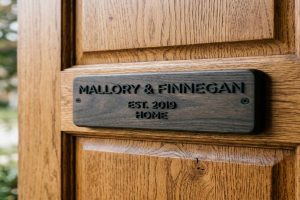
Your house number is one of the first things people see when they approach your home. It also helps emergency responders find you fast. Choosing the right material, such as metal house plates, makes a real difference in how long it lasts and how good it looks year after year.
Stainless steel house numbers are not the right pick for every home. But in the right situation, they are the best choice you can make. This guide tells you exactly when that is, which grade and finish to order, and how to keep them looking sharp for decades.
📥 Free Resource: Download our Stainless Steel Grade and Finish Selection Checklist to pick the right specification before you order.
At a Glance: Stainless Steel vs. Other Materials
| Feature | Stainless Steel | Aluminum | Brass | Acrylic |
| Coastal and salt air resistance | Excellent (316 grade) | Good | Fair (oxidizes over time) | Poor (UV yellowing) |
| Weight | Medium to heavy | Light | Heavy | Very light |
| Maintenance | Low | Very low | Moderate (needs polishing) | Very low |
| Outdoor lifespan | 20 to 30 plus years | 15 to 25 years | 15 to 20 years if lacquered | 5 to 10 years |
| Best home style | Modern, contemporary, industrial | All styles | Traditional, heritage, farmhouse | Contemporary, backlit |
| Relative cost | Medium to high | Low to medium | High | Low |
Start here. Find the feature that matters most to your situation and use it to guide your decision.
What Makes Stainless Steel the Right Choice for House Numbers?
Stainless steel is not the right choice for every home. It becomes the right choice when three things line up: the environment is tough, the home style is contemporary, and long-term durability matters more than upfront cost.
In corrosive environments, stainless steel is the only common residential signage material that holds its finish without needing repainting or recoating, making it perfect for weatherproof beach house signs. Aluminum oxidizes slowly under constant salt exposure. Brass develops a patina that darkens it over time. Acrylic yellows under UV light. Correctly specified stainless steel holds its appearance for decades with only basic cleaning.
Also, for modern and contemporary homes, stainless steel delivers the cleanest visual result. Its naturally cool, metallic surface looks intentional and architectural rather than decorative, which is exactly what clean-lined contemporary facades need.
Expert Note: Verifying the corrosion resistance of a stainless steel house number in a salt-air environment uses a neutral salt spray test cabinet calibrated to ASTM B117, which is the Standard Practice for Operating Salt Spray (Fog) Apparatus. The number is exposed to a 5 percent NaCl aerosol at 35 degrees Celsius for a minimum 500-hour test duration. The face, back, and machined edges are then inspected for red rust versus white rust per ASTM A380, which covers Standard Practice for Cleaning, Descaling, and Passivation of Stainless Steel Parts, Equipment, and Systems. A 316-grade stainless number in UNS S31600 must show zero red rust at 500 hours to confirm marine-grade corrosion resistance for coastal residential use.
What Is the Difference Between 304 and 316 Stainless Steel for House Numbers?
The grade of stainless steel is the most important decision you make when ordering outdoor house numbers. Getting the grade wrong in a corrosive environment leads to visible pitting, brown discoloration, and surface rust within two to five years.
Here is how the two grades compare:
| Property | Grade 304 (UNS S30400) | Grade 316 (UNS S31600) |
| Chromium content | 18% | 16% |
| Nickel content | 8% | 10% |
| Molybdenum content | None | 2 to 3% |
| Chloride resistance | Moderate, pitting risk in salt air | Excellent, molybdenum blocks chloride attack |
| Coastal performance | Acceptable beyond 3km from ocean | Required within 3km of ocean |
| Tea-staining risk | Present in coastal environments | Minimal |
| Relative cost | Lower | 15 to 25% higher |
| Best application | Inland, suburban, low-humidity areas | Coastal, estuaries, islands, high-humidity zones |
The difference between the two grades comes down to one element: molybdenum. The 2 to 3 percent molybdenum in 316 grade fills the microscopic gaps in the chromium-oxide protective layer that 304 leaves open. In salt air, those gaps in 304 become the starting points for pitting corrosion. Molybdenum in 316 closes those gaps before the attack can begin.
Use the 3km coastal rule as your guide. If your home is within 3 kilometers of the ocean, a bay, or any tidal waterway, specify 316 grade. Beyond 3km in a standard inland environment, 304 performs well for 20 to 30 years.
Expert Note: Confirming that a stainless steel house number is genuine 316 grade uses portable X-ray fluorescence (XRF) elemental analysis calibrated to ASTM E1476, which is the Standard Guide for Elemental Analysis by Wavelength Dispersive X-Ray Fluorescence Spectrometry. The XRF analyzer measures the molybdenum content at the surface and at 1mm depth. The target is 2 to 3 percent molybdenum per UNS S31600 under ASTM A240, which is the Standard Specification for Chromium and Chromium-Nickel Stainless Steel Plate, Sheet, and Strip for Pressure Vessels and General Applications. A molybdenum reading below 1.8 percent at any point confirms the material is 304 grade or lower and must be replaced before coastal outdoor installation.
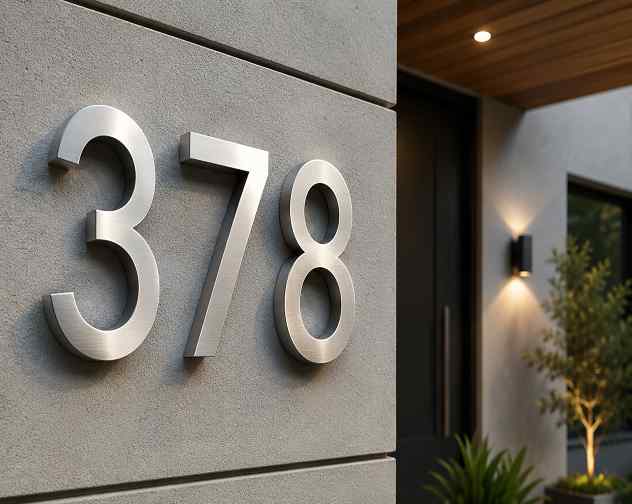
Which Stainless Steel Finish Is Right for Your Home’s Style?
Stainless steel house numbers come in four main surface finishes. Each one behaves differently outdoors, hides or shows marks differently, and suits a different architectural style.
Here is how each finish compares:
| Finish | Surface Look | Reflectivity | Fingerprint Resistance | Best Architecture Style | Maintenance Level |
| Mirror (No. 8) | Glass-smooth, very shiny | Very high | Low, shows all marks | Luxury modern, statement facade | High, needs frequent cleaning |
| Satin (No. 6) | Smooth, soft glow | Medium | Moderate | Minimalist, upscale contemporary | Low to medium |
| Brushed (No. 4) | Directional grain, soft shine | Low | High, grain hides marks | All modern and industrial styles | Low, easiest to maintain |
| Matte (bead-blasted) | Fully flat, no glare, textured | None | High | Industrial, concrete or dark facades | Low |
Brushed (No. 4) finish is the most practical outdoor choice for most homes. The directional grain pattern breaks up fingerprint smears and light surface scratches naturally. This means the surface looks clean with very little effort.
Also, brushed finish does not reflect direct sunlight into a driver’s eyes. This is a real readability problem with mirror-finished numbers in sunny climates and something most buyers do not think about before they order.
Mirror finish suits entrance gates, covered porticos, and architectural walls where the reflected light is a deliberate design choice, not a maintenance burden.
Expert Note: Verifying surface finish consistency on a brushed (No. 4) stainless steel house number uses a profilometer with a 0.8mm sampling length cutoff and 0.001 micron Ra resolution calibrated to ISO 4288, which covers Geometrical Product Specifications: Rules and Procedures for Assessment of Surface Texture. The instrument measures the arithmetic mean surface roughness (Ra) across the grain direction and perpendicular to it at three locations on the number face. A No. 4 brushed finish should record an Ra value of 0.5 to 1.0 micron across the grain per ASTM A480, which is the Standard Specification for General Requirements for Flat-Rolled Stainless and Heat-Resisting Steel Plate, Sheet, and Strip. Readings outside this range indicate incorrect abrasion that compromises the fingerprint-hiding texture.
How Do You Install Stainless Steel House Numbers Correctly?
Stainless steel numbers are heavier than aluminum numbers of the same size. This means the anchor type and wall strength matter more than they do for lighter materials. Choose the wrong anchor and the number can pull away from the wall over time.
Here is the right installation method for each wall surface:
| Wall Surface | Recommended Method | Fastener Specification | Air Gap Needed |
| Rendered masonry or concrete | Threaded standoff with resin anchor | M6 A4-316 stud, minimum 40mm embedment | Yes, minimum 10mm |
| Brick or natural stone | Sleeve anchor and standoff post | 3/16-inch Tapcon A4-316 grade | Yes, minimum 10mm |
| Fiber cement siding | Pan-head screw with neoprene washer | A4-316 stainless self-tapping, 1.5-inch | Yes, minimum 6mm |
| Timber fascia | Coach screw | A4-316 grade, 50mm length | Optional, 6mm recommended |
| Metal cladding | Self-tapping stainless screw | A4-316 HSS-rated self-tapping | Optional |
| Direct bond (flat wall) | 3M VHB mounting tape or CT1 sealant | Rated minimum 3.0 MPa tensile strength | No gap (flat mount) |
For floating standoff installations, the standoff barrel depth controls the gap between the number face and the wall. A standard 12mm standoff reveal works for most facades. Increase to 20mm if the wall surface is irregular or textured, so the number face sits parallel to the wall rather than at an angle.
Also, always use A4-316 grade stainless fasteners to match the number material. Using carbon steel or zinc-plated fasteners with 316 numbers creates a galvanic reaction at every anchor point. This leaves rust staining on the wall surface below each anchor within the first wet season.
Expert Note: Verifying the pull-out strength of a threaded standoff stud embedded in a rendered masonry wall uses a mechanical pull tester with a calibrated load cell rated to 2 kN, calibrated per ASTM E4, which covers Standard Practices for Force Verification of Testing Machines. The tester applies a direct tensile load to the M6 stainless standoff stud embedded in the polymer-modified render coat meeting ASTM C926, which is the Standard Specification for Application of Portland Cement-Based Plaster, at a minimum 40mm embedment depth. An anchor reading below 800 N of pull-out resistance fails the minimum threshold per ICC-ES AC193, which covers Acceptance Criteria for Mechanical Anchors in Concrete Elements, and requires a deeper embedment or a resin-bonded anchor system.
How Do Stainless Steel House Numbers Perform in Coastal Environments?
Coastal environments attack outdoor materials in three ways at once: salt aerosol, high humidity, and UV radiation. Choosing the right grade of stainless steel for your specific coastal zone makes the difference between a 25-year installation and a 5-year replacement.
Here is how exposure intensity maps to the grade you need:
| Exposure Zone | Distance from Shore | Salt Level | Recommended Grade | Expected Lifespan |
| Severe marine | Under 500m from breaking surf | Very high | 316 grade minimum | 20 to 25 years with cleaning |
| Marine | 500m to 3km | High | 316 grade | 25 plus years with cleaning |
| Moderate coastal | 3km to 10km | Medium | 304 or 316 | 20 plus years |
| Inland urban | Over 10km | Low (road salt possible) | 304 grade | 25 to 30 plus years |
| Industrial | Varies | Chemical contamination risk | 316 grade | Confirm with specifier |
In severe marine zones within 500 meters of breaking surf, even correctly specified 316 numbers benefit from a quarterly freshwater rinse. Also plan an annual inspection for crevice corrosion at the standoff-to-number joint. Crevice corrosion happens when two stainless surfaces contact each other and trap salt water in the gap, creating a low-oxygen pocket that attacks the protective layer from the inside.
The fix is simple. Use a 1mm ventilation gap between the standoff barrel face and the back of the number. This prevents the stagnant water pocket that starts crevice corrosion at that joint.
Expert Note: Testing for crevice corrosion susceptibility at the standoff-to-number contact point uses a crevice corrosion test assembly with a PTFE crevice former pressed against the 316 stainless substrate at a torque of 0.28 Nm per ASTM G48, which covers Standard Test Methods for Pitting and Crevice Corrosion Resistance of Stainless Steels and Related Alloys by Use of Ferric Chloride Solution. The assembly is immersed in a 6 percent ferric chloride solution at 22 degrees Celsius for 72 hours. The maximum acceptable crevice attack depth on a compliant 316-grade number substrate is 0.025mm per ASTM G48 Method B. A depth exceeding this threshold indicates insufficient passive film quality and requires the number to be re-passivated per ASTM A380 before final installation.
How Do You Clean and Maintain Stainless Steel House Numbers?
Stainless steel needs less maintenance than brass and about the same as aluminum. The key difference from aluminum is that the cleaning direction matters. Always wipe along the grain of a brushed or satin finish. Never wipe across it.
Here is the right cleaning method for each type of soiling:
| Soiling Type | Method | Product | Frequency | Direction |
| General dust and pollen | Soft microfiber cloth with warm water | Plain water | Monthly | Along grain |
| Fingerprints and smudges | Microfiber cloth with mild dish soap | pH-neutral soap | As needed | Along grain |
| Water spots and mineral deposits | Soft cloth with undiluted white vinegar | White vinegar | As needed | Along grain |
| Tea staining (brown surface marks) | Stainless-specific cleaner or oxalic acid solution | Bar Keepers Friend or equivalent | Annually or as needed | Along grain |
| Coastal salt deposit | Warm freshwater rinse, then dry immediately | Plain water | After storm events | Full rinse |
| Rust transfer from nearby iron or steel | Citric acid solution at 10 percent, soft cloth | Citric acid or dedicated rust remover | As needed | Along grain |
Never use steel wool, abrasive scouring pads, bleach, or ammonia-based cleaners on stainless steel. These products scratch through the protective chromium-oxide surface layer and create new sites where corrosion can start, even on 316-grade material.
Also never use iron-containing cleaning tools like standard steel wire brushes or carbon steel scrapers. Iron particles transfer onto the stainless surface and cause rust spots within days of contact.
Expert Note: Restoring a tea-stained 316 stainless steel house number face to its original brushed appearance uses a 20 percent citric acid passivation solution applied by soft cloth along the grain direction for 5 to 10 minutes per ASTM A380. The treated surface is rinsed with deionized water and dried immediately. The re-formed chromium-oxide passive layer thickness is then confirmed using a field-portable ellipsometer calibrated to ASTM E2475, which is the Standard Guide for Spectroscopic Ellipsometry. A passive layer below 2 nanometers indicates incomplete passivation and requires a second citric acid treatment cycle before the number is returned to outdoor service.
How Do Stainless Steel Numbers Compare to Aluminum and Brass?
Choosing between stainless steel, aluminum, and brass comes down to climate, home style, and budget. Each material has a specific performance profile that makes it the best pick for a different type of installation.
Here is the full comparison:
| Feature | Stainless Steel (316) | Aluminum (anodized) | Brass (lacquered) |
| Salt air resistance | Excellent | Good | Fair, lacquer required |
| UV resistance | Excellent | Excellent | Good if lacquered |
| Weight | Medium to heavy in large sizes | Light | Heavy |
| Finish durability | 20 to 30 plus years, no recoat | 15 to 25 years, no recoat | Lacquer needs renewal every 5 to 10 years |
| Scratch resistance | Very good | Good | Fair |
| Fingerprint resistance | Depends on finish, brushed is best | Good (anodized) | Low (polished) |
| Best home style | Modern, contemporary, industrial | All styles | Traditional, heritage, farmhouse |
| Relative cost | Medium to high | Low to medium | High |
Aluminum is the best all-around value for inland installations. It is lighter, easier to mount, and costs much less than stainless steel while performing nearly as well in non-coastal climates.
Stainless steel is the better long-term investment for coastal homes, humid tropical climates, and contemporary architecture where the material’s weight and finish quality are part of the design intent.
Brass suits traditional and period-style homes but requires lacquer maintenance every five to ten years. Without renewal, the natural patina darkens the surface beyond most owners’ preferences.
Expert Note: Measuring the galvanic potential between a stainless steel house number standoff and a dissimilar metal mounting surface uses a high-impedance voltmeter with a 10 megaohm input impedance to record the open-circuit potential difference between the two metals in a 3.5 percent NaCl solution per ASTM G71, which is the Standard Guide for Conducting and Evaluating Galvanic Corrosion Tests in Electrolytes. A measured potential difference above 250 mV between the stainless standoff (cathodic) and the zinc coating (anodic) confirms a significant galvanic cell that will accelerate zinc consumption at the contact zone. The fix is to isolate the standoff from the panel with a PTFE isolation sleeve and neoprene washer rated to ASTM D1056, which is the Standard Specification for Flexible Cellular Materials Sponge or Expanded Rubber.
What Are the Most Common Stainless Steel House Number Mistakes?
These seven mistakes cause most of the premature failures and appearance problems with stainless steel house numbers:
- Mistake 1: Ordering 304 grade for a coastal location within 3km of the ocean. Tea staining and pitting appear within two to five years and cannot be fixed without replacing the numbers entirely.
- Mistake 2: Using carbon steel or zinc-plated fasteners with stainless numbers. Rust bleed from the dissimilar fastener stains the wall below each anchor point within one wet season.
- Mistake 3: Choosing mirror finish for a south-facing or west-facing wall in a sunny climate. Specular reflection from mirror-finish numbers in direct afternoon sun makes the address unreadable from certain approach angles.
- Mistake 4: Wiping across the grain of a brushed or satin finish when cleaning. Cross-grain wiping adds visible scratch marks that compound over time and permanently dull the finish texture.
- Mistake 5: Mounting numbers flat against the wall with no standoff gap. Trapped moisture between the number back and the wall creates a crevice corrosion environment even on 316 grade.
- Mistake 6: Using steel wool or abrasive pads to remove tea staining. These tools embed iron particles in the surface that cause new rust spots within days of contact.
- Mistake 7: Not testing contrast before ordering. A brushed stainless finish on a light gray or silver cladding wall creates a near-zero contrast situation that fails IFC 505.1 visibility requirements.
Expert Note: Diagnosing iron contamination on a stainless steel house number surface after incorrect cleaning uses the Ferroxyl test, which is an ammonium thiocyanate indicator solution at 10g per 100ml deionized water, mixed 1:1 with 3 percent hydrogen peroxide. The solution is applied by soft cloth to the suspected area on the 316-grade stainless number face meeting UNS S31600 per ASTM A240. Iron contamination sites display an immediate deep red color change as the iron reacts with thiocyanate to form iron thiocyanate complex. Per ASTM A380, any red-positive site requires citric acid passivation treatment to dissolve the embedded iron particles and re-form the chromium-oxide passive layer before the number is returned to outdoor service.
How Do You Choose the Right Stainless Steel House Number for Your Home?
Making the right purchase decision requires answering four specific questions in order. Take them one at a time and the right specification becomes clear.
Question 1: How Far Are You from the Ocean?
Under 3km: specify 316 marine grade. Over 3km: 304 grade is sufficient and costs 15 to 25 percent less. This is the single most important question.
Question 2: What Is Your Home’s Architectural Style?
Match the finish to the facade. Use brushed or matte for industrial and dark concrete facades. Use satin for minimalist contemporary homes. Use mirror only for sheltered entrance walls where the reflective effect is a deliberate design choice.
Question 3: What Contrast Does Your Wall Provide?
Hold a piece of gray or silver card against your wall in daylight. If you can barely see the card, a brushed stainless finish will have the same problem from the road. In that case, choose matte black powder-coated aluminum instead, or add a dark contrasting backer panel behind the stainless numbers.
Question 4: What Digit Size Does Your Setback Require?
Divide your road setback in feet by 10 and round up to the nearest whole inch. Confirm the result is at or above 4 inches per IFC 505.1. Stainless steel numbers are available from 3 to 24 inches in most styles, so size is rarely a limitation.
Here is a quick decision table to summarize:
| Your Situation | Best Choice |
| Coastal, modern home, premium budget | 316 marine grade, brushed finish, floating standoff |
| Coastal, any style, mid budget | 316 marine grade, brushed finish, direct mount |
| Inland, modern home | 304 grade, brushed or satin finish, floating standoff |
| Inland, traditional home | Brass or 304 grade with brushed finish |
| Low contrast wall (light gray or silver cladding) | Add contrasting backer panel or choose matte black |
| Industrial or dark concrete facade | 304 grade matte finish, or brushed with standoff reveal |
Expert Note: Confirming the color contrast compliance of a brushed stainless steel house number against a light exterior wall uses a portable spectrophotometer with a 45/0-degree measurement geometry calibrated to CIE Publication 15, which covers Colorimetry. This tool measures the CIE Lab color coordinates of both the number face and the wall background in the same ambient light. The luminance contrast ratio is calculated from the L values of each surface. A contrast ratio below 3:1 fails the minimum legibility standard per ANSI/SEGD S1.0, which is the Standards for Environmental Graphic Design, and requires a finish change or a contrasting backer panel before the installation meets IFC 505.1 visibility requirements.
Frequently Asked Questions
Yes, in coastal environments and for long-term contemporary homes. A correctly specified 316 marine-grade stainless number lasts 20 to 30 years with only basic cleaning. Aluminum numbers cost less upfront but may need replacement in corrosive environments in 15 to 20 years. Over a 25-year period, the total cost of ownership often favors stainless steel in demanding climates.
Use 316 marine grade, also called UNS S31600. The 2 to 3 percent molybdenum content in 316 grade blocks the chloride ion attack that causes pitting and tea staining on 304 grade in salt air. Apply the 3km coastal rule: within 3 kilometers of the ocean or any tidal waterway, always specify 316.
Stainless steel can show surface discoloration called tea staining in salt air, especially if 304 grade is used in a coastal zone or if iron contamination occurs from cleaning tools. This is a surface issue, not structural corrosion. It can be removed with a citric acid cleaning treatment. True red rust on correctly specified 316-grade material is very rare and usually points to a specification or installation error.
Brushed (No. 4) finish is the easiest to maintain outdoors. Its directional grain pattern naturally breaks up fingerprint smears and hides light surface scratches. Mirror finish shows every mark and needs frequent cleaning to look good. Matte bead-blasted finish also hides marks well but can trap dirt in its open texture over time.
Yes, with the correct anchor type for each surface. Concrete and masonry use resin anchors with M6 A4-316 grade standoff studs. Brick uses Tapcon-type masonry screws. Timber fascia uses stainless coach screws. Fiber cement siding uses self-tapping pan-head screws with neoprene washers. Always match fastener grade to number grade — use 316 fasteners with 316 numbers in coastal installations.
Wipe with a soft microfiber cloth dampened with undiluted white vinegar. Work along the grain direction of the finish, not across it. The acetic acid in white vinegar dissolves the calcium and magnesium carbonate deposits that form water spots. After wiping, rinse with clean water and dry immediately to prevent new spots from forming as the rinse water evaporates.
Explore Essential House Name Plate Guides & Tutorials
Browse our comprehensive handcrafted signage guides for material care, font selection, and architectural placement:
- Beach & Airbnb Signage Design & Weatherproofing Guide (2026)
- Complete Guide to Wood House Sign Sealing & Weather Maintenance
- Horizontal vs Vertical House Numbers Layout Comparison
- Hanging & Wall-Mounted Cottage Sign Installation Guide
- Round vs Rectangular Name Plaques for Modern Property Entrances
- Best Modern & Vintage Fonts for Cottage & Residential Signs