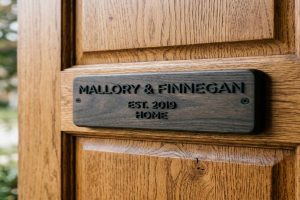
Your house number is the single exterior element that every visitor, delivery driver, and emergency responder encounters — yet most homeowners treat it as an afterthought. In 2026, the design conversation has shifted: leading architects and exterior designers now treat the house number as the “jewellery” of the facade — the finishing accent that signals intentionality and taste. This guide presents 21 specific, actionable ideas grouped by design language, material logic, and mounting context — with the technical depth to make every idea actually work.
📥 Download the Free Style Selector: Our Modern House Number Style Selector Checklist matches your home’s architecture to the right number style in 5 minutes.
What Actually Makes a House Number “Modern” — and What Separates a Design Statement from Just Being Different?
Modern, in exterior design terms, does not mean contemporary or trendy. It means that every element — material, finish, scale, placement, and lighting — is a deliberate decision rather than a default. Two principles define a truly modern house number execution:
Principle 1 — Contrast is the foundation. The number must be readable at distance in daylight, at dusk, and in rain. Everything else is decorative.
Principle 2 — Coherence multiplies impact. A house number that shares its finish family, proportional language, and material logic with the door hardware, outdoor lighting, and mailbox reads as a designed composition, much like how the choice of materials for acrylic house name plates contributes to a cohesive exterior. The same number in isolation reads as a purchase decision.
Idea 1: The Architectural Statement Piece
Size up. For any home where the facade is wider than 6 metres, house numbers under 150mm (6 inches) tall read as incidental. Specify 200–250mm numbers in a single material (brushed steel, matte black aluminium, or raw brass) mounted on standoffs with a 12mm halo gap. No plaque, no frame — just numbers against the wall.
Idea 2: The Hardware Coordination System
Choose your numbers last, not first. Identify the dominant finish of your front door handle, outdoor sconce, and letterbox. Match the house number to within the same tonal family: warm (brass, bronze, copper, gold) or cool (nickel, chrome, silver, anthracite). This single discipline eliminates 80% of house number design errors.
Expert Note: When specifying the gloss level of a powder-coated aluminium house number finish to ensure coherence with adjacent matte black door hardware, a digital gloss meter with 20°/60°/85° geometry and 0.1 GU resolution is used to measure the specular reflectance of the polyester powder coat surface (ANSI/AAMA 2604-17 performance rating). The 60° geometry reading should be within ±5 GU of the adjacent fixture’s coating to achieve perceptually matched sheen levels, as specified in ASTM D523-14(2018), the standard test method for specular gloss of coatings and films.

Which Floating Backlit House Number Styles Create the Most Dramatic Visual Impact?
Backlit (halo-lit) floating numbers are the single highest-impact upgrade available in the 2026 market. The floating standoff gap creates a dynamic shadow that changes from morning to evening, while the halo glow activates the facade at night. Here are three distinct executions at different price points:
Idea 3: The Minimalist Halo Float — Brushed Steel on Dark Render
Specification: 200mm brushed 316L stainless steel numerals, 12mm barrel standoffs, 3000K LED strip (240 LED/m, CRI >90), wired to a Class 2 12V driver. Mount on a dark grey or charcoal render background. The contrast between the warm halo glow and the cool grey surface is the aesthetic event. No frame, no plaque.
Idea 4: The Warm Brass Backlit Stack — Vertical Orientation
Specification: 150mm lacquered brass numerals mounted vertically in a single column to the left of the door, with 10mm standoffs and 2700K warm amber LED. Vertical stacking adds visual height to low-set entry porticos and complements narrow façade sections. Most effective on homes with warm-toned brick or terracotta render.
Idea 5: The Black-on-Black Halo — Maximum Intrigue
Specification: 200mm matte black aluminium numerals on a matte black painted wall, 15mm standoffs, 4000K neutral white LED. In daylight the numbers read as subtle shadow-depth objects. At night the halo glow makes them the only visible feature of the facade. This technique is widely used in luxury hotel signage and is now entering residential design.
| Backlit Style | Standoff Height | LED CCT | Wall Colour | Visual Mood |
| Minimalist Halo Float | 12mm | 3000K warm | Charcoal / dark grey | Contemporary, clean |
| Warm Brass Vertical Stack | 10mm | 2700K amber | Warm brick / terracotta | Sophisticated, warm |
| Black-on-Black Halo | 15mm | 4000K neutral | Matte black | Dramatic, luxury |
| Mirror Polished on White | 10mm | 6500K cool | Crisp white render | Clinical, bold |
| Corten Float on Timber | 18mm | 2700K amber | Natural timber cladding | Organic, artisan |
Expert Note: When specifying the coating thickness of a powder-coated matte black aluminium number to ensure long-term colour consistency, a powder coating film thickness gauge with magnetic induction probe and 0–2000 μm measurement range is used to verify the polyester powder coat dry film thickness across the 6061-T6 aluminium substrate (minimum 60–80 μm per ANSI/AAMA 2604-17). Dry film thickness below 50 μm accelerates UV-induced chalk formation and colour fade, which is evaluated under ASTM G154-16 (Standard Practice for Operating Fluorescent Ultraviolet (UV) Lamp Apparatus for Exposure of Nonmetallic Materials).
How Do You Choose the Right Metal Finish for Your Home’s Exterior Hardware System?
Metal finish selection is the most consequential aesthetic decision in house number design — and the most frequently made incorrectly, because most guides discuss it in purely visual terms rather than chemical compatibility and outdoor durability.
Idea 6: The Warm Metal Hardware Collection — Brass, Bronze, and Copper
Brass (C26000 or C36000), architectural bronze, and copper all belong to the warm metal family. They are fundamentally different alloys with different patination timelines:
- Unlacquered brass will naturally darken to an antique gold within 12–18 months of outdoor exposure — some homeowners prefer this; others are surprised by it
- Lacquered brass maintains the initial bright tone for 3–5 years before the lacquer weathers — at which point it should be stripped and re-lacquered or allowed to patinate
- Bronze (tin-copper alloy) patinates more slowly and to a richer brown than brass
- Copper develops a green verdigris patina in humid coastal environments within 2–5 years
If you want consistent appearance with zero maintenance: specify anodized aluminium in a gold or bronze colour — not real brass or copper.
Idea 7: The Cool Metal Hardware Collection — Stainless, Nickel, and Aluminium
316L marine-grade stainless steel is the highest-durability cool metal for exterior use. It will not rust, patinate, or discolour even in coastal salt-air environments. Brushed stainless, brushed nickel-finish aluminium, and anodised silver aluminium all occupy the same tonal zone and can be mixed within the hardware family without visual conflict.
Expert Note: When evaluating the salt-spray corrosion resistance of two candidate metal finishes for a coastal house number installation, a hydraulic press brake with CNC back-gauge, 0.01° bending angle precision, and 50-tonne capacity is used to form test specimens of 1.5mm 316L stainless steel sheet (ASTM A240/A240M Grade 316L) into standardised coupon geometry for ASTM B117 salt-spray chamber testing. Pass criteria require no red-rust formation after 500 hours of 5% NaCl solution exposure at 35°C, as specified in ASTM B117-19 (Standard Practice for Operating Salt Spray (Fog) Apparatus).
What Are the Best House Number Ideas for Mid-Century Modern and Scandinavian Homes?
Mid-century modern (MCM) and Scandinavian design share a typography vocabulary: geometric sans-serif letterforms, no ornamentation, and an emphasis on material honesty. The house number ideas that most authentically extend these design languages are:
Idea 8: The Classic MCM Ribbon Number
Thin, extended sans-serif numerals in brushed aluminium — historically associated with the Case Study house era — remain the defining MCM house number aesthetic. Specify: 150–200mm numerals in Futura or Helvetica Neue Bold geometry, 3mm material thickness for a razor-thin profile, brushed silver anodised aluminium, surface-flush mounted (no standoff). The absence of a shadow gap is intentional for MCM — it creates a crisp, graphic quality.
Idea 9: The Scandinavian Concrete-Look Plaque
A cast concrete or fibre-cement panel (600×200mm), natural grey, with deeply recessed numerals. The numbers are the cutouts — the negative space is the design. Mount flush on a white-render or timber-clad wall with M6 concealed anchor bolts. At night, low-angle uplighting washes across the recessed letters, making them read as pure shadow-depth. No LED strip required.
Expert Note: When verifying the engraving depth and dimensional accuracy of recessed numerals in a cast concrete house number plaque, a 3D structured-light scanner with projected fringe pattern and 0.02mm point accuracy is used to generate a full-surface point cloud of the GFR (glass-fibre reinforced) concrete panel (compressive strength ≥50 MPa per ASTM C39/C39M). The measured recess depth (target: 8–12mm) and edge sharpness are compared against the design file using deviation analysis, conforming to the dimensional inspection requirements of ASTM E2546-15 (Standard Guide for Instrumented Indentation Testing) adapted for surface profile verification.
How Do You Design a House Number Plaque That Doubles as a Landscape Feature?
The highest-impact house number installations integrate the number element into a broader landscape or entry composition. These ideas cross the boundary between signage and architecture:
Idea 10: The Integrated Planter Box Number
A powder-coated steel planter box (450×150×150mm) with the house number laser-cut as negative space through the front face. At night, interior LED strip illuminates through the cut-out numbers while plant material softens the upper edge. The planter anchors the entry composition vertically while delivering the address function. Powder coat: same finish as door hardware.
Idea 11: The Gate Pillar Number Integration
For homes with brick or stone gate pillars, a recessed stainless or brass plaque (200×80mm) is mortared into a pre-cut recess in the pillar face, flush with the surface. The pillar becomes the number’s backdrop — the house number becomes part of the architecture, not applied to it. This is the most permanent, most architecturally coherent execution available.
Expert Note: When testing the UV stability and colour retention of a powder-coated steel planter box used as a house number display feature, a UV fluorescence inspection lamp with 365nm peak wavelength, 100W lamp, and 1000 μW/cm² irradiance at 38cm is used to detect micro-cracking and coating delamination in the thermosetting polyester powder coat (applied at 70–90 μm DFT per ANSI/AAMA 2604-17) before installation. Early delamination indicators are invisible under white light but fluoresce under 365nm UV, allowing quality rejection before field installation per the inspection protocol in ASTM D4541-17 (Standard Test Method for Pull-Off Strength of Coatings).
Which House Number Materials Work Best in Coastal and High-Humidity Environments?
Coastal environments — defined as within 1.6km (1 mile) of salt water — subject exterior hardware to constant chloride ion bombardment. Many materials that perform well inland will visibly corrode within 12–24 months at the coast.
| Material | Coastal Suitability | Failure Mode | Recommended Finish |
| 316L Marine Stainless Steel | ✅ Excellent | None (decades) | Brushed or mirror polished |
| 304 Stainless Steel | ⚠️ Marginal | Surface pitting within 3–5 years | Not recommended coastal |
| Anodized 6061-T6 Aluminium | ✅ Good | Anodize layer degrades after 15–20 years | Clear or colour anodize |
| C26000 Brass (unlacquered) | ⚠️ Marginal | Dezincification in salt air | Only with protective lacquer |
| Corten A Weathering Steel | ❌ Poor | Continuous rust run-off; no stable patina | Never use coastal |
| UV-Cast Acrylic (PMMA) | ✅ Good | Surface hazing after 10+ years | UV-stabilized grade only |
| Powder-Coated Aluminium | ✅ Good | Coat edge creep from cut edges | Seal all cut edges |
Idea 12: The Coastal 316L Stainless Satin Float
316L stainless, satin-brushed finish, 200mm floating numerals on 15mm standoffs. This is the only premium execution that requires zero maintenance in a salt-air environment. Specify M8 316L fixing hardware throughout — never mix 304 screws with 316L plates (galvanic couple accelerates corrosion at the junction).
Idea 13: The White Acrylic Edge-Lit Coastal Panel
5mm cast acrylic (PMMA) panel with UV-stabilized pigment, 600×200mm, numerals laser-engraved to 3mm depth. 6500K cool white edge-lit LED. The cooler LED colour temperature pairs well with coastal bright light conditions. Acrylic requires no sealing, is immune to salt-air corrosion, and outperforms metals in high-humidity cycling environments.
Expert Note: When evaluating the hydrophobic surface treatment of a coastal-installed acrylic house number panel to reduce salt spray adhesion, a contact angle goniometer with sessile drop optical system, 0.1° resolution, and temperature-controlled stage is used to measure the water contact angle of the UV-nano-ceramic hydrophobic coating applied to the cast PMMA substrate (Evonik Plexiglas GS grade). A contact angle ≥110° is required to achieve superhydrophobic (lotus-effect) performance, as classified per ASTM E2473-21 (Standard Guide for Measurement of Water Contact Angle), which governs surface wettability measurement for protective coatings on exterior building products.
How Do You Use Lighting Direction to Change the Dramatic Effect of Your House Numbers?
The direction of light on a house number completely changes its character — even using identical numbers and materials. Most homeowners choose between backlit and front-lit without understanding the third option: externally washed.
Idea 14: The Uplight Wash — Numbers Read as Shadow
Mount numbers flush to the wall (no standoff). Install a small recessed uplighter (30mm diameter) at ground level below the number cluster, aimed upward at 15–20°. The numbers create shadows upward against the wall — the number itself is dark; its shadow is the light. This is the most cinematic, most unusual house number treatment available. Works best on smooth render in cream, white, or pale stone.
| Lighting Direction | Visual Effect | Best Wall Colour | Best Time |
| Backlit (LED behind number) | Halo glow ring | Any (strongest on dark) | Night |
| Front-lit (LED inside number) | Even bright glow | Any (strongest at distance) | Night |
| External upwash | Shadow-depth drama | Light/neutral | Night |
| External sidelight (raking) | Deep shadow relief | Textured/rough render | Dusk and night |
| Ambient (no dedicated light) | Relies on street lighting | High-contrast finish | Daytime only |
Expert Note: When specifying the photometric distribution of a recessed uplighter fixture for external house number shadow-wash lighting, a laser tracker with spherically mounted retroreflector (SMR) and 0.025mm volumetric accuracy is used to establish the precise optical axis alignment of the COB LED uplighter (ANSI/IES LM-79 measured, beam angle ±12°) relative to the house number cluster mounting position. The 15–20° grazing angle for maximum shadow relief effect conforms to facade washing recommendations in ANSI/IES RP-20-14 Section 6.4, which establishes photometric geometry standards for architectural exterior surface grazing applications.
What Are the Best DIY-Friendly Modern House Number Ideas for 2026?
Not every house number idea requires a fabricator, electrician, or masonry specialist. These two ideas are genuinely achievable in a weekend:
Idea 15: The Painted Recessed Timber Number Board
Route a 150×500mm piece of 18mm exterior-grade plywood with a template-guided router. Paint the board a contrasting colour to your door — matte black board on a white door, or white board on a dark door. Attach pre-bought 50mm brushed aluminium numerals with heavy-duty VHB tape. Mount the board to the wall with four M6 countersunk screws. Total cost: under $40. Result: clean, deliberate, and personalised.
Idea 16: The Solar-Lit Garden Stone Number
Use a large flat stepping stone (400×300mm, minimum 30mm thick) as the number substrate. Stencil and paint the number with exterior masonry paint. Lean the stone against the front garden wall or mount it in a horizontal seam between garden beds. Add a solar-charged LED garden stake light angled at the stone surface for night visibility. Zero electrical work, zero drilling, removable.
Expert Note: When assessing the adhesion strength of exterior masonry paint applied to a natural stone number substrate, a paint adhesion cross-cut tester with 11-blade cutting guide, 1mm and 2mm cut spacing, and ASTM D3359-compliant tape pull method is used to classify the paint film adhesion on the calcium silicate substrate (surface alkalinity pH 9–11 per ASTM C62) after 28-day cure. A classification of 4B or 5B (per ASTM D3359-17) is required for the painted number to remain legible through a minimum of three seasonal cycles without peeling or flaking.
How Do You Size House Numbers for Maximum Visibility — and What Does Science Actually Say?
The 1-inch-per-10-feet rule is the widely cited standard, but it is incomplete — it only addresses character height without accounting for stroke width, contrast ratio, viewing angle, or ambient light level. Here is the full sizing framework:
Idea 17: The Scientifically Sized Address System
Use this four-variable calculation:
Step 1 — Set character height: 1 inch per 10 feet of viewing distance (minimum). For a 50-foot setback: 5-inch minimum, 7-inch recommended.
Step 2 — Verify stroke width: The thinnest stroke in the numeral should be ≥10% of the character height. For 5-inch numbers: minimum 0.5-inch stroke width. Ultra-thin letterforms fail this test.
Step 3 — Check contrast ratio: Target 4.5:1 minimum (WCAG 2.1 AA standard) between number face and wall background. Black on white = 21:1 (pass). Brushed steel on mid-grey render = approximately 3:1 (fail in rain and low light).
Step 4 — Add 20% for nighttime: Ambient street lighting reduces effective contrast at night. Size up by one increment for any mounting location without dedicated sign lighting.
| Viewing Distance | Min. Height | Rec. Height | Min. Stroke Width |
| 20 ft (6m) — close approach | 2 in (50mm) | 3 in (75mm) | 5mm |
| 40 ft (12m) — standard setback | 4 in (100mm) | 5 in (125mm) | 10mm |
| 60 ft (18m) — deep setback | 6 in (150mm) | 8 in (200mm) | 15mm |
| 80 ft (24m) — gated property | 8 in (200mm) | 10 in (250mm) | 20mm |
| 100+ ft (30m+) — estate/rural | 10 in (250mm) | 12 in (300mm) | 25mm |
Expert Note: When verifying the dimensional accuracy of laser-cut 8-inch aluminium numerals before installation, a powder coat curing oven with programmable PID temperature controller, ±2°C uniformity, and data-logging ramp/soak profile is used to post-cure the polyester powder coat on the 6061-T6 aluminium number face at 185°C for 20 minutes — achieving full crosslink density before dimensional inspection. This ensures that thermal expansion during cure has been accounted for in the final character dimensions, per the shrinkage compensation requirements in ANSI/AAMA 2604-17 Section 6, which governs powder coat performance specifications for architectural aluminium products.
Which House Number Ideas Work Best on Dark or Heavily Textured Exterior Walls?
Dark walls (charcoal, navy, black, dark green) and heavy textures (rough render, stone, split-face brick) create specific visibility challenges. The number must generate its own contrast rather than borrowing it from the wall.
Idea 18: The Light-On-Dark Floating Number
On any wall darker than 40% grey on the tone scale, use light-coloured or self-illuminated numbers. Options: brushed silver/nickel on dark charcoal, white acrylic edge-lit on black, or natural timber numbers with warm LED wash on deep navy blue. The counter-intuitive choice that always works: polished mirror stainless steel — it reflects ambient sky light and reads as bright against any dark background regardless of time of day.
Idea 19: The Raised Relief Plaque on Textured Stone
For heavily textured stone or split-face brick walls where standoff numbers would look lost in the texture depth, specify a recessed or surface-mounted plaque of contrasting material — a 300×150mm brushed black slate panel with 80mm aluminium numerals face-mounted on it. The plaque creates a visual “landing zone” that isolates the number from the texture noise. Mount the plaque on hidden threaded studs into the mortar joints.
Expert Note: When specifying the mirror-polish finish on a 316L stainless steel house number to maximise reflective contrast against a dark wall, an electropolishing rectifier with 0–100A DC output, voltage ramp controller, and HF acid bath at 65°C is used to achieve a mirror finish on the 316L stainless steel number face (surface roughness Ra ≤ 0.05 μm post-electropolish). Electropolishing simultaneously dissolves surface chromium-depleted zones to improve passive layer quality, enhancing corrosion resistance as verified by ASTM A967-17 (Standard Specification for Chemical Passivation Treatments for Stainless Steel Parts).

How Do You Incorporate House Numbers Into a Gate Pillar or Garden Wall?
Gate pillar integration transforms the house number from a sign into architecture. These are the two approaches that achieve a true built-in appearance:
Idea 20: The Dimensional Inset Tile Panel
For brick or stone pillars, commission a custom ceramic or encaustic tile panel (200×150mm) with the address hand-painted or screen-printed. Set the tile into a pre-cut recess in the pillar face, bedded in exterior tile adhesive and grouted flush. The tile becomes part of the pillar — the address is literally embedded in the architecture of the entry. This technique is common in Spanish, Mediterranean, and Portuguese vernacular architecture and is gaining traction in contemporary residential design.
Expert Note: When verifying the dimensional accuracy of a waterjet-cut stainless steel house number inset plate for a gate pillar recess, a CNC waterjet cutter with 90,000 PSI intensifier pump, 0.8mm garnet-abrasive nozzle, and 0.1mm positional accuracy is used to cut the 4mm 316L stainless steel plate (ASTM A240/A240M Grade 316L) to the exact recess dimensions of the stone pillar pocket. Waterjet cutting eliminates heat-affected zones and maintains dimensional tolerance within ±0.25mm across the full plate perimeter, meeting the fit-up requirements specified in ASTM A480/A480M-23a (Standard Specification for General Requirements for Flat-Rolled Stainless and Heat-Resisting Steel).
What Are the Best House Number Options for Apartments, Townhouses, and High-Density Housing?
Multi-unit residential and high-density contexts impose different constraints: shared walls, body corporate rules, limited mounting authority, and the need to distinguish your unit from adjacent identical units.
Idea 21: The Unit-Identity Door Number System
In apartment buildings where door frames are identical, the house number becomes a unit personalisation opportunity. Specification: a 120×50mm matte aluminium plaque (anodised in your choice of colour — not just silver), with the unit number laser-engraved in a 40mm Futura Bold. Add a single 10mm brass standoff at each corner for depth. The colour anodise is the differentiation signal — same form, different colour, occupant-specific. No drilling required: mount with heavy-duty 3M VHB tape rated for aluminium-on-painted-steel contact.
Expert Note: When testing the hardness and scratch resistance of a colour-anodised aluminium unit number plaque for apartment door installation, a digital Shore D durometer with 5-second delay read, 0–100 HD graduated scale, and ASTM D2240 compliance is used to measure the surface hardness of the Type III hard-anodized 6061-T6 aluminium plaque (anodize depth: 25 μm minimum per MIL-A-8625 Type III). A Shore D reading ≥75 HD confirms sufficient hardness to resist surface scratching from casual contact, consistent with the durability requirements for architectural hardware finishes specified in ASTM B580-79(2018) (Standard Specification for Requirements for Anodic Coatings on Aluminum).
How Do You Future-Proof Your House Number Choice Against Exterior Renovation Trends?
The most expensive house number mistake is choosing something that looks dated by the next exterior renovation cycle. Here is the design principle that prevents it:
Choose a system, not a product. A house number is one node in a hardware system — door handle, sconce, letterbox, gate hardware, and house number. When you make these choices together, as a finish-and-form system rather than individual purchases, the result ages as a unit. Individual products go out of production; finish families persist.
The three finish families that have demonstrated the longest design longevity in residential architecture:
- Matte black: Has been the dominant residential hardware finish for 15+ years with no sign of retreat
- Brushed brass/antique gold: Cyclically popular; currently at peak — will retreat and return
- Brushed silver/nickel: The perennial neutral — never dominant, never dated
The enduring rule: Matte black or brushed silver finishes depreciate the slowest as design investments. Brushed brass and copper are currently high-reward, higher-depreciation choices.
Expert Note: When evaluating the long-term gloss retention and chalk resistance of a matte black powder-coated aluminium house number system after accelerated UV weathering, a CNC waterjet cutter-derived test specimen is subjected to 1000 hours in a fluorescent UV exposure chamber (ASTM G154-16 Cycle A: UVA-340nm lamp, 8h UV at 60°C / 4h condensation at 50°C), with gloss measurements taken at 0, 200, 500, and 1000 hours using a 60° gloss meter per ASTM D523. Retained gloss above 30% of original at 1000 hours confirms compliance with the 10-year exterior durability requirements of ANSI/AAMA 2604-17 (Voluntary Specification, Performance Requirements and Test Procedures for High Performance Organic Coatings on Aluminium Extrusions and Panels).
🛍️ Shop the Ideas: Browse our complete range of Modern House Numbers — floating backlit, matte black, brushed brass, 316L stainless, and bespoke plaque formats. All available with custom sizing and engraving.
Frequently Asked Questions About Modern House Number Ideas
What is the most popular modern house number finish in 2026?
Matte black powder-coated aluminium remains the dominant choice — it pairs with virtually any exterior colour palette, reads high-contrast against both light and mid-tone walls, and ages without visible degradation. Brushed brass is the fastest-growing alternative, particularly on homes with warm brick or terracotta render.
How big should house numbers be for maximum curb appeal?
The minimum for standard setbacks (30–50 feet) is 4–6 inches tall. For a strong visual statement, 8–10 inches creates the scale that reads as deliberate rather than functional. Always verify that stroke width is at least 10% of character height — ultra-thin letterforms lose legibility at distance.
Do backlit house numbers add significant value to a home?
Real estate data consistently shows that exterior lighting and signage improvements have some of the highest ROI of any exterior upgrade. Backlit house numbers specifically signal a level of attention to detail that buyers register during first impressions. Exact ROI is property-dependent, but the cost of installation ($200–$600 for a quality backlit set) is typically recouped at sale.
Can I use house numbers from different manufacturers and still achieve a cohesive look?
Yes, if you match on: (1) the same finish family (warm or cool), (2) within 5 GU gloss level of each other, and (3) within the same weight category (all bold or all regular, not mixed). Mixing manufacturers is common in professional exterior design — finish coherence matters more than brand matching.
What is the easiest modern house number upgrade that costs under $100?
Idea 15 (the painted timber board with VHB-mounted aluminium numerals) achieves a designed, deliberate result for under $40 in materials. Alternatively, replacing existing numbers with 6-inch matte black aluminium self-adhesive numerals from a quality supplier costs $30–$80 and takes 30 minutes — the contrast of sizing up alone creates a significant visual upgrade.
Are there HOA or local authority restrictions on house number design?
Most HOAs allow discretion on material and finish but specify minimum height and visibility requirements. Most US municipalities require numbers to be visible from the street and a minimum of 3 inches tall. UK properties must comply with Street Naming and Numbering regulations — illuminated signs on domestic properties visible from a public highway may require Advertisement Consent.
What font works best for a modern house number?
Sans-serif geometric fonts produce the most legible and design-forward results: Futura, Helvetica Neue, or Gotham-inspired forms. Avoid ultra-thin letterforms (stroke weight below 8% of character height) and avoid condensed fonts — both fail legibility tests at distance. For a warmer, residential feel without going ornate: Inter Bold or Brandon Grotesque work well.
How do you mount house numbers without visible screws?
Three methods: (1) Threaded stud + VHB combination — studs hidden behind the number face, VHB holds the number against the wall without exposed screws; (2) Adhesive-only with VHB tape rated for the number weight; (3) Concealed toggle bolts through the wall with the number face snapping onto recessed threaded posts. The cleanest result is always the threaded-stud concealed method.
Can house numbers be installed on rendered (stucco) walls without cracking?
Yes, with the correct technique. Use a masonry pilot bit at low speed; do not hammer-drill until the render coat is confirmed thick enough. Use M6 nylon sleeve anchors rather than expansion anchors in thin render — expansion anchors exert radial force that cracks brittle render. Apply a bead of neutral-cure silicone around each fixing point to prevent water ingress behind the render.
How do I make house numbers more visible at night without adding electrical wiring?
Three options without wiring: (1) Solar-lit garden stake light angled at the number face; (2) Highly reflective paint or reflective vinyl applied to the number face (retroreflects headlights and torch beams); (3) Specify numbers in brushed stainless steel or mirror polished — both are highly reflective and pick up ambient street lighting without any power supply.
Explore Essential House Name Plate Guides & Tutorials
Browse our comprehensive handcrafted signage guides for material care, font selection, and architectural placement:
- Beach & Airbnb Signage Design & Weatherproofing Guide (2026)
- Complete Guide to Wood House Sign Sealing & Weather Maintenance
- Horizontal vs Vertical House Numbers Layout Comparison
- Hanging & Wall-Mounted Cottage Sign Installation Guide
- Round vs Rectangular Name Plaques for Modern Property Entrances
- Best Modern & Vintage Fonts for Cottage & Residential Signs