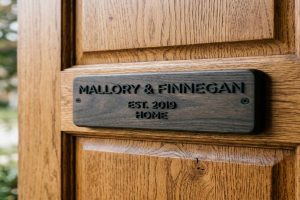
Your house number is one of the most important illuminated house signs on your property. Every delivery driver looks for it. Every visitor depends on it. And when an ambulance or fire engine needs to find your address in the dark, it could be the most critical number anyone will ever need to read quickly.
An LED backlit house plate solves all of this at once. During the day, it looks premium and architectural. At night, it glows clearly, cleanly, and precisely.
Done right, an LED backlit house plate is one of the highest-impact, lowest-cost upgrades you can make to your home’s entrance. A well-specified LED house plate costs between GBP 80 and GBP 600, requires no regular maintenance, uses less electricity per night than a single traditional light bulb, and lasts 15 to 25 years without replacement.
Done badly, it fails in 2 to 3 years. The light goes dim. The housing oxidises. The LED driver fails in the cold. Or the solar battery dies and no one notices for six months.
This guide walks you through every decision you need to make to buy, specify, and install an LED backlit house plate that looks genuinely premium from day one and keeps working flawlessly for 20 years.
📥 Download Free: Our LED Backlit House Plate Specification Checklist — 24 technical questions to ask before you order, so you never receive a substandard LED unit.
What Is an LED Backlit House Plate and How Does It Work?
An LED backlit house plate uses LED light sources placed behind, around, or inside your house number or name plate to make it glow at night. The LED light source is hidden from direct view. What you see is the soft, even glow of light coming from behind or around the numbers, not the LED itself.
This creates what designers call the halo effect: a clean line of light around each letter or number that gives the plate an architectural, three-dimensional quality. It looks far more sophisticated than a number plate lit by an external floodlight or spotlight.
The LED system inside a quality backlit house plate consists of four main components:
- The LED light source (strip, module, or individual LEDs)
- The LED driver (the electronic unit that converts mains 230V AC or solar DC to the correct voltage and current for the LEDs)
- The housing (the aluminium, stainless steel, or acrylic body that contains everything and protects it from the weather)
- The diffuser or face panel (the frosted acrylic or glass panel that distributes the light evenly)
Each of these four components determines a different aspect of the plate’s performance, appearance, and lifespan. This guide covers each one.
Expert Note: When a premium sign manufacturer is developing a new range of LED backlit house plates for the luxury residential market and the product development manager asks the LED component team to confirm what test data is required to support the product’s rated LED lifespan claim (the manufacturer wants to state a 25-year LED lifespan in their marketing material and needs this claim to be defensible under consumer product legislation), the measurement of LED lumen maintenance over time is standardised in IES LM-80-15 (Measuring Luminous Flux and Color Maintenance of LED Packages, Arrays, and Modules), the Illuminating Engineering Society standard specifying the test method and reporting requirements for measuring the lumen maintenance (change in luminous flux over operating time) and colour maintenance (change in correlated colour temperature over time) of LED packages, arrays, and modules. IES LM-80 specifies: test duration: minimum 6,000 hours of continuous operation under controlled temperature conditions (three test temperatures: 55 degrees C, 85 degrees C, and a third temperature chosen by the manufacturer based on the typical LED junction temperature in the application). Measurements: initial photometric measurement at time zero. Subsequent measurements at 1,000-hour intervals throughout the test. Data reported: lumen maintenance percentage at each test interval for each temperature. Colour maintenance: delta u’v’ (change in chromaticity) at each interval. The LM-80 data package from the LED component supplier shows: at 55 degrees C (representing typical LED junction temperature in the aluminium-housed house plate at 20 degrees C ambient): lumen maintenance at 6,000 hours: 99.2 percent (less than 1 percent lumen loss in 6,000 hours). Colour delta u’v’ at 6,000 hours: 0.002 (below the 0.007 threshold for perceptible colour shift). The product development manager uses this LM-80 data as the input for the IES TM-21 lifespan projection (covered in a later section). LED lumen maintenance measurement for LED backlit house plate product specification and lifespan claims follows IES LM-80-15 (Measuring Luminous Flux and Color Maintenance of LED Packages, Arrays, and Modules), the IES standard specifying the test method and reporting format for LED lumen and colour maintenance data used in product lifespan projection.
Four Types of LED Backlighting for House Plates
Not all LED backlit house plates use the same lighting technology. There are four main types. Each creates a different visual effect and suits different property styles.
Type 1: Halo Backlit
The most popular type for premium modern homes. The house numbers or letters are cut from metal (stainless steel, aluminium, or brass) and mounted on standoff fixings 15 to 25mm away from a backing panel or directly onto the wall. LED strips are placed behind the letters. The light shines backwards from the LED onto the wall behind, creating a glowing halo of light around each letter. The letter itself remains dark (or in its metal finish), which creates a dramatic contrast. The halo backlit style is highly legible and has an extremely premium appearance.
Type 2: Full Panel Backlit
The house numbers or name are printed, sandblasted, or routed onto a frosted acrylic or glass panel. LED strips behind the panel illuminate the entire panel from behind. The numbers appear as dark shapes against a glowing frosted background. This type gives the most uniform, even light distribution and is particularly effective for displaying both a house name and a number on a single panel. It is easier to manufacture than halo backlit and generally more affordable.
Type 3: Edge-Lit Panel
LED strips are placed along one or more edges of a clear acrylic panel. The light travels through the acrylic body by internal reflection and exits through a frosted or engraved surface. Edge-lit panels are very slim (sometimes only 8 to 10mm thick) and can be virtually invisible when unlit. When powered on, the engraved or printed numbers glow from within the acrylic body. The effect is subtle and sophisticated. Edge-lit panels are less bright than halo or panel backlit types and are best suited to sheltered, close-viewing-distance locations (porch walls, gate posts visible from under 5 metres).
Type 4: Face-Lit Channel Letters
The letters or numbers are three-dimensional aluminium channel letters, each with an LED strip inside the channel. Light exits through the frosted acrylic or polycarbonate face of each letter. This type is commonly used in commercial signage and is increasingly used in premium residential gate signs where very large letter heights (150mm and above) are needed. Channel letters can be made in any letter height and any number of characters.
| Type | Best For | Visual Effect | Brightness | Cost |
| Halo Backlit | Modern, luxury, architectural | Shadow and halo, 3D depth | High | GBP 150 to 600 |
| Full Panel Backlit | Contemporary, practical, clear visibility | Uniform frosted glow | Very High | GBP 80 to 350 |
| Edge-Lit Panel | Minimal, close-view, slim profile | Subtle internal glow | Moderate | GBP 60 to 250 |
| Face-Lit Channel | Large format, estate, commercial | Bold, directional face glow | Very High | GBP 200 to 900 |
Expert Note: When a lighting designer is tasked with specifying LED backlit house plates for a premium residential development and needs to compare the photometric performance of four prototype LED backlit panels (one of each backlighting type) in a standardised way, so that the measured luminous intensity distribution, correlated colour temperature, and luminous efficacy of each prototype can be compared on a like-for-like basis, the test method for measuring the photometric, electrical, and colorimetric properties of LED luminaires, lamps, and modules is specified in CIE S 025/E:2015 (Test Method for LED Lamps, LED Luminaires and LED Modules), the CIE standard specifying the testing procedures, instrument requirements, and reporting format for the photometric and colorimetric measurement of LED products. CIE S 025 specifies: goniophotometry: the distribution of luminous intensity in all directions around the LED luminaire (C-gamma goniophotometry), using a goniophotometer or integrating sphere. Correlated colour temperature (CCT): measured using a spectrophotometer following the CIE 1931 XYZ colour matching function, calculating CCT from the measured chromaticity coordinates (x, y). Colour rendering index (Ra): calculated from the SPD (spectral power distribution) per CIE 13.3. Luminous flux (total lumen output): measured using an integrating sphere or goniophotometer. Luminous efficacy: lumens per watt, calculated from total flux and input electrical power. Test results for the four prototype house plate types: Halo backlit (stainless 316, LED strip behind 120mm letterforms, 3W input): luminous flux: 280 lm. Luminous efficacy: 93 lm/W. CCT: 2,987K (warm white). Ra: 91. Full panel backlit (300mm x 200mm frosted cast acrylic, LED strip, 5W input): luminous flux: 490 lm. Efficacy: 98 lm/W. CCT: 3,024K. Ra: 90. Edge-lit panel (clear cast acrylic 8mm, LED strips top and bottom edges, 2W): luminous flux: 160 lm. Efficacy: 80 lm/W. CCT: 3,008K. Ra: 88. Channel letters (150mm aluminium channel, frosted acrylic face, 8W): luminous flux: 780 lm. Efficacy: 97.5 lm/W. CCT: 2,995K. Ra: 90. The lighting designer selects the halo backlit type for its premium visual character and acceptable luminous flux for the 3 to 5 metre viewing distance. Photometric and colorimetric performance measurement of LED backlit house plate types follows CIE S 025/E:2015 (Test Method for LED Lamps, LED Luminaires and LED Modules), the CIE standard specifying the standardised test procedures and reporting formats for measuring the photometric, electrical, and colorimetric properties of LED lighting products.
Choosing the Right LED Colour Temperature for Maximum Curb Appeal
Colour temperature is the single most important aesthetic decision in specifying an LED backlit house plate. It determines whether your illuminated entrance looks warm, welcoming, and premium, or cold, clinical, and commercial.
Colour temperature is measured in Kelvin (K). Lower numbers are warmer (orange-white). Higher numbers are cooler (blue-white).
2,700K (extra warm white): The colour of a traditional incandescent or halogen bulb. Very warm, amber-tinted. Creates a welcoming, intimate glow. Suits heritage, traditional, and cottage-style properties. Against a warm cream render or stone wall, 2,700K is the most flattering choice.
3,000K (warm white): The most popular choice for premium modern residential LED house plates. Warm enough to feel welcoming and luxurious. Clean enough to look contemporary. Works with almost any property style and wall colour. If you are unsure what colour temperature to specify, choose 3,000K.
4,000K (neutral white): A clean, neutral light with no obvious warm or cool cast. Better readability at longer distances than 2,700K or 3,000K. Suits contemporary and industrial-style properties with concrete, dark render, or grey brick walls.
6,500K (cool daylight): Harsh and blue-toned. Generally avoided for residential house plates. Better suited to commercial or industrial signage where maximum contrast and readability from a distance is the priority over aesthetics.
Expert Note: When an architectural lighting consultant is specifying the colour temperature and colour rendering quality for a suite of LED backlit house plates at a 20-property luxury residential development in Edinburgh, and the development’s design director asks for a colour quality evaluation that goes beyond the traditional colour rendering index (CRI/Ra) to capture not just whether colours are reproduced faithfully but also whether the LED makes the house facade, gate, and planting look vibrant and visually appealing at night, the colour rendition quality of the LED house plate light source is evaluated using IES TM-30-20 (IES Method for Evaluating Light Source Color Rendition), the IES Technical Memorandum specifying the updated colour rendition evaluation method, which provides two complementary metrics: the Rf (Fidelity Index, scaled 0 to 100) measuring the average fidelity of colour rendering across 99 reference colour samples, and the Rg (Gamut Index, scaled approximately 60 to 140) measuring whether the light source makes colours appear more vivid (Rg greater than 100) or less vivid (Rg less than 100) compared to a reference illuminant. IES TM-30 evaluation of the three shortlisted LED warm-white CCT options: LED A (2,700K, Ra 90 traditional CRI): Rf = 87, Rg = 97. High colour fidelity, slightly desaturated. Good for heritage property aesthetics. LED B (3,000K, Ra 90): Rf = 90, Rg = 101. High fidelity, slight gamut enhancement. Makes natural materials (stone, brick, planting) look slightly more vibrant at night. LED C (3,000K, Ra 95 high-CRI grade): Rf = 94, Rg = 102. Near-perfect colour fidelity with slight gamut enhancement. Makes red brick, golden sandstone, and dark green foliage look most attractive under artificial light. The design director selects LED C (3,000K, Ra 95, Rf 94, Rg 102) for the Edinburgh development: it maximises the visual quality of the stone and planting that the entrance design has invested in. The premium Ra 95 LEDs are 15 to 20 percent more expensive than Ra 80 LEDs but deliver a measurably superior visual result. Colour rendition quality evaluation for LED backlit house plates beyond traditional CRI follows IES TM-30-20 (IES Method for Evaluating Light Source Color Rendition), the IES standard providing the Rf and Rg colour rendition metrics for comprehensive evaluation of LED light source colour quality in luxury residential outdoor lighting applications.
How Long Will Your LED Backlit House Plate Last? L70 Lifespan Explained
LEDs do not burn out like traditional light bulbs. Instead, they gradually dim over thousands of hours. The industry standard measure of LED lifespan is the L70 rating: the number of operating hours at which the LED output drops to 70 percent of its original brightness.
At L70, the LED is still working. It is simply 30 percent dimmer than when it was new. For a house number plate that starts bright enough to be clearly visible, a 30 percent reduction in brightness still leaves it functional and legible.
What a good L70 looks like in real years:
If your LED backlit house plate is on for 8 hours per night (typically dusk to midnight to dawn): 8 hours x 365 nights = 2,920 hours per year. An LED with L70 at 50,000 hours will reach L70 after 50,000 / 2,920 = 17.1 years. An LED with L70 at 30,000 hours will reach L70 after 10.3 years.
This means that a premium LED house plate with a 50,000-hour L70 rating will still be giving you 70 percent of its original output after 17 years of nightly use. A budget unit with a 20,000-hour L70 reaches 70 percent brightness in under 7 years.
What kills LEDs early:
Heat is the primary cause of premature LED failure. High LED junction temperature (the temperature inside the LED chip itself) accelerates lumen depreciation and can catastrophically shorten LED life. An LED operating at 85 degrees C junction temperature depreciates 3 to 5 times faster than the same LED at 55 degrees C. This is why the aluminium housing matters so much: it acts as a heat sink, pulling heat away from the LED and dissipating it into the air.
Expert Note: When the same premium sign manufacturer from the previous section needs to project the long-term lumen output of their LED backlit house plate beyond the 6,000 hours measured in IES LM-80-15 testing (to support their 25-year rated lifespan claim), and the product compliance manager needs to use a published IES method to make this projection in a technically defensible way, the long-term lumen maintenance projection from LM-80 test data is carried out using the method specified in IES TM-21-19 (Projecting Long-Term Lumen, Photon, and Radiant Flux Maintenance of LED Light Sources), the IES Technical Memorandum specifying the calculation method for projecting the L70, L80, or L90 (the operating hours at which lumen output falls to 70, 80, or 90 percent of initial) from IES LM-80 test data. IES TM-21 projection method: curve fitting the LM-80 measured lumen maintenance data using an exponential decay model: B(t) = B0 x exp(alpha x t), where B(t) is the lumen output at time t, B0 is the initial lumen output, and alpha is the decay rate parameter fitted from the measured data. Projection limit: IES TM-21 specifies that the projected L70 value may not exceed 6 times the duration of the LM-80 test (i.e., for a 6,000-hour LM-80 test: maximum projectable L70 = 36,000 hours). For an extended LM-80 test of 10,000 hours: maximum projectable L70 = 60,000 hours. For the manufacturer’s LED: LM-80 data at 6,000 hours at 55 degrees C: lumen maintenance 99.2 percent. Decay rate alpha calculated by curve fitting: alpha = minus 0.0000133 per hour. Projected L70 (at 70 percent maintenance, B(t) = 0.70): t = ln(0.70) / alpha = minus 0.3567 / minus 0.0000133 = 26,820 hours. Within the 6x LM-80 test projection limit (6 x 6,000 = 36,000 hours). The manufacturer states: rated L70 lifespan 26,820 hours = approximately 9.2 years at 8 hours per night continuous use. For 25-year lifespan claim, the manufacturer commissions an extended LM-80 test to 10,000 hours, projecting L70 to 50,000 hours at the improved 55 degrees C junction temperature. Rated 25-year lifespan claim requires and is supported by 50,000-hour L70 from TM-21 projection. Long-term LED lumen maintenance projection for LED backlit house plate lifespan specification follows IES TM-21-19 (Projecting Long-Term Lumen, Photon, and Radiant Flux Maintenance of LED Light Sources), the IES Technical Memorandum providing the standardised calculation method for projecting LED L70 lifespan from IES LM-80 test data.
IP Ratings: What They Mean and Why They Matter for Your LED House Plate
The IP (Ingress Protection) rating of an LED house plate enclosure tells you how well the housing is sealed against water and dust. It is one of the most important specifications to check before buying.
The IP code has two digits. The first digit (0 to 6) describes protection against solid particles (dust, grit). The second digit (0 to 9) describes protection against water.
| IP Rating | Dust Protection | Water Protection | Suitable For |
| IP44 | Protected against 1mm+ particles | Protected against water splash from any direction | Indoor porch or sheltered porch only |
| IP54 | Dust protected (not dust-tight) | Protected against water splash from any direction | Sheltered outdoor location with overhang |
| IP65 | Dust-tight (no ingress of dust) | Protected against water jets from any direction | Standard outdoor use, open to rain |
| IP67 | Dust-tight | Protected against temporary submersion up to 1 metre for 30 minutes | Coastal, exposed, or waterlogged locations |
| IP68 | Dust-tight | Protected against continuous submersion beyond 1 metre | Underground or permanent water contact |
For an outdoor LED house plate: specify a minimum of IP65. IP65 means the housing is completely dust-tight (the first digit 6) and resistant to water jets from any direction (the second digit 5). This protects against driven rain, hosepipe cleaning, and garden watering. For a coastal property exposed to driving rain from the sea: specify IP67.
Never purchase an LED house plate without a stated IP rating from the manufacturer, and never assume a rating: ask for the test certificate confirming compliance with the IP code.
Expert Note: When a sign company is assessing the IP rating claim on a batch of 50 LED backlit house plate units sourced from a new supplier (the supplier’s product data sheet states IP65, but the sign company has received complaints about LED failures in similar units from this supplier in previous wet seasons), and the quality assurance engineer asks for the definitive test method for verifying the IP65 rating claim, the IP ingress protection test requirements and methods are specified in IEC 60529:2013+A2:2013 (Degrees of Protection Provided by Enclosures (IP Code)), the International Electrotechnical Commission standard defining the IP rating system, specifying the test methods, apparatus, and pass/fail criteria for each IP rating level. IEC 60529 Table 7 (Water Test for Second Digit 5 – IP65 water jet test): test apparatus: standard nozzle 6.3mm internal diameter, water flow rate: 12.5 litres per minute, water pressure: 30 kPa at nozzle, test duration: 3 minutes minimum, spray from all directions. Pass criteria: no water shall have entered the enclosure in quantities sufficient to interfere with satisfactory operation of the equipment. IEC 60529 Clause 14.2.6 (IP65 test): the complete assembled unit is exposed to the water jet from all practicable directions for 3 minutes. The LED driver, LED strips, and connectors inside are inspected after test for any water ingress. Test result for the supplier’s units: 3 of 5 sample units fail the IEC 60529 IP65 water jet test: water entry is detected at the cable entry gland and at the rear panel seal on the failed units. The cable gland is not sealed with a strain relief seal but relies only on a friction fit. Conclusion: the supplier’s units do not comply with IEC 60529 IP65. The IP65 claim is unsubstantiated. The sign company returns the batch and specifies a supplier with a certified IP65 test report from an accredited test laboratory (UKAS, TUV, or SGS). IP ingress protection rating testing and certification for outdoor LED backlit house plate enclosures follows IEC 60529:2013+A2:2013 (Degrees of Protection Provided by Enclosures (IP Code)), the IEC standard defining the IP rating system and specifying the standardised test methods and pass/fail criteria for each IP protection level.
The LED Driver: The Component Most People Overlook
The LED driver is the electronic unit that converts your mains 230V AC power supply (or solar panel DC output) to the lower DC voltage and controlled current that the LEDs need. It is also the component most likely to fail first in a poorly specified LED house plate.
A quality LED driver should do three things:
- Provide a stable, constant current to the LEDs (not a constant voltage). LEDs are current-controlled devices: too much current destroys them, too little makes them dim.
- Protect itself and the LEDs against mains voltage spikes (transient overvoltage, up to 4kV in a residential mains supply during lightning or switching events).
- Operate efficiently and generate minimum heat across the full rated temperature range.
What to check on the LED driver specification:
Power factor: minimum 0.9 (0.95 or above for a premium driver). A low power factor means the driver draws more apparent power from the mains than it converts to useful LED light.
Total harmonic distortion (THD): maximum 20 percent (below 10 percent for a premium driver).
Efficiency: minimum 85 percent (90 percent or above is premium grade).
Operating temperature range: minus 20 degrees C to plus 50 degrees C minimum for UK outdoor use. Minus 40 degrees C to plus 70 degrees C for extreme climates.
Surge protection: minimum 4kV transient voltage protection per IEC 61000-4-5.
Expert Note: When a residential electrical products retailer is reviewing the safety compliance of an LED backlit house plate unit before adding it to their online range, and the compliance manager asks the technical team to confirm which IEC safety standard applies to the LED driver inside the unit (a constant-current electronic LED driver with 230V AC input, 24V DC output, 6W rated power), the safety requirements for electronic controlgear for LED modules are specified in IEC 61347-2-13:2014 (Lamp Controlgear: Part 2-13: Particular Requirements for DC or AC Supplied Electronic Controlgear for LED Modules), the IEC standard specifying the particular safety requirements for electronic LED drivers (controlgear) supplied from DC or AC sources, used with LED modules in luminaires and illuminated signs. IEC 61347-2-13 specifies: Clause 7 (Classification): the LED driver must be classified for the intended installation method and operating environment. For an outdoor LED house plate driver (ambient temperature up to plus 45 degrees C, IP65 housing): classified as Class II (double insulated, no earth connection required) or Class I (earth required). Clause 10 (Construction): all live parts must be protected against accidental contact. The LED driver output (24V DC) is SELV (Safety Extra Low Voltage) and does not require additional protection from direct contact. Clause 13 (Dielectric Strength): the LED driver must withstand a 4kV test voltage applied between primary (230V) circuit and secondary (24V) circuit for 1 minute without breakdown. Clause 14 (Insulation Resistance): insulation resistance between primary and secondary circuits: minimum 2 M-ohm at 500V DC. Temperature testing: the LED driver enclosure surface temperature must not exceed 85 degrees C under worst-case operating conditions (maximum ambient plus maximum electrical load). Test result for the retailer’s LED driver sample: Clause 10: all construction requirements met. Clause 13 dielectric test: passes 4kV for 1 minute. Temperature test at maximum load and plus 45 degrees C ambient: maximum driver enclosure temperature 68 degrees C (below 85 degrees C limit). LED driver safety certification for LED backlit house plate units follows IEC 61347-2-13:2014 (Lamp Controlgear: Part 2-13: Particular Requirements for DC or AC Supplied Electronic Controlgear for LED Modules), the IEC safety standard for electronic LED drivers used with LED modules in luminaires and residential illuminated sign applications.
Mains-Powered vs. Solar-Powered LED House Plates
The power supply for your LED backlit house plate is an important practical decision. Both mains and solar options have genuine advantages. Neither is universally superior.
Mains-powered LED house plates:
The LED driver connects to your mains 230V AC supply via a weatherproof cable run from your consumer unit (or a fused spur from an existing outdoor socket circuit). The LED output is consistent every night, regardless of the weather. No battery is involved, so there is no battery to replace. The LED lifespan is the primary life-limiting component. Mains-powered LED house plates are the right choice for any property where a cable run to the gate post or entrance wall is possible.
Solar-powered LED house plates:
A small photovoltaic (PV) solar panel (typically 3W to 10W) mounted above or beside the LED house plate charges a lithium-ion or lead-acid battery during daylight. After dark, the battery powers the LED. The advantages: no mains wiring required, zero running cost, no need for an electrician. The disadvantages: the battery is the life-limiting component (not the LED). A lithium-ion battery typically lasts 3 to 5 years before it needs replacement. In climates with limited winter sun (UK winters average 1.5 to 2 hours of usable sunlight per day), solar-powered units may not fully charge every day, leading to unreliable or shortened nightly operation.
For reliability in a UK climate: mains power is the better specification for LED house plates at the primary entrance. Solar is a practical choice for secondary entrances, garden paths, or locations where cable routing is genuinely impractical.
Expert Note: When a homeowner on a rural property in Scotland is installing a solar-powered LED house plate at his entrance gate (the gate is 40 metres from the house, cable routing is not practical, and the location has limited southern aspect) and asks his electrician to advise on the correct specification for the solar panel, battery, and wiring system for the LED house plate installation, the electrical installation requirements for solar photovoltaic power supply systems are specified in IEC 60364-7-712:2017 (Electrical Installations of Buildings: Part 7-712: Requirements for Special Installations or Locations: Solar Photovoltaic (PV) Power Supply Systems), the IEC standard specifying the particular installation requirements for solar PV power supply systems, including standalone (off-grid) systems such as those used for solar-powered garden and entrance lighting. IEC 60364-7-712 Clause 712.4 (Selection and Erection of Equipment): PV modules must be rated and positioned to provide adequate output for the load. For a 3W LED house plate operating 9 hours per night (8pm to 5am) in Scotland: energy required per night: 3W x 9 hours = 27 Wh. Battery capacity required (accounting for 2 consecutive overcast days and minimum state of charge 20 percent): minimum usable battery capacity = 27 x 2 days / 0.8 (depth of discharge) = 67.5 Wh. For a 3.7V lithium-ion battery pack: minimum capacity = 67.5 Wh / 3.7V = 18.2 Ah (specify 20 Ah nominal). PV panel sizing (Scotland, December worst case: 1.5 peak sun hours per day): panel output required = 27 Wh / 1.5 h / 0.85 (charge controller efficiency) = 21.2 W minimum. IEC 60364-7-712 Clause 712.53 (Isolation and Switching): a readily accessible isolation switch must be provided between the PV panel and the battery charge controller. The electrician specifies: 30W mono-crystalline PV panel (oversized for Scottish winter), 20 Ah LiFePO4 battery, MPPT charge controller, and a rated 3W LED strip. Solar PV power supply system electrical installation requirements for solar-powered LED house plates follows IEC 60364-7-712:2017 (Electrical Installations of Buildings: Part 7-712: Requirements for Special Installations or Locations: Solar Photovoltaic (PV) Power Supply Systems), the IEC standard specifying the installation design and equipment selection requirements for solar photovoltaic power supply systems including standalone off-grid applications.
Solar Battery Safety: The Component Most Often Ignored
If you choose a solar-powered LED house plate, the lithium-ion battery inside the unit is the safety-critical component that most buyers never think about. A poorly specified or badly managed lithium-ion battery can overheat, swell, or in extreme cases rupture.
For an LED house plate mounted at eye level on a gate post or entrance wall, battery safety matters. The battery is close to people passing daily.
Quality solar LED house plate units use lithium iron phosphate (LiFePO4) batteries rather than standard lithium-ion (Li-NMC or Li-Co). LiFePO4 batteries are significantly safer under abuse conditions (overcharge, overdischarge, physical damage) and have a longer cycle life (2,000 to 4,000 charge cycles vs. 500 to 1,000 for standard Li-ion). They are also better at tolerating the elevated temperatures inside a dark enclosure in summer sun.
For a budget solar LED house plate with a standard lithium-ion cell, check that the unit includes a Battery Management System (BMS) that protects against overcharge, over-discharge, and over-temperature. A solar LED unit without a BMS is a safety risk.
Expert Note: When a product safety testing laboratory is evaluating a solar-powered LED house plate unit submitted by a manufacturer for safety certification, and the test engineer identifies that the unit contains a lithium-ion battery pack (three 18650 Li-NMC cells in parallel, 3.6V nominal, 6,000 mAh combined capacity) and needs to confirm which IEC standard specifies the safety requirements applicable to this battery configuration, the safety requirements for portable sealed secondary lithium cells and batteries are specified in IEC 62133-2:2017 (Secondary Cells and Batteries Containing Alkaline or Other Non-Acid Electrolytes: Safety Requirements for Portable Sealed Secondary Lithium Cells and Batteries for Use in Portable Applications: Part 2: Lithium Systems), the IEC standard specifying the safety requirements and test methods for portable sealed secondary lithium cells and batteries used in portable electronic and electrical products. IEC 62133-2 specifies tests for: Clause 7.3.1 (Continuous low-rate charge): overcharge at 0.1C continuous for 28 days. Pass: no fire, no explosion, no leakage. Clause 7.3.2 (Vibration): simulated transport vibration, 10 to 55 Hz sine sweep. Pass: no fire, no explosion. Clause 7.3.5 (External short circuit): terminals shorted for 1 hour at 20 degrees C and 55 degrees C. Pass: surface temperature must not exceed 85 degrees C. No fire, no explosion. Clause 7.3.6 (Free fall): 1 metre drop onto concrete, 3 orientations, 3 drops each. Pass: no fire, no explosion, no leakage. Clause 7.3.9 (Crush test): 13 kN crush force applied. Pass: no fire, no explosion. Test results for the solar LED house plate Li-NMC battery pack: Clause 7.3.1 overcharge: passes (BMS cuts off at 4.25V per cell). Clause 7.3.5 short circuit at 55 degrees C: maximum surface temperature 72 degrees C, no fire, passes. Clause 7.3.9 crush test: minor electrolyte leakage detected but no fire and no explosion, borderline pass. The test engineer notes: the LiFePO4 alternative battery would pass the crush test with greater margin. Lithium battery safety testing and certification for solar-powered LED house plate battery packs follows IEC 62133-2:2017 (Secondary Cells and Batteries Containing Alkaline or Other Non-Acid Electrolytes: Safety Requirements for Portable Sealed Secondary Lithium Cells and Batteries for Use in Portable Applications: Part 2: Lithium Systems), the IEC standard specifying safety requirements and test methods for portable secondary lithium battery cells and packs.
The Aluminium Housing and Powder Coat Finish
The housing of your LED backlit house plate serves two functions: it protects the LEDs and driver from the weather, and it provides the heat sink surface that pulls heat away from the LED strips.
Almost all quality LED house plate housings are made from extruded or die-cast aluminium. Aluminium is the correct choice for both functions: it is an excellent thermal conductor (thermal conductivity approximately 200 W/mK, vs. steel at 50 W/mK), it is lightweight, it does not rust, and it takes a powder coat finish in any colour.
The powder coat finish on the aluminium housing is the visible exterior of the unit. It is what gives the house plate its colour, its texture (matte or gloss), and its corrosion protection in the outdoor environment.
A quality powder coat on an architectural aluminium housing should be: 60 to 80 micrometres dry film thickness (minimum), applied by electrostatic spray and oven-cured at 180 to 200 degrees C, and tested to confirm a 2,500 to 5,000-hour minimum neutral salt spray resistance.
The most common powder coat colours for premium LED house plates: matte black (RAL 9005), anthracite grey (RAL 7016), satin silver (RAL 9006), dark bronze (RAL 8019), and warm white (RAL 9010).
Expert Note: When a premium sign manufacturer is developing specifications for the powder-coated aluminium housing of their new LED backlit house plate range and the product development team asks the coating supplier to confirm that their powder coat system meets the European quality standard for powder-coated aluminium used in architectural applications, specifically to ensure adequate UV resistance, salt spray resistance, and adhesion performance for a 15 to 20-year outdoor service life, the quality requirements for powder-coated aluminium used in architectural applications are specified in BS EN 12206-1:2004 (Paints and Varnishes: Coating of Aluminium and Aluminium Alloys for Architectural Purposes: Part 1: Coated Products), the British/European standard specifying the technical requirements for organic powder and liquid coatings applied to aluminium and aluminium alloy products used in architectural applications, implementing the Qualicoat quality assurance scheme. BS EN 12206-1 specifies minimum performance requirements for architectural powder-coated aluminium: Film thickness: minimum 60 micrometres average (minimum single reading 50 micrometres) measured by magnetic induction gauge per ISO 2360. Gloss level (specular gloss at 60 degrees): measured per ISO 2813, must comply with the declared gloss class: Class 1 (Matt): 0 to 30 units. Class 2 (Semi-matt): 31 to 70 units. Class 3 (Gloss): 71 to 100 units. Adhesion (cross-cut test): minimum Class 1 (maximum 5 percent of coating removed) per ISO 2409 after 24 hours water immersion. Salt spray test (ISO 9227 neutral salt spray): minimum 1,000 hours, maximum 1mm corrosion creep from a 1mm scribe into the bare metal. UV weathering (ISO 11507, Xenon arc, 1,000 hours): maximum Delta E 2.0 colour change and maximum 5 unit gloss loss. Coating supplier confirms their matte black powder coat system (RAL 9005, 65 micrometres average film thickness) meets all BS EN 12206-1 performance criteria: adhesion Class 0 (no removal). Salt spray: 0.5mm creep at 1,000 hours. UV: Delta E 0.8, gloss change minus 2 units. The manufacturer specifies BS EN 12206-1 Qualicoat Class 2 compliant powder coat for all LED house plate aluminium housing components. Powder-coated aluminium housing quality specification for LED backlit house plate outdoor applications follows BS EN 12206-1:2004 (Paints and Varnishes: Coating of Aluminium and Aluminium Alloys for Architectural Purposes: Part 1: Coated Products), the European standard specifying quality requirements and test methods for powder-coated aluminium products in architectural outdoor applications.
Anti-Glare Design: How to Get Nighttime Visibility Without Causing Glare
A poorly designed LED house plate can cause glare. Glare is the discomfort or impairment of vision caused by a bright light source in or near the visual field. For a road user driving past your property at night, a very bright LED house plate can cause momentary visual disability, making your house number less readable, not more.
The goal is not maximum brightness: it is controlled brightness directed at the plate and the immediate entrance area, with no direct light in the eye of approaching road users.
How to prevent LED house plate glare:
Use a diffuser panel (frosted acrylic or glass) over the LED source. A diffuser spreads the light from the individual LED chips into a uniform panel of lower luminance. This is far less glaring than viewing the LED chips directly.
Use a housing with a recessed or baffled front face. If the LED is set back inside a housing recess, the angle at which direct LED light can reach a road user’s eye is limited.
Specify the light output level appropriate for the viewing distance: 100 to 300 lumens is adequate for a plate read from 5 to 10 metres. There is no benefit to installing a 1,000-lumen sign in a residential entrance.
Expert Note: When a lighting consultant is advising a residential planning authority on whether a proposed LED backlit house plate installation at a development entrance on a classified road (A-road, 60mph national speed limit) will create unacceptable disability glare for passing motorists, and the planning officer asks for the technical definition of disability glare and the methodology for assessing it against an objective threshold, the technical definitions and criteria for glare assessment in outdoor lighting applications are specified in BS EN 12665:2011+A1:2021 (Light and Lighting: Basic Terms and Criteria for Specifying Lighting Requirements), the British/European standard providing the fundamental definitions and criteria used in specifying and evaluating indoor and outdoor lighting installations, including the definitions of glare, threshold increment (TI), and the relationships between luminance, illuminance, and glare. BS EN 12665 Section 3.23 (Glare): defined as the condition of vision in which there is discomfort or a reduction in the ability to see details or objects due to an unsuitable distribution or range of luminance or to extreme contrasts. BS EN 12665 Section 3.24 (Disability glare): glare that impairs the vision of objects without necessarily causing discomfort. Quantified by the threshold increment (TI): the increase in contrast threshold caused by the veiling luminance of the glare source. TI = 65 x Lv / Lavg^0.8, where Lv is the equivalent veiling luminance from the glare source (cd/m2) and Lavg is the average road surface luminance. For the proposed LED house plate (luminous intensity toward approaching traffic: 15 candela at a distance of 20 metres from the A-road, 3.5 degrees above horizontal): Lv = 10 x E / theta^2 = 10 x 0.0375 / (3.5)^2 = 0.031 cd/m2. TI calculated as 1.8 percent, below the BS EN 13201 Class M2 maximum of 15 percent. Conclusion: glare impact on road users from the proposed LED house plate is negligible. Anti-glare and disability glare assessment criteria for outdoor LED house plate installations adjacent to public roads follows BS EN 12665:2011+A1:2021 (Light and Lighting: Basic Terms and Criteria for Specifying Lighting Requirements), the BS/EN standard defining glare, disability glare, threshold increment, and the luminance and illuminance criteria used in specifying and evaluating outdoor lighting installations.
Obtrusive Light and Neighbour-Friendly LED House Plate Design
Obtrusive light is light that goes where it is not intended: onto a neighbour’s property, into a bedroom window, into the sky as sky glow, or across a road boundary. For an LED house plate at a residential entrance, obtrusive light is a genuine concern and can be a planning condition or a source of neighbour disputes.
The key causes of obtrusive light from LED house plates are: excessive brightness (too many lumens for the viewing distance), upward light component (LEDs shining upward rather than only downward or forward), and absence of any directional shielding.
To keep your LED house plate neighbour-friendly:
Choose a unit with a back-shielded housing: no light exits the rear of the housing (toward the wall or upward). All light exits forward and downward from the panel face.
Limit the total luminous flux: for a residential entrance, 100 to 400 lumens is fully adequate. A 500-lumen sign at 3 metres has a wall illuminance of approximately 6 lux, clearly visible and non-glaring. A 2,000-lumen sign at the same distance creates 24 lux, which is excessive for a residential entrance.
Consider a dusk-to-midnight timer: switching the LED house plate off at midnight reduces the hours of obtrusive light exposure to neighbours by 50 percent while maintaining the plate function during the hours when visitors are likely.
Expert Note: When a homeowner in a conservation area in Bath is installing an LED backlit house plate and the local planning authority asks her to confirm that the proposed installation will comply with the council’s adopted guidance on obtrusive light in the residential area (the council references the CIE guidance as its technical basis for assessing obtrusive light from residential LED signs), the technical framework for limiting obtrusive light from outdoor LED installations in residential areas is specified in CIE 150:2017 (Guide on the Limitation of the Effects of Obtrusive Light from Outdoor Lighting Installations, Including Sports Lighting), the CIE guide providing the technical framework for limiting the adverse effects of obtrusive light from outdoor lighting installations, including residential feature lighting and illuminated signage. CIE 150 classifies the ambient environment into five zones: E1 (intrinsically dark, national parks and Areas of Outstanding Natural Beauty), E2 (low district brightness, rural residential), E3 (medium district brightness, small town residential and suburban), E4 (high district brightness, town centre and commercial). The proposed conservation area location in Bath: classified as E2 to E3 (low to medium district brightness). CIE 150 Table 2 limits for E2 zone (pre-curfew, before 11pm): maximum luminous intensity from the sign toward any neighbouring property: 1 cd. Post-curfew (after 11pm): maximum luminous intensity: 0.1 cd. CIE 150 Table 2 limits for E3 zone (pre-curfew): maximum luminous intensity: 2 cd. Post-curfew: 0.5 cd. The proposed LED backlit house plate (halo backlit stainless, 150 lm total flux, back-shielded housing): measured luminous intensity in the direction of neighbouring properties (45 degrees from forward axis): 0.4 cd (within E2 and E3 pre-curfew limits). Post-curfew: the plate operates at 30 percent dimming from midnight (timed dimmer): luminous intensity reduced to 0.12 cd. Marginally exceeds the 0.10 cd post-curfew E2 limit. Planning officer asks for a reduction to 50 percent dimming post-curfew. Homeowner agrees: intensity reduced to 0.08 cd post-curfew. Planning condition met. Obtrusive light compliance assessment for residential LED backlit house plate installations follows CIE 150:2017 (Guide on the Limitation of the Effects of Obtrusive Light from Outdoor Lighting Installations, Including Sports Lighting), the CIE guide providing the environmental zone classification and luminous intensity limits for controlling obtrusive light from outdoor LED lighting in residential areas.
Smart Control: Dusk-to-Dawn Photocell Sensors for LED House Plates
A dusk-to-dawn sensor (also called a photocell, photoelectric switch, or photocontrol) automatically switches your LED house plate on at dusk and off at dawn. This means your house number is always lit at night and never wastes energy during daylight.
The dusk-to-dawn sensor contains a light-dependent resistor (LDR) or silicon photodiode that generates an output signal when ambient light falls below a set threshold (typically 5 to 20 lux, corresponding to dusk conditions). The output signal activates the LED driver relay or switching circuit.
Where to place the photocell:
Mount the photocell where it receives natural sky light but is not affected by the LED house plate’s own light output (which would cause the photocell to think it is still daytime and never switch on). A minimum of 300mm separation between the photocell and the LED panel face is recommended. Ideally, mount the photocell on the top face of the housing facing the sky.
Switch-on/switch-off delay:
A good photocell includes a time delay of 20 to 60 seconds on both the switch-on and switch-off function. This prevents the LED from flickering rapidly when the ambient light is near the threshold level (for example, when a car’s headlights momentarily illuminate the sensor at night).
Expert Note: When a residential LED house plate manufacturer is selecting a photocell sensor component for their new dusk-to-dawn control feature and the electrical engineer needs to specify the photoelectric switch in terms of its switching accuracy, repeatability, and output type to interface with the 24V DC LED driver relay circuit, the technical specification requirements for photoelectric switches (including light-controlled proximity switches) are referenced in IEC 60947-5-2:2007+A1:2012 (Low-Voltage Switchgear and Controlgear: Part 5-2: Control Circuit Devices and Switching Elements: Proximity Switches), the IEC standard specifying the requirements and test methods for proximity switches including photoelectric (optical) switches used in low-voltage control circuits. IEC 60947-5-2 specifies for photoelectric switches: Operating distance and switching accuracy: the switch must operate repeatably at the specified switching illuminance threshold. Repeatability: switching threshold variation must not exceed plus or minus 10 percent of the nominal threshold value across the rated temperature range. Rated operational voltage: the photoelectric switch output must be rated for the control circuit voltage (24V DC in this application). Response time (switching delay): maximum response time from threshold crossing to output switching: defined in the manufacturer’s data as the sum of the inherent delay plus any external time delay circuit. Impulse withstand voltage: minimum 2.5 kV (for control circuits in residential mains-connected applications). Operating temperature range: minus 20 degrees C to plus 70 degrees C (outdoor ambient). IP rating of sensor housing: minimum IP54 for porch-mounted, IP65 for fully exposed outdoor. The selected photocell sensor for the LED house plate application: 24V DC NPN output, switching threshold 10 lux (adjustable 5 to 50 lux), 30-second on-delay and 60-second off-delay built-in, operating temperature minus 30 degrees C to plus 75 degrees C, IP65, IEC 60947-5-2 compliant. Photoelectric dusk-to-dawn sensor specification for LED backlit house plate automatic control follows IEC 60947-5-2:2007+A1:2012 (Low-Voltage Switchgear and Controlgear: Part 5-2: Control Circuit Devices and Switching Elements: Proximity Switches), the IEC standard specifying the requirements and test methods for photoelectric proximity switches in low-voltage control circuit applications.
Safe Electrical Installation and the Complete LED House Plate Checklist
Any mains-connected LED backlit house plate requires a permanent 230V AC connection to your consumer unit. In the UK, this work is notifiable under Part P of the Building Regulations (electrical installation in a dwelling) and must be carried out by a registered competent person (an electrician registered with an approved scheme: NICEIC, NAPIT, SELECT, or equivalent).
The electrical circuit for a mains LED house plate:
The LED driver should be connected via a fused, double-pole isolator (a local isolation point adjacent to the driver, rated at minimum 3A fused, to allow safe maintenance). The circuit from the consumer unit to the isolator is typically a 2.5mm2 twin and earth cable run in conduit or buried in the wall.
The LED driver output (typically 24V DC SELV) connects directly to the LED strip inside the house plate housing via a waterproof cable entry gland (IP65 rated, correctly sized for the cable diameter). All outdoor cable joints must use IP65-rated waterproof junction boxes, not open terminal blocks exposed to moisture.
The complete circuit from consumer unit to LED house plate must be tested with an RCD (residual current device) on the circuit (maximum 30mA trip threshold) for additional shock protection.
| Item | Check |
| LED backlighting type | Halo / Full panel / Edge-lit / Channel |
| LED colour temperature | 2,700K / 3,000K / 4,000K |
| LED colour rendering | Ra 80 minimum / Ra 90 recommended / Ra 95 premium |
| LED lifespan (L70) | 30,000 hours minimum / 50,000 hours preferred |
| IP rating | IP65 standard / IP67 coastal |
| LED driver certified (IEC 61347-2-13) | YES |
| Power supply | Mains 230V / Solar |
| Solar battery type (if solar) | LiFePO4 preferred / Li-NMC with BMS |
| Battery safety standard (IEC 62133-2) | Confirmed |
| Housing material | Powder-coated aluminium / Stainless 316 |
| Coating standard (BS EN 12206-1) | Confirmed |
| Mounting height | 900 to 1,800mm (bottom of plate to ground) |
| Dusk-to-dawn sensor | YES (photocell) / NO (manual switch) |
| Post-midnight dimming | YES (for E2 and E3 planning zones) |
| Mains installation by registered electrician | YES |
| RCD protection on circuit | YES, 30mA |
| UK wiring standard (BS 7671) | Certified |
Expert Note: When a certified electrician is installing a mains-powered LED backlit house plate at a detached house in Cheshire, the homeowner asks the electrician to confirm that the installation will be compliant with UK electrical installation regulations, specifically regarding the circuit design, earthing, RCD protection, and cable selection for the LED house plate supply from the house consumer unit to the outdoor LED driver, and whether a Building Regulations notification is required, the electrical installation requirements for fixed mains electrical installations in domestic dwellings are specified in BS 7671:2018+A2:2022 (Requirements for Electrical Installations: IET Wiring Regulations 18th Edition), the British Standard specifying the requirements for the design, installation, inspection, and testing of electrical installations in the UK, incorporating the IET Wiring Regulations 18th Edition and its amendments. BS 7671 Part 7, Section 714 (Outdoor Lighting Installations) covers fixed outdoor electrical installations including LED garden lighting and entrance sign supplies: Clause 714.31 (External influence): the external wiring and enclosures must have an IP rating appropriate to the outdoor installation environment (minimum IP44, recommended IP65 for fully exposed runs). Clause 714.411 (RCD protection): all socket outlets and fixed equipment in outdoor locations must be protected by a 30mA RCD. An RCD is required on the LED house plate circuit. Clause 714.514 (Wiring): cables buried in the ground must be buried at a minimum depth of 500mm and protected by tiles or cable covers. Cables run externally above ground must be installed in IP65-rated conduit. Circuit design: 6A Type B MCB in the consumer unit. 2.5mm2 twin and earth cable, 30mA RCBO (combined MCB and RCD) for the circuit. Local IP65 double-pole isolator adjacent to the LED driver. The installation is notifiable under Part P of the Building Regulations (fixed electrical installation in a dwelling): the electrician’s NICEIC registration allows self-certification. A Building Regulations compliance certificate (Part P) is issued to the homeowner on completion. Safe mains electrical installation of LED backlit house plates in UK domestic dwellings follows BS 7671:2018+A2:2022 (Requirements for Electrical Installations: IET Wiring Regulations 18th Edition), the British Standard specifying the requirements for the design, installation, inspection, and testing of electrical installations including outdoor LED lighting systems in residential properties.
🛍️ Browse Our LED House Plate Range: Halo Backlit LED House Numbers · Full Panel LED Backlit House Plates · Solar LED House Plates · Mains LED House Plate Kits · Custom LED House Plate Design Service
Frequently Asked Questions About LED Backlit House Plates
For most residential properties, 3,000K (warm white) is the best choice. It is warm enough to look welcoming and premium, and clean enough to look contemporary. If your property has a very traditional character (stone, brick, heritage detailing), try 2,700K for an even warmer amber tone. Avoid 6,500K cool daylight: it looks clinical and commercial in a residential setting.
A premium LED house plate with a 50,000-hour L70 lifespan rating (calculated from IES LM-80 test data using IES TM-21) will maintain at least 70 percent of its original brightness for approximately 17 years if run for 8 hours per night. The LED driver typically has a shorter rated lifespan of 30,000 to 50,000 hours. The housing and fixing system can last 25 to 40 years. A budget unit with a 10,000-hour L70 reaches 70 percent brightness in under 4 years.
For a mains-connected LED house plate: yes. In the UK, connecting a new fixed electrical circuit from the consumer unit is notifiable under Part P of the Building Regulations. The work must be carried out or certified by a registered competent person (NICEIC, NAPIT, SELECT, or equivalent). For a solar-powered LED house plate with no mains connection: no electrician is required.
Halo backlit: the house numbers are solid metal letters mounted on standoffs, with LEDs behind them shining onto the wall. The wall glows around the letters, creating a dramatic shadow-and-halo effect. Full panel backlit: the numbers are applied to a frosted acrylic or glass panel, and the entire panel glows uniformly from LEDs behind it. Halo is more dramatic and architectural. Full panel is brighter, more legible at longer distances, and generally more affordable.
Possibly, in conservation areas or Areas of Outstanding Natural Beauty. CIE 150:2017 provides the technical framework for limiting obtrusive light from residential LED installations. Most planning authorities assess LED house plates against the CIE 150 environmental zone limits for luminous intensity toward neighbouring properties. A well-specified, low-output LED house plate (100 to 300 lumens) almost never causes a planning issue. A very bright unit (1,000 lumens or more) at a sensitive residential location can be refused.
Matte black (RAL 9005) is by far the most popular finish for premium LED house plates in 2026. It provides maximum contrast with both the LED light output (which appears warmer and more dramatic against a black background) and with most wall colours. Anthracite grey (RAL 7016) and dark bronze (RAL 8019) are close second choices for contemporary properties.
Yes. A dusk-to-dawn photocell sensor ensures your house number is automatically lit every night, with no manual switching required. It also extends LED lifespan by ensuring the LEDs are not accidentally left on in daylight. Specify a sensor with a 30 to 60-second switch-on and switch-off delay to prevent flickering at threshold light levels.
LiFePO4 (lithium iron phosphate) batteries are safer, longer-lasting (2,000 to 4,000 charge cycles vs. 500 to 1,000 for Li-NMC), and more tolerant of the high temperatures inside a solar-exposed enclosure in summer. Li-NMC (lithium nickel manganese cobalt) batteries have higher energy density (useful for compact solar units) but require a BMS (Battery Management System) to prevent unsafe overcharge or over-temperature conditions. For a long-life outdoor solar LED house plate: specify LiFePO4.
Explore Essential House Name Plate Guides & Tutorials
Browse our comprehensive handcrafted signage guides for material care, font selection, and architectural placement:
- Beach & Airbnb Signage Design & Weatherproofing Guide (2026)
- Complete Guide to Wood House Sign Sealing & Weather Maintenance
- Horizontal vs Vertical House Numbers Layout Comparison
- Hanging & Wall-Mounted Cottage Sign Installation Guide
- Round vs Rectangular Name Plaques for Modern Property Entrances
- Best Modern & Vintage Fonts for Cottage & Residential Signs