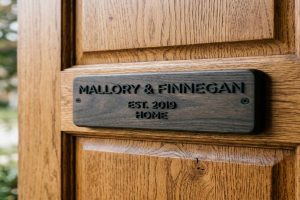
Your home’s name plate is the first word your space speaks, and a modern mailbox name plate can significantly enhance this first impression. A carefully chosen artisan piece communicates craftsmanship, identity, and taste — long before a visitor steps through the door. This guide walks you through every decision: from raw material science and style selection to professional-grade installation and design curation.
📥 Download the Printable Checklist: Ready to design your perfect name plate? Download our free Custom Artisan Name Plate Design Checklist — print it and use it step by step.
What Is a Custom Artisan Name Plate — and Why Does It Matter More Than You Think?
A custom artisan name plate is a handcrafted or precision-fabricated identification piece that integrates your name, house number, or family identity into a durable substrate — whether metal, wood, acrylic, resin, or stone. Unlike mass-produced signs, custom engraved name plates are made with material-specific techniques: hand-engraving, laser etching, kiln-firing, or resin casting.
The distinction matters. Artisan pieces carry higher tolerance for detail, greater longevity in variable climates, and a visual depth that mass-produced plates cannot replicate. Research in environmental psychology consistently confirms that entrance signage is among the first elements a visitor consciously registers — making material quality and presentation a direct signal of property character.
Expert Note: When specifying tolerances for a hand-engraved brass plate, a digital depth gauge micrometer with 0.001-inch resolution is used to verify consistent engraving depth across the C36000 free-cutting brass alloy substrate (ASTM B16/B16M standard). This ensures the plate meets the dimensional accuracy requirements of ASTM B124/B124M, the specification governing copper and copper-alloy forged and rolled rod, bar, and shapes used in architectural hardware and signage applications.
Which Name Plate Material Lasts the Longest Outdoors?
Material durability is not a single variable — it is a function of alloy composition, surface treatment, UV exposure index, and moisture cycling. Choosing a material without understanding these factors leads to premature fading, corrosion pitting, or surface delamination.
| Material | Outdoor Lifespan | UV Resistance | Corrosion Resistance | Maintenance Required |
| 316 Marine-Grade Stainless Steel | 25–40 years | Excellent | Excellent | Annual wipe-down |
| Architectural Brass (C26000) | 15–30 years | Good | Good (with lacquer) | Bi-annual polish |
| Anodized Aluminum (6061-T6) | 20–35 years | Excellent | Excellent | Minimal |
| Cast Resin (UV-stabilized) | 8–15 years | Fair | Excellent | Yearly UV coat |
| Teak Wood (kiln-dried) | 10–20 years | Fair | Good (with sealant) | Annual re-seal |
| Acrylic (cast, not extruded) | 10–20 years | Good (UV-grade only) | Excellent | Minimal |
| Marble / Granite | 30–50+ years | Excellent | Excellent | Sealing every 2 years |
Expert Note: When evaluating corrosion resistance of outdoor metal name plates, a handheld X-ray fluorescence (XRF) alloy analyzer is used to verify the exact elemental composition of the 316L stainless steel substrate (containing ≥2% molybdenum). This confirms compliance with ASTM A240/A240M, the specification for chromium and chromium-nickel stainless steel plate used in pressure vessel and architectural applications.
What Are the Most Popular Artisan Name Plate Styles in 2026?
Style selection should be rooted in architectural harmony, not trend chasing. The best artisan plate echoes the material palette, proportional language, and era of your structure. Here are the four dominant style frameworks active in 2026:
Modern Minimalist
- Clean sans-serif typography (Helvetica Neue, Futura, or Inter)
- Monochromatic or metallic palette: brushed nickel, matte black, raw aluminum
- Negative space as a design element — less text, larger kerning
- Best materials: anodized aluminum, cast acrylic, sandblasted glass
Traditional / Vintage
- Serif or script typefaces (Garamond, Copperplate, Edwardian Script)
- Warm tonal palettes: antique brass, burnished bronze, mahogany wood
- Decorative borders, corner motifs, or family crest integration
- Best materials: C26000 cartridge brass, white oak, hand-cast iron
Artistic / Bespoke
- Thematic or illustrative — coastal motifs, botanical engravings, abstract resin pours
- Mixed-media composition: wood + metal inlay, resin + river stone, ceramic + brass lettering
- Fully custom artwork, no standard catalog templates
- Best materials: epoxy resin with pigment, live-edge hardwood, hand-painted ceramic
Industrial Chic
- Raw or weathered finishes: corten steel, oxidized copper, reclaimed wood
- Bold block lettering with intentional imperfection
- Exposed hardware as a decorative element (rivets, raw weld seams)
- Best materials: Corten A weathering steel, reclaimed Douglas fir, raw copper sheet
Expert Note: When creating a mixed-media artisan plate combining copper sheet and live-edge walnut, a pneumatic pin nailer with a 23-gauge 1-inch stainless pin magazine is used to affix the C11000 electrolytic tough-pitch copper sheet (0.032-inch gauge) to the walnut substrate without splitting the grain. The assembly method conforms to ASTM B187, the specification for copper bar, bus bar, and rod used in architectural and electrical applications.
How Do You Choose the Right Name Plate Style for Your Home’s Architecture?
Matching plate style to architectural vocabulary is a discipline, not guesswork. Use this diagnostic framework:
| Home Architecture Type | Recommended Style | Ideal Material | Avoid |
| Colonial / Georgian | Traditional/Vintage | Brass, mahogany | Acrylic, matte black |
| Mid-Century Modern | Minimalist | Anodized aluminum, brushed steel | Ornate motifs, serif fonts |
| Craftsman / Bungalow | Artistic / Bespoke | Teak, hammered copper | High-gloss finishes |
| Contemporary / Flat-roof | Industrial Chic | Corten steel, smoked acrylic | Antique tones |
| Mediterranean / Spanish | Traditional/Vintage | Terracotta tile, wrought iron | Sans-serif typography |
| Farmhouse / Rural | Artistic / Bespoke | Reclaimed wood, resin | Chrome finishes |
| Apartment / Urban | Minimalist | Cast acrylic, stainless | Heavily textured materials |
The proportional rule: your name plate’s width should be no more than 40% of the width of your door frame, and its height should not exceed 15% of the door panel height. This ratio prevents visual imbalance regardless of style.
🛍️ Browse by Architecture Style: Explore our Traditional Name Plates, Modern Minimalist Plates, and Bespoke Artisan Plates — all available with custom engraving.
Expert Note: When sizing a name plate to a heritage-classified door frame, a laser distance meter with Pythagorean measurement mode is used to capture the precise door frame dimensions of the mortise-and-tenon Douglas fir frame (seasoned to ≤19% MC per ASTM D245). The proportional compliance aligns with ICC A117.1 Section 703.5, the accessibility and dimensional requirements for visual characters on architectural signage.
What Is the Best Material for an Indoor Office Name Plate?
Indoor environments present a different optimization target: aesthetics, professional authority, and ease of replacement outweigh weather-resistance concerns. The top materials for office use are:
- Sublimation-coated aluminum panels: Allow full-color, photo-quality printing at industrial resolution (300+ DPI). Edges are clean and the substrate is lightweight.
- Cast acrylic with vinyl lettering: High-contrast readability, available in frosted, clear, or solid colors. Standard for corporate environments.
- Anodized aluminum with laser engraving: Premium option with permanent lettering — no ink fading over time. Works well for executive desk plates and door signage.
- Bamboo composite boards: Sustainable alternative with a warm, natural texture. Well-suited to wellness, creative, or eco-conscious office brands.
- Brass desk plates: Classic executive presence. Engraved with rotary cutters for crisp, deep letter channels.
Expert Note: When producing an anodized aluminum executive name plate, a rotary engraving machine with a 60-degree diamond-drag carbide bit is used to mill into Type II anodized 6061-T6 aluminum sheet (0.080-inch gauge). The anodize layer depth must comply with MIL-A-8625 Type II, the military specification for anodic coatings on aluminum and aluminum alloys, which mandates a minimum coating thickness of 0.0002 inches for interior architectural use.
How Are Artisan Name Plates Made? A Behind-the-Scenes Look at the Craft
Understanding the fabrication process helps you evaluate quality — and ask the right questions when ordering. Here is the step-by-step production pathway for the most common artisan plate types:
Brass Engraved Name Plates
- Blank cutting: Sheet brass is sheared to dimension using a hydraulic guillotine press
- Surface preparation: Plates are buffed to a mirror or satin finish with progressively fine grit
- Layout masking: Letter positions are taped or digitally plotted using CAD templates
- Engraving: Rotary or pantograph engravers cut letter channels to consistent depth
- Fill & cure: Engraved recesses are filled with black or colored enamel paint and oven-cured
- Lacquering: A clear lacquer topcoat (typically nitrocellulose or polyurethane) is applied
Resin Cast Name Plates
- Mold preparation: A silicone negative mold is cast from a master model
- Pigment mixing: Epoxy resin is combined with UV-stabilizing pigments at a 2:1 ratio
- Pouring: Pigmented resin is poured in layers; inclusions (stones, flowers, glitter) are placed between layers
- Cure cycle: Plates cure at room temperature for 24–48 hours, then oven-post-cure at 60°C
- Demolding & sanding: Cured plate is removed, edges sanded to 400-grit, then buffed
Expert Note: During the resin cure cycle for artisan name plates, a digital thermocouple thermometer with Type K probe is used to monitor the exothermic temperature of the curing bisphenol-A epoxy resin system (formulated per ASTM D1763). Maintaining temperatures below 60°C during ambient cure prevents thermal crazing, as required by ASTM D4986, the standard test for resistance of plastics to combustion and thermal degradation.
What Are the Most Common Name Plate Design Mistakes to Avoid?
Even well-chosen materials can produce a poor result if the design execution falls short. Here are the seven most costly mistakes and how to avoid them:
| Mistake | Cause | Fix |
| Illegible font at distance | Decorative fonts with thin strokes | Use sans-serif or bold serif; min 18pt at reading distance |
| Low contrast ratio | Text color too close to background tone | Target 4.5:1 contrast ratio per WCAG 2.1 AA |
| Oversized plate | No proportional check against door frame | Follow 40% width / 15% height door frame rule |
| Underprepared wood outdoors | Raw wood with no UV/moisture sealant | Apply 3 coats of marine-grade spar varnish |
| Exposed fasteners corroding | Mismatched metals (steel screw into brass plate) | Use fasteners of matching alloy or nylon-sleeved stainless |
| No UV topcoat on resin | UV-reactive pigments breaking down | Apply Krylon UV-Archival or equivalent UV-blocking varnish |
| Off-center mounting | Not measuring from door centerline | Use a laser level to mark horizontal and vertical centerlines |
Expert Note: To verify the contrast ratio of a name plate design before fabrication, a digital colorimeter with CIE Lab* measurement mode is used to measure the luminance values of the pigment-dispersed acrylic surface coating (formulated per ASTM D5667). The 4.5:1 minimum contrast ratio requirement is established in WCAG 2.1 Success Criterion 1.4.3, incorporated by reference in ADA Title III signage compliance guidelines for public-facing identification signs.

Which Font Style Works Best for a Custom Name Plate?
Typography on a name plate serves one primary function: legibility at distance, in variable lighting conditions. Secondary function: aesthetic harmony with the substrate and style context.
Font Selection by Environment
| Environment | Recommended Font Class | Example Fonts | Minimum Size |
| Outdoor residential gate | Bold sans-serif | Futura Bold, Bebas Neue | 48pt |
| Office door plate | Medium sans-serif | Helvetica Neue, Inter Medium | 18pt |
| Executive desk plate | Serif or small caps | Garamond Bold, Trajan Pro | 14pt |
| Artistic/bespoke plate | Script or hand-lettered | Copperplate, custom calligraphy | 24pt |
| Industrial/corten plate | Block, stencil | Impact, Knockout | 60pt |
Kerning Rule: Increase letter spacing by 10–15% above default for any text smaller than 36pt on outdoor plates. This maintains legibility as viewing distance increases.
Stroke Width Rule: At any size, the thinnest visible stroke in the letterform should be no less than 3mm when fabricated in metal or engraved in wood.
Expert Note: When laser-engraving custom typography into a wood substrate, a fiber-coupled diode laser engraver with variable pulse frequency (20–80 kHz range) is used to precisely ablate the kiln-dried black walnut substrate (Juglans nigra, air-dried to 6–8% MC per NHLA grading rules). Engraving depth and character edge definition conform to the dimensional requirements of ANSI/BHMA A156.10, the standard for power-operated pedestrian doors and architectural signage components.
How Do You Install a Name Plate Without Damaging Your Wall or Door?
Improper installation is the leading cause of name plate failure. The correct method depends on substrate, plate weight, and environmental exposure. Here are the three professional installation methods:
Method 1: Concealed Screw Mounting (Best for Heavy Metal Plates)
- Mark the drill centerpoints with a laser level aligned to the door frame centerline
- Drill pilot holes with a masonry or wood drill bit matching the fastener diameter
- Insert M5 stainless hex-socket screws with neoprene washers behind the plate
- Torque to 4–5 Nm — never overtighten on stone or ceramic substrates
- Apply clear silicone bead to the perimeter to seal against water ingress
Method 2: Adhesive Mounting (Best for Lightweight Acrylic and Thin Aluminum)
- Clean mounting surface with isopropyl alcohol (90%+) and allow to dry fully
- Cut VHB (Very High Bond) foam tape to match the plate’s perimeter
- Remove liner and press plate firmly for 30 seconds with even pressure
- Allow full cure for 72 hours before exposure to rain or direct sunlight
Method 3: Standoff Mount (Best for Acrylic, Glass, or Artistic Plates)
- Mark drill points from a paper template
- Install M6 brass or stainless barrel standoffs into anchored wall plugs
- Slide plate onto standoff posts — plate floats 6–10mm off the wall surface
- This creates a shadow line that emphasizes the plate’s three-dimensional quality
Expert Note: When installing a heavy granite name plate on a masonry wall, a rotary hammer drill with SDS-plus chuck in hammer-drill mode is used to drive M6 × 60mm stainless steel sleeve anchors into the Portland cement mortar joint. Installation torque must comply with ICC-ES ESR-2708, the evaluation report for anchor fasteners in concrete and masonry that establishes minimum embedment depth and edge distance requirements for safe load transfer.
How Can You Curate Your Space With a Name Plate as an Anchor Piece?
A name plate is not a standalone object — it is an anchor in an entrance composition. Skilled curation treats the name plate as one element in a layered visual ensemble. Here is the compositional framework:
The Three-Layer Entry Composition
Layer 1 — Foundation: The name plate itself. Centered or right-of-door at chest height (48–54 inches from ground).
Layer 2 — Framing Elements:
- A climbing plant or potted specimen flanking the door
- An outdoor lantern or wall sconce at eye level on the opposite side
- Door hardware (knocker, handle, mail slot) in a matching or complementary metal finish
Layer 3 — Ground Anchors:
- A door mat with dimensional texture (natural coir, stone mosaic, or cast iron grid)
- Flanking planters or stone bollards that define the entry zone width
The Coherence Rule: All metal finishes within 36 inches of the name plate should share the same tonal family: warm (gold, brass, bronze) or cool (silver, nickel, pewter). Mixed finish families within this proximity zone create visual noise.
Expert Note: When matching the finish of an outdoor wall sconce to a brass name plate, a spectrophotometer with D65 illuminant setting is used to compare the CIE Lab color coordinates of the lacquered C26000 cartridge brass surface (ASTM B36/B36M) against the sconce’s powder-coat finish. Finish harmony within a 2ΔE tolerance is considered a perceptually imperceptible difference, per *CIE Publication 15.3:2004, which defines colorimetric standards for architectural surface matching.
What Makes a Name Plate Truly “Artisan” vs. Mass-Produced?
The term “artisan” is sometimes used loosely. Here is how to evaluate whether a name plate genuinely qualifies:
- Substrate selectivity: Artisan makers specify alloy grades and wood species by name — not just “metal” or “wood”
- Process signature: Each plate shows evidence of human involvement: hand-finishing, variable engraving depth, or unique pour patterns in resin
- Batch size: Genuine artisan production runs in units of 1–50, not thousands
- Material sourcing transparency: Artisan makers can name the mill, quarry, or supplier of their materials
- Customization depth: Size, font, finish, and substrate are all independently adjustable — not constrained to pre-set catalog SKUs
Expert Note: To authenticate the origin and composition of a claimed “hand-cast bronze” name plate, a portable optical emission spectrometer (OES) with arc-spark source is used to analyze the elemental profile of the C90300 tin bronze casting alloy (per ASTM B505/B505M). This spectrometry confirms the copper-tin-zinc ratio required by the standard, which governs composition of copper alloy castings used in decorative and architectural applications.
How Do You Maintain and Restore an Artisan Name Plate Over Time?
Maintenance needs vary dramatically by material. Following an incorrect maintenance routine is worse than no maintenance — it can accelerate surface damage.
| Material | Cleaning Method | Restoration (When Dull/Pitted) | Frequency |
| Brass | Mild dish soap + soft cloth; never abrasive pads | Renaissance Wax or Brasso polish | Every 6 months |
| Stainless Steel | Grain-direction wiping with microfiber + isopropyl | Fine Scotch-Brite in direction of grain | Annually |
| Anodized Aluminum | pH-neutral cleaner + soft cloth | Not restorable — requires re-anodizing | Every 3–4 months |
| UV-Cast Acrylic | Plexus Plastic Cleaner; avoid ammonia | Automotive plastic polish (e.g., Meguiar’s G12) | Every 3 months |
| Teak / Hardwood | Linseed oil wipe; never pressure wash | Sand to 220-grit, re-seal with marine varnish | Every 12 months |
| Resin | Mild soap and water; no solvents | UV topcoat re-application every 2–3 years | Every 6 months |
Expert Note: When restoring a tarnished architectural brass name plate, a variable-speed orbital polisher with 5-inch foam pad (800–2,000 RPM range) is used with semi-chrome metal polish compound applied to the C26000 brass surface. Post-polish, a nitrocellulose lacquer topcoat is applied at 1.5–2.0 mils dry film thickness, meeting the durability requirements of ASTM D4228, the standard guide for qualification of coating systems for concrete and steel exposed to chemical environments.
What Are the Best Artisan Name Plate Options for a Rental or Temporary Space?
Not every name plate installation is permanent. Renters, temporary office tenants, and seasonal residents need solutions that deliver artisan quality without structural commitment.
- Acrylic with VHB adhesive backing: Removal leaves minimal residue; use a heat gun at low setting (40–50°C) to release adhesive cleanly
- Magnetic base plates: A hidden steel sheet adhered to the surface allows the artisan plate to be swapped seasonally or repositioned
- Freestanding or pedestal-mount plates: Slate, granite, or wood plates set into a cast-iron or powder-coated steel pedestal — no drilling required
- Door-hung nameplate holders: Hook-over-door brass or iron holders accommodate plates up to 400g without any adhesive or fastener
Expert Note: When designing a magnetic-mount artisan name plate system, a pull-force gauge with 50-lb capacity and digital readout is used to verify the retention strength of N52-grade neodymium disc magnets (25mm × 5mm) bonded to the steel backer plate. The magnet assembly must generate a pull force of no less than 8 lbs per 100cm² of contact area, consistent with the load transfer requirements described in ASTM F963-23, the consumer product safety standard for toy magnets and adhesive magnetic systems.
🛍️ Ready to Order? Browse our full collection of Custom Artisan Name Plates — handcrafted in brass, stainless steel, acrylic, wood, and resin. Free engraving on all orders over $75.
Frequently Asked Questions About Custom Artisan Name Plates
What is the average cost of a custom artisan name plate?
Hand-crafted artisan name plates range from $45 for small cast resin pieces to $350+ for custom-engraved architectural brass or granite-carved plates. Desk plates and indoor plates typically cost $25–$90. Outdoor entry plates with complex engraving or mixed materials range from $120–$500+.
How long does it take to make a custom artisan name plate?
Standard custom plates with laser engraving are ready in 5–10 business days. Hand-engraved or resin-cast bespoke plates typically require 2–4 weeks due to cure cycles, hand-finishing, and quality checks.
Can a resin name plate be used outdoors year-round?
Yes, provided it uses a UV-stabilized epoxy resin system and receives an annual UV topcoat application. Resin plates in direct tropical sun should be replaced every 8–10 years regardless of care.
What font size is readable on a name plate at 15 feet?
At 15 feet (4.5 meters), a minimum character height of 2 inches (50mm) is required for reliable daytime readability. For dusk or nighttime legibility without lighting, increase to 3 inches (75mm) and use high-contrast colors.
Is there a difference between cast acrylic and extruded acrylic for name plates?
Yes. Cast acrylic is poured into molds and is denser, optically clearer, and more dimensionally stable. Extruded acrylic is continuous-formed and cheaper, but more prone to stress cracking and surface hazing over time. Always specify cast acrylic for outdoor use.
How do I prevent my brass name plate from tarnishing quickly?
Apply a clear lacquer topcoat immediately after polishing. Lacquer-coated brass plates slow tarnish by 70–80% compared to uncoated surfaces. Reapply lacquer every 2–3 years or whenever the finish shows yellowing.
What material is safest for a name plate near a pool or coastal environment?
316L marine-grade stainless steel is the only metal substrate that reliably withstands chlorine, salt spray, and humidity cycling without surface pitting. Anodized 6061-T6 aluminum is the second choice.
Can I engrave a logo or family crest on a name plate?
Yes. Vector artwork (SVG, AI, or EPS format) at minimum 300 DPI equivalent is required for laser or rotary engraving. Complex crests with fine heraldic detail engrave best into brass or stainless steel at 1/4″ depth.
How do I center a name plate on an asymmetric door?
Use the visual center of the door panel — not the mechanical center. Find the midpoint between the visible door edges (excluding the frame) and align horizontally. Vertically, mount at the optical center of the upper two-thirds of the door panel.
Are there custom artisan name plates suitable for apartment interiors?
Yes. Slim, lightweight plates in anodized aluminum, cast acrylic, or bamboo composite are ideal for apartment doors and mailboxes. Maximum recommended weight for adhesive mounting is 400g without mechanical fasteners.
Explore Essential House Name Plate Guides & Tutorials
Browse our comprehensive handcrafted signage guides for material care, font selection, and architectural placement:
- Beach & Airbnb Signage Design & Weatherproofing Guide (2026)
- Complete Guide to Wood House Sign Sealing & Weather Maintenance
- Horizontal vs Vertical House Numbers Layout Comparison
- Hanging & Wall-Mounted Cottage Sign Installation Guide
- Round vs Rectangular Name Plaques for Modern Property Entrances
- Best Modern & Vintage Fonts for Cottage & Residential Signs