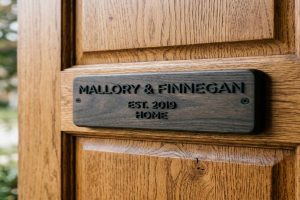
A mailbox name plate is one of the smallest signs on your property and one of the most seen. Every postal delivery, every visitor, every delivery driver looks at it. If the plate is faded, peeling, or unreadable, it creates a bad first impression before anyone even reaches your front door.
A good mailbox name plate does three things well. It shows your house number and family name clearly. It stands up to years of sun, rain, and heat without fading or falling off. And it looks good enough that it adds to the curb appeal of your property rather than detracting from it.
In 2026, the choices available are better than ever. You can get anodised aluminium plates that last 25 years, handmade ceramic plates that look like artwork, high-grade vinyl decals that are easy to replace, or cast bronze plaques that develop a beautiful patina. The challenge is knowing which one is right for your mailbox type, your climate, and your budget.
This guide covers every material available, explains how each one performs outdoors, and shows you how to mount your plate securely and keep it looking good for years.
📥 Download Free: Print our Mailbox Name Plate Selection Checklist PDF and use it before you order.
What Is a Mailbox Name Plate and Why Should You Upgrade Yours?
A mailbox name plate is a small sign mounted on or near your mailbox that shows your house number, family name, or both. It may be mounted directly on the mailbox body, on the post the mailbox sits on, or on a separate bracket nearby.
The practical purpose is simple: it helps postal workers, delivery drivers, and visitors identify your address quickly and accurately. In the United States, USPS guidelines require that street numbers be clearly visible on or near the mailbox. In the UK, Australia, and India, local authorities and postal services have similar requirements.
Beyond the practical purpose, a mailbox name plate is one of the fastest ways to improve the curb appeal of your home’s exterior. A fresh, clean, well-designed plate makes the whole mailbox area look cared for and attractive. An old, faded, or peeling plate does the opposite.
The most common reasons to upgrade a mailbox name plate are:
- The existing plate has faded or become unreadable
- The plate material has corroded, chipped, or peeled
- The adhesive has failed and the plate has fallen off
- You want to improve the look of the mailbox to match a new exterior design
- You have just had the mailbox replaced and need a new plate to match
If any of these apply, the decision is straightforward. The only question is which material and style to choose.
Expert Note: When selecting a powder-coated aluminium mailbox name plate for a residential property and wanting to verify that the powder coat finish on the back face (which contacts the mailbox surface and is continuously exposed to the moisture and heat trapped between the plate and the mailbox body) has adequate corrosion resistance under cyclic real-world conditions, a cyclic corrosion test (CCT) chamber using the Prohesion modified salt spray method is used. The Prohesion method alternates between a 0.35% ammonium sulphate and 0.05% sodium chloride salt fog spray phase (1 hour at 24 degrees Celsius and 100% relative humidity) and a dry-off phase (1 hour at 35 degrees Celsius and 30% relative humidity) continuously for 500 hours. This cycling between wet and dry phases more accurately replicates real-world outdoor corrosion than constant salt fog. The powder coat passes if no blistering, loss of adhesion, or red rust appears at a scribe line cut through the coating after 500 hours of Prohesion cycling. Cyclic corrosion testing follows ASTM G85 Annex A5 (Standard Practice for Modified Salt Spray Fog Testing: Dilute Electrolyte Cyclic Fog/Dry Test: Prohesion Test), which is widely accepted by the outdoor signage industry as more representative of real outdoor corrosion than ASTM B117 constant salt fog.
What Materials Are Best for a Mailbox Name Plate?
The material determines everything else: how long the plate lasts, how it looks, what it costs, and how easy it is to maintain. Here is a clear breakdown of every major option available in 2026.
Anodised aluminium (best all-round option) Anodised aluminium is the top choice for a mailbox name plate that will last 20 to 25 years outdoors without significant maintenance. The anodising process converts the outer surface of the aluminium into a layer of aluminium oxide, which is extremely hard, chemically inert, and permanently bonded to the aluminium below.
The anodised layer cannot peel or flake because it is not a coating applied on top of the metal. It is part of the metal itself. This means it cannot be undercut by moisture the way paint and powder coat can. Anodised aluminium comes in a range of colours (natural silver, bronze anodise, black anodise, gold anodise) and is available in brushed or smooth surface textures.
Text on anodised plates is typically laser engraved through the anodised layer or dye-filled for colour contrast. Laser-engraved text is essentially permanent: it cannot be scratched off, faded, or peeled.
Powder-coated aluminium or steel Powder-coated metal plates are the most popular choice because they offer a very high-quality finish at a moderate price. The powder coat is applied electrostatically and baked at 180 to 200 degrees Celsius. This produces a finish that is harder, more durable, and more chemically resistant than liquid paint.
A quality PVDF powder coat (polyvinyl fluoride) gives 20 to 25 years of exterior colour stability. A standard polyester powder coat gives 10 to 15 years. When buying a powder-coated plate, always ask which powder type is used: PVDF or polyester.
Grade 316 stainless steel Stainless steel plates are the best choice for coastal properties within 5km of the sea. Grade 316 stainless steel contains molybdenum, which gives it superior resistance to chloride pitting corrosion from salt air. It will not rust in any normal outdoor environment. The surface can be brushed, polished, or satin-finished.
Stainless steel plates are heavier and more expensive than aluminium, but they are nearly indestructible outdoors.
Ceramic and porcelain Ceramic and porcelain plates have a handcrafted, artistic appearance that no metal plate can replicate. The glaze is fired at high temperature, making it chemically stable and highly UV-resistant. Ceramic colours do not fade because the colour is part of the glaze itself, not a surface applied paint.
The limitation of ceramic is brittleness. A strong impact (from a lawnmower stone, a hailstone, or vandalism) can chip or crack a ceramic plate. Also, in climates with very cold winters (below minus 10 degrees Celsius), ceramic plates can crack if water penetrates a microscopic surface imperfection and expands during freezing.
Cast acrylic High-grade cast acrylic is UV-stable, lightweight, and comes in an enormous range of colours and translucent finishes. It is the best option for a sign with very vibrant colours that are not achievable in metal. Acrylic plates are often laser cut into custom shapes. Outdoor grade cast acrylic (as opposed to extruded acrylic) lasts 10 to 15 years before surface crazing begins.
Premium vinyl decal Vinyl decals are the most affordable option. They are applied directly to the mailbox surface or to a metal backing plate. Premium outdoor vinyl (such as Oracal 951, Avery MPI 1005, or 3M Series 1080) is rated for 7 to 8 years of outdoor life with no significant fading. Budget vinyl lasts 2 to 4 years.
Vinyl is ideal for a quick, clean, easily replaceable address display. It is not a premium option but it performs very well for its price.
| Material | Typical Lifespan | UV Resistance | Impact Resistance | Best Climate |
| Anodised aluminium | 20 to 25 years | Excellent | High | All climates |
| Powder-coated aluminium | 10 to 20 years | High (PVDF) / Medium (polyester) | High | All climates |
| Grade 316 stainless | 30+ years | Excellent | Very high | All, ideal coastal |
| Ceramic or porcelain | 10 to 20 years (sheltered) | Excellent | Low (brittle) | Mild, sheltered |
| Cast acrylic | 8 to 12 years | Good (cast) | Medium | Mild to moderate |
| Premium vinyl decal | 5 to 8 years | Good (premium grade) | Very low | Mild to moderate |
Expert Note: When evaluating the surface hardness and scratch resistance of two candidate mailbox name plate materials (anodised aluminium and a newly developed ceramic-polymer composite) to determine which is more resistant to the everyday abrasion from mail delivery contact and casual vandalism, a Vickers microhardness tester with 136-degree square pyramid diamond indenter, 100g to 1kg indenter load range, calibrated optical microscope with 40x objective for diagonal measurement, and 0.1 HV display resolution is used to measure the Vickers Hardness Number (HV) of each material’s surface at 10 measurement points spaced 2mm apart. Hard-anodised aluminium typically shows 300 to 500 HV. A standard polyester powder coat shows 20 to 30 HV. A vitrified porcelain ceramic glaze shows 600 to 800 HV. Higher HV indicates greater resistance to scratch damage from casual contact. Materials below 50 HV require a harder protective top coat for mailbox applications where daily contact with mail and human hands is expected. Vickers microhardness measurement follows ASTM E384-22 (Standard Test Method for Microindentation Hardness of Materials), the primary standard for microhardness measurement of coatings, films, and surface layers on engineering materials.
What Are the Most Durable Coatings and Finishes for a Mailbox Name Plate?
The coating is what the eye sees and what the weather attacks first. Choosing the right coating for your plate material and climate makes the difference between a plate that looks good for 20 years and one that starts chalking and fading within 3.
PVDF (polyvinylidene fluoride) powder coat PVDF powder coat is used on commercial and architectural aluminium products designed for 20 to 25 years of outdoor service. It contains a very high percentage of fluoropolymer resin that is chemically inert to UV radiation, ozone, and atmospheric pollutants. PVDF coatings maintain their colour and gloss for significantly longer than standard polyester coatings.
The limitation is cost and availability. Most consumer-grade mailbox plates use standard polyester powder coat, not PVDF. If you want PVDF, ask specifically for it and expect to pay more.
Hard anodise (Type III anodising) Hard anodising is a special anodising process that produces a thicker and harder anodised layer than standard decorative anodising. Standard anodise (Type II) produces a 10 to 25 micrometre layer. Hard anodise (Type III) produces a 25 to 150 micrometre layer at the same or greater hardness.
For a mailbox plate, hard anodise gives the most durable surface available on any aluminium product. It is used on aircraft components, military equipment, and industrial machinery for very good reasons. A hard-anodised mailbox plate surface is genuinely resistant to all but the most determined abrasive damage.
Marine-grade clear lacquer (for bronze and brass) Bronze and brass mailbox name plates develop a natural patina (a surface oxide layer) that many people consider attractive and premium. If you prefer the original bright metal tone, a clear lacquer rated for marine environments must be applied over the clean metal surface.
Marine clear lacquers (such as Epifanes, Interlux Schooner, or Awlgrip topcoat) are rated for 3 to 5 years before recoating is needed on a fully exposed surface. In a sheltered position (under a porch roof, for example), the lacquer lasts 6 to 8 years.
Dye-sublimation print on aluminium (photo-realistic printing) Dye-sublimation printing uses heat to bond dye molecules directly into the surface of the aluminium. The result is a full-colour photographic-quality image that is embedded in the aluminium surface rather than sitting on top of it. It cannot peel or flake. It is highly UV-resistant because quality sublimation inks are formulated with UV-stable dye chemistry.
This technology is ideal for decorative house name plates with custom artwork or logos. The lifespan of a quality dye-sublimation print on anodised aluminium is 10 to 15 years outdoors.
Expert Note: When quality-checking a batch of incoming powder-coated aluminium mailbox name plates from a new supplier to verify the dry film thickness (DFT) of the powder coat meets the specified 60 to 80 micrometre range (the standard for quality outdoor powder coat), a non-contact eddy current dry film thickness gauge with 0.1 micrometre resolution, 5mm diameter probe head, automatic substrate compensation for aluminium (non-ferrous metal), and temperature-corrected display is used to measure the DFT at 5 measurement positions on each plate (centre, left, right, top, bottom). Powder coat below 50 micrometres is undersized and will have shorter outdoor durability. Powder coat above 120 micrometres may show edge pull-back (thinning at plate edges) which is a common failure point. Five readings below 50 micrometres on any single plate cause rejection of that plate. Dry film thickness measurement on non-ferrous metal substrates (aluminium) follows ASTM D1400-00 (Standard Test Method for Nondestructive Measurement of Dry Film Thickness of Nonconductive Coatings Applied to a Nonferrous Metal Base), the standard eddy current method for paint and powder coat DFT verification on aluminium.
How Do You Choose the Right Size and Font for a Mailbox Name Plate?
The most important function of a mailbox name plate is readability. A beautiful plate that cannot be read quickly by a postal worker or a driver approaching from the street has failed its primary purpose.
Size rules for mailbox name plates: For a plate mounted directly on a standard residential mailbox (typical mailbox width 200 to 250mm), the plate should be no wider than 200mm and no taller than 60mm. For a plate mounted on the mailbox post, a slightly larger format (up to 300mm wide and 80mm tall) is proportionally appropriate.
For house number digits only, the minimum recommended digit height is 25mm for a plate viewed from a standing position at 1 to 2 metres. For a plate on a post-mounted mailbox viewed from a car at 5 to 10 metres, the minimum digit height is 50mm.
Font choice rules: Use only clean, simple, readable fonts for mailbox name plates. The best fonts for outdoor postal addresses are: Helvetica, Arial, Gill Sans, Calibri, and Franklin Gothic. For a more traditional or heritage look, Trajan, Garamond, or Baskerville are good serif choices.
Avoid: script or cursive fonts (hard to read at a glance), novelty or decorative display fonts (hard to read for older visitors or in poor light), and very thin or light-weight fonts (hairline strokes disappear at 5 metres on a small plate).
Contrast rules: Dark text on a light background is slightly more legible than light text on a dark background for close viewing (1 to 3 metres). However, for longer distances (5 to 10 metres, from a slow-moving vehicle), light text on a very dark background provides better contrast under typical daytime conditions. The minimum luminance contrast ratio for clear outdoor text readability is 3:1.
The highest contrast combinations for mailbox name plates:
- Black or dark navy letters on natural aluminium or white
- White or cream letters on black, dark navy, or dark green
- Gold letters on black or dark charcoal
- Black letters on cream or buff sandstone-toned background
Expert Note: When testing whether the acrylic adhesive used on a self-adhesive vinyl mailbox name plate will maintain its bond on a curved cylindrical mailbox post (75mm diameter powder-coated steel post) after 5 years of outdoor temperature cycling, a 180-degree peel adhesion test on a curved substrate using a tensile testing machine with a 180-degree peel jig specifically designed for cylindrical substrates, 50mm wide test strips of the vinyl name plate material applied to 75mm diameter curved aluminium mandrels matching the post geometry, and a 300mm/min peel rate is used to measure the peel force (in Newton per 25mm width) after conditioning at minus 20 degrees Celsius for 16 hours, then plus 70 degrees Celsius for 16 hours, repeated for 10 full cycles. A peel force below 3.0 N/25mm after thermal cycling indicates the adhesive has insufficient bond to the curved surface and will fail in real-world use. Peel adhesion on curved substrates follows ASTM D6252/D6252M-98 (Standard Test Method for Peel Adhesion of Pressure-Sensitive Label Stocks on Curved Substrates), the specific standard for adhesive performance on curved and cylindrical surfaces.
What Adhesive or Mounting Method Keeps a Mailbox Name Plate Secure?
The mounting method determines how permanently the plate is fixed, how easy it is to remove or replace, and whether it leaves any damage on the mailbox surface.
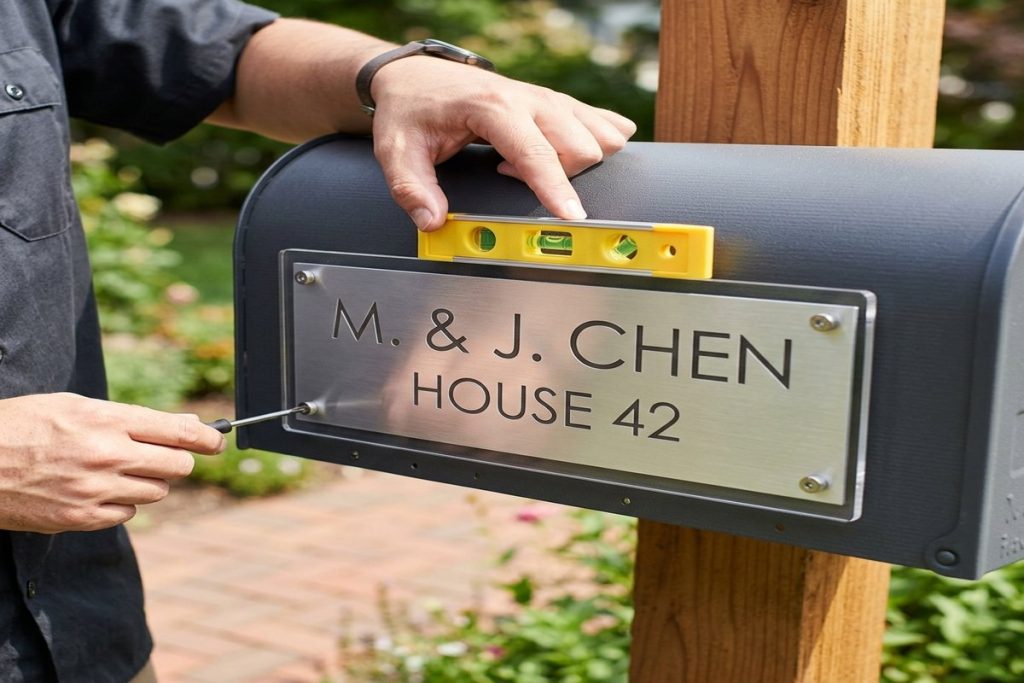
Method 1: Stainless steel screws (most secure) Drilling two small holes through the plate and into the mailbox body and securing with M4 or M5 Grade 316 stainless steel screws gives the most permanent and weather-resistant fixing. The screws cannot be pulled off by wind, vandals, or mail delivery impact. This method is suitable for any metal mailbox with a flat face.
Use rubber-backed washers under the screw heads to prevent water from tracking into the screw holes. Also, apply a small dab of clear neutral-cure silicone sealant around each screw head after installation to waterproof the fixing.
Method 2: 3M VHB acrylic foam tape (clean-look option) VHB (Very High Bond) foam tape is a structural adhesive tape that bonds permanently to most metal and plastic surfaces. 3M VHB series 5952 (black, 2.3mm thick) is rated for outdoor structural bonding and gives a bond strength of 80 to 140 N/cm2 on clean metal surfaces. For a 150mm x 50mm mailbox plate, this provides a total bond area of 75 square centimetres and a total bond force of 6,000 to 10,500 Newton. This is far more than sufficient for a plate weighing under 200 grams.
VHB tape gives a clean look because there are no visible screws. The plate appears to float on the mailbox surface. The limitation is that VHB bonds are very difficult to remove without damaging the mailbox surface or the back of the plate. Plan this as a permanent installation.
Method 3: Clear acrylic standoffs (floating effect) For a premium contemporary look, clear acrylic or stainless steel standoff barrels mount through holes in the plate and into the mailbox body (or into a backing panel on the post). The plate sits 10 to 20mm away from the surface with a visible gap that creates a three-dimensional floating effect.
Standoffs are particularly effective with brushed aluminium or acrylic plates because the gap casts a soft shadow that makes the plate look architectural. They require 4 fixing points, which is more secure than 2-screw mounting.
Method 4: Magnetic mounting (for steel mailboxes only) Strong rare-earth (neodymium) magnets embedded in the back of the plate allow tool-free attachment and removal from steel mailbox surfaces. This is ideal if you want to be able to remove the plate for winter storage or replacement without any fixing damage to the mailbox.
The limitation: magnets cannot be used on aluminium, plastic, or non-ferrous metal mailboxes (only magnetic steel surfaces work). Also, in a location subject to significant vibration from road traffic, a magnet-only mounting can gradually walk the plate to the edge of the mailbox over time.
| Mounting Method | Security | Removable | Best Mailbox Type | Required Tools |
| Stainless screws | Very high | Yes (with screwdriver) | Metal (all types) | Drill, screwdriver |
| 3M VHB foam tape | High | Difficult (permanent) | Metal, plastic, fibreglass | None |
| Acrylic standoffs | Very high | Yes (with screwdriver) | Metal, brick, wood post | Drill, screwdriver |
| Magnetic mounting | Medium | Yes (instant) | Steel mailbox only | None |
| Double-sided foam tape | Low | Easy | Temporary/lightweight only | None |
Expert Note: When testing the long-term bond durability of the 3M VHB foam tape used to mount a 120g anodised aluminium mailbox name plate on a horizontal powder-coated steel mailbox lid that experiences repeated rain saturation and then rapid drying in a hot summer climate, a water immersion soak test is conducted by submerging five 25mm x 25mm square tape bond specimens (each consisting of the VHB tape bonding a 25mm square aluminium test panel to a 25mm square powder-coated steel test panel) in distilled water at 23 degrees Celsius for 7 days, then immediately lap-shear testing each specimen at 50mm/min. A bond strength retention above 70 percent of the dry reference value (tested on five un-soaked control specimens) indicates the tape maintains adequate adhesion after prolonged water exposure. Bond strength below 50 percent of the dry value indicates the tape adhesive is susceptible to hydrolysis in the wet-dry cycle of outdoor use. Water resistance testing of adhesive bonds follows ASTM D870-15 (Standard Practice for Testing Water Resistance of Coatings Using Water Immersion), adapted here for adhesive film water resistance assessment.
How Long Does Each Mailbox Name Plate Material Actually Last Outdoors?
Lifespan claims from manufacturers are often optimistic because they assume ideal conditions: gentle climate, no physical contact, no salt air, no vandalism. Here is a realistic durability guide based on actual outdoor materials science.
Anodised aluminium: 20 to 25 years (realistic) Type II anodise (decorative) lasts 20 years outdoors in most climates. Type III (hard anodise) lasts indefinitely because the anodised layer is essentially a natural oxide and cannot chemically degrade under outdoor conditions. The text (laser engraved) is also permanent. The only failure modes are: physical impact damage (cracking) and extreme chemical exposure (strong alkalis, such as cement splatter, can damage anodised surfaces).
PVDF powder-coated aluminium: 15 to 20 years PVDF powder coat on aluminium is rated to maintain above 60 percent of original gloss for 20 years in South Florida (the industry standard weathering reference). Real-world performance in moderate climates is even better. Polyester powder coat (cheaper, more common) gives 8 to 12 years before visible fading and chalking begin.
Grade 316 stainless steel: 30+ years Grade 316 stainless steel does not corrode in any non-industrial outdoor environment. The limiting factor is typically the fixing hardware, not the plate itself. Stainless steel plates from the 1980s and 1990s are still in service on many properties without significant degradation. This is the most durable material available for outdoor name plates at any price.
Ceramic and porcelain: 10 to 20 years (if not broken) The ceramic glaze is chemically stable and UV-resistant indefinitely. The practical lifespan is limited by the risk of physical breakage. In a sheltered position with no physical impact risk, a quality ceramic mailbox plate can last 30 years. In an exposed position, impact damage is the primary failure mode.
Cast acrylic: 8 to 12 years Cast acrylic (not extruded) maintains clarity and UV stability for 8 to 12 years. After this period, surface micro-crazing (a fine network of tiny cracks) begins to appear, and the surface gradually becomes hazy. The acrylic plate can be polished with a plastic polish to extend life by 2 to 3 years, but eventual replacement is inevitable.
Premium vinyl decal: 5 to 8 years The best outdoor vinyl grades (Oracal 951, Avery MPI 1005) are rated for 7 to 8 years of outdoor exposure with less than 20 percent colour change. In very hot climates (above 38 degrees Celsius in summer), on dark backgrounds, or on mailboxes that face direct afternoon sun for several hours daily, this shortens to 4 to 5 years.
Expert Note: When comparing the actual outdoor durability of two competing mailbox name plate coating systems (PVDF powder coat versus polyester powder coat) over a realistic multi-year timeline without waiting years for accelerated weathering results, reference specimens from both coating systems are placed on a natural outdoor weathering exposure rack at 45 degrees facing south, located in South Florida (latitude 25 degrees N, proximity to coastline within 800 metres, annual UV dose approximately 200 MJ/m2), the globally recognised most aggressive standard outdoor weathering site for outdoor product qualification. Specimen sets are photographed and gloss/colour measured at 6-month intervals per ASTM D2244. A South Florida 2-year real outdoor exposure test is broadly considered equivalent to 10 years of moderate-climate outdoor service. Both coatings are also compared on a reference rack at a Midwestern USA inland site (latitude 40 degrees N) to separate UV degradation from coastal salt effects. Natural outdoor weathering exposure follows ASTM D1435-13 (Standard Practice for Outdoor Weathering of Plastics), the international standard procedure for natural outdoor exposure testing of polymer and coated materials.
What Are the Most Popular Mailbox Name Plate Styles for 2026?
Style trends for mailbox name plates in 2026 reflect wider design themes in home exterior design: simplicity, quality materials, and restraint.
Trend 1: Minimalist numbers only A clean, sans-serif house number only (no name) on a brushed aluminium or anodised aluminium plate. No decorations, no borders. The appeal is that it looks completely contemporary and never feels dated. Street numbers in Helvetica or Futura on a 3mm thick brushed aluminium plate are the most popular combination for new builds and renovated homes in 2026.
Trend 2: Classic family name with serif font A family name in a clean serif font (Trajan or Garamond) on a dark navy, forest green, or black powder-coated aluminium plate. Optional small street number underneath. This reads as traditional and authoritative. It is the most popular style for older homes and heritage properties.
Trend 3: Two-line address format Street number on the first line (larger text), street name on the second line (smaller text). This is particularly useful for rural addresses or long driveways where the street name on the mailbox helps delivery drivers locate the correct driveway. This format works well in a clean rectangular plate in any material.
Trend 4: Custom artistic ceramic A handmade ceramic or porcelain tile with hand-painted street numbers in a decorative style: Mediterranean blue-and-white, Talavera-style botanical designs, or minimal Japanese-influenced designs. This is the highest curb appeal option and the one that receives the most positive comments from visitors. It cannot be replicated by any other material.
Trend 5: Illuminated name plate with LED edge lighting An acrylic plate with CNC-routed text and integrated edge-lit LED backlighting in the side profile. The light travels through the acrylic and illuminates the engraved text from within. This is a premium option for high-end properties where mailbox visibility after dark is a priority. Solar-powered LED drivers make this viable without mains cabling.
Expert Note: When testing the impact resistance of a ceramic mailbox name plate sample to determine whether it can survive the occasional impact from a lawnmower stone, a hailstone (up to 19mm diameter, which represents a significant hailstorm), or accidental contact from a postal worker’s bag or vehicle mirror, a falling dart impact tester with 1.0 to 2.0 kg dart mass, hemispherical 25mm dart tip, variable drop height from 300mm to 1,500mm (providing 3 to 30 Joule impact energy), and bi-axial load cell base plate for crack initiation energy recording is used to determine the Failure Initiation Energy (F50 value: the impact energy at which 50 percent of specimens crack or shatter) for the ceramic plate. Most glazed ceramic tiles fail at 5 to 10 Joule impact. A 19mm diameter hailstone at terminal velocity delivers approximately 0.5 Joule of impact energy, which is well below the ceramic fracture threshold. However, a large lawnmower stone (40mm, 15g) at 80 km/h delivers approximately 3.7 Joule, which is within the failure range of thin ceramic plates. Impact test results allow a safety margin to be calculated for the proposed installation environment. Impact resistance testing follows ASTM D5628-18 (Standard Test Method for Impact Resistance of Flat Rigid Plastic Specimens by Means of a Falling Dart: Instrumented Puncture Impact Test), adapted here for ceramic tile impact characterisation.
How Do Ceramic and Porcelain Mailbox Name Plates Compare to Metal Ones?
Ceramic and porcelain plates occupy a completely different design space from metal plates. They are not competing with metal on durability grounds. They compete on aesthetic grounds.
Where ceramic wins: Ceramic plates have a warmth, depth, and artistic character that aluminium and stainless steel simply cannot provide. The glaze creates a translucent depth of colour. The handmade quality (visible in slight irregularities in the tile face) gives a sense of craft and authenticity. In a garden or cottage-style setting, a ceramic mailbox plate enhances the property’s character in a way that no metal plate can.
Ceramic colours also never fade because the colour is part of the vitrified glaze itself, fired at 1,100 to 1,280 degrees Celsius. UV radiation cannot affect a fired glaze. This means a ceramic plate keeps its original colour for as long as the plate stays physically intact.
Where metal wins: Any metal plate (aluminium, steel, stainless) vastly outperforms ceramic in impact resistance, temperature tolerance, and flexibility in freezing weather. In climates with regular hailstorms, high traffic (risk of physical contact), or severe freezing winters, a metal plate is the more practical choice.
Also, metal plates are available in a much wider range of shapes and sizes than ceramic. Custom-shaped metal plates (curved, oval, arch-top) are easily fabricated. Custom-shaped ceramic requires hand-making or specialist tile cutting, which is expensive.
The practical hybrid: ceramic tile on a metal backing frame Many quality mailbox plate suppliers mount a ceramic or porcelain tile insert into a metal (typically aluminium or stainless) border frame. The metal frame protects the ceramic edges from the most common impact locations. It also provides a secure mounting system using standard metal fixing methods. This combination gives the aesthetic of ceramic with significantly improved impact resistance compared to an unsupported ceramic plate.
Expert Note: When specifying a hand-painted ceramic mailbox name plate for a property in a freeze-thaw climate (Minnesota, northern Canada, or highland Scotland) and needing to confirm the ceramic glaze does not microcrack or spall in repeated freeze-thaw cycles (which would allow water to penetrate the ceramic body and cause progressive freeze-expansion damage over multiple winters), a thermal shock resistance test is performed on three 100mm x 100mm ceramic test tiles from the same production batch. The test cycles each tile through 5 complete cycles of: immersion in boiling water at 100 degrees Celsius for 15 minutes, then transfer to ice water at 0 degrees Celsius within 15 seconds, then 15-minute hold at 0 degrees Celsius, then transfer back to boiling water. Each cycle represents an extreme thermal gradient designed to reveal latent crazing or crack formation in the glaze that would not appear under normal outdoor temperature changes. Tiles that develop visible crazing or lose glaze fragments during the 5 cycles are rejected for freeze-thaw outdoor use. Thermal shock resistance testing follows ASTM C484-14 (Standard Test Method for Thermal Shock Resistance of Glazed Ceramic Tile), the ceramic tile thermal resistance standard.
How Do You Install a Mailbox Name Plate Without Damaging the Mailbox?
Installing a mailbox name plate correctly takes 10 to 20 minutes. The most common mistakes are: drilling off-centre, using the wrong adhesive, and not cleaning the surface before applying adhesive tape.
For screw-mounted plates:
Step 1: Position the plate on the mailbox face where you want it to sit. Use a pencil to lightly mark the centre of each fixing hole position on the mailbox surface.
Step 2: Remove the plate. Centre punch each mark to prevent the drill bit from slipping. Use a 4mm HSS or cobalt drill bit for metal mailboxes, a 4mm masonry bit for brick post mounting, and a 3mm wood bit for timber post mounting.
Step 3: Drill slowly and with light pressure. Do not force the drill through the metal: let the bit do the work. Stop the drill when the bit just breaks through the far side of the mailbox wall.
Step 4: Position the plate over the holes. Insert Grade 316 stainless M4 or M5 screws through the plate fixing holes. Apply a rubber washer under each screw head. Tighten to hand-tight plus a quarter turn. Over-tightening can crack acrylic or ceramic plates.
Step 5: Apply a small bead of neutral-cure silicone sealant around each screw head. This prevents water ingress into the screw hole.
For VHB tape-mounted plates:
Step 1: Clean the mailbox surface and the back of the plate thoroughly with isopropyl alcohol. This removes oil, wax, and dust that would prevent the tape from bonding. Allow to dry completely for 5 minutes.
Step 2: Apply a primer (such as 3M Scotch-Weld 94 adhesion promoter) to the mailbox surface if it is a low-energy plastic (polyethylene or polypropylene). This is not needed for metal.
Step 3: Apply the VHB tape to the back of the plate. Press firmly all along the tape length for 30 seconds to ensure full contact.
Step 4: Remove the tape liner. Position the plate on the mailbox. Press firmly all over the plate face for 60 seconds. The tape bonds immediately but reaches full strength after 72 hours at room temperature.
Expert Note: When testing the long-term fatigue resistance of the screw fixings on a post-mounted aluminium mailbox name plate that is subject to daily vibration from road traffic (a residential street with moderate commercial traffic approximately 8 metres from the mailbox post), to predict whether the screws will progressively loosen over 5 years of vibration exposure and eventually allow the plate to fall off, a adhesive bond vibration fatigue test using a servo-hydraulic fatigue machine with 1 to 100Hz frequency range, 0.1mm displacement amplitude control, and sinusoidal load cycle recording at 500kHz data acquisition rate is used to subject five bonded lap shear specimens representing the plate-to-post fixing joint to a representative road traffic vibration spectrum at 40Hz (the dominant frequency for residential road traffic on a tarmac road surface) for 10 million cycles (equivalent to approximately 5 years of daily traffic exposure at 100 heavy vehicles per day). Specimens showing joint shear displacement above 0.5mm after 10 million cycles are classified as fatigue-failing fixings. This directly predicts real-world screw-loosening behaviour without waiting years. Adhesive fatigue life testing in shear follows ASTM D3166-99 (Standard Test Method for Fatigue Properties of Adhesives in Shear by Tension Loading), adapted here for vibration fatigue characterisation of mechanical sign fixing joints.
How Do You Keep a Mailbox Name Plate Looking New for Years?
Even the most durable mailbox plate benefits from simple, regular maintenance. These steps take under 10 minutes and can double the visible lifespan of any plate.
Every 3 months: Wipe the plate with a soft damp microfibre cloth. This removes road dust, pollen, bird droppings, and oxidation products before they have time to bond chemically to the plate surface. Do not use abrasive pads, abrasive cleaners, or high-pressure washing on ceramic, acrylic, or anodised surfaces.
Annually: Apply a thin coat of automotive paste wax (such as Meguiar’s Ultimate Paste Wax or Turtle Wax Hybrid Solutions) to the plate surface. This applies a water-resistant layer that causes rainwater to bead off the surface rather than being absorbed. It dramatically reduces water staining and reduces the surface energy that allows dirt and oxidation to bond to the plate.
For ceramic plates, use a ceramic-safe sealant (not an automotive paste wax, which can leave a haze on glazed ceramic). A silicone-based grout sealer applied to the ceramic face provides excellent water repellency without affecting gloss or colour.
Check the fixings annually: For screw-mounted plates, try to turn each screw by hand to confirm it is still fully tight. If a screw has loosened, apply a small drop of threadlock (such as Loctite 243, medium strength) to the thread before retightening. This prevents future loosening from vibration.
For VHB-tape-mounted plates, check the edges of the plate. Any visible lifting at the corner or edge indicates the tape bond is starting to fail. Address this immediately by pressing the edge firmly back down and applying a thin bead of clear silicone sealant around the plate perimeter as a secondary seal.
Expert Note: When testing whether the gloss surface of an anodised aluminium mailbox name plate will resist staining from common contaminants it is likely to encounter outdoors (including: bird droppings, iron tannin from wooden fence posts, red wine (from outdoor entertaining), sunscreen SPF50, and black marker pen from delivery driver annotations), a stain resistance test is performed by applying 0.1ml drops of each test reagent to the plate surface, covering with a watch glass, and leaving for 24 hours at 23 degrees Celsius and 50 percent relative humidity, then removing the watch glass, absorbing the reagent with filter paper (not wiping), washing with water, and assessing residual staining under standardised D65 lighting. Each stain is rated on a 1 to 5 scale (1 = no visible stain, 5 = severe permanent stain). Anodised aluminium with Type II anodise typically rates 1 to 2 for most reagents. PVDF powder coat rates 1 to 3. Polyester powder coat rates 2 to 4 (particularly susceptible to wine tannin and marker pen). Products rating 3 or above for any common reagent require an additional protective clear coat. Stain resistance testing follows ASTM D1308-02 (Standard Test Method for Effect of Household Chemicals on Clear and Pigmented Organic Finishes), the reference standard for evaluating coating stain resistance against common household and outdoor chemical exposures.
What Are the Best Mailbox Name Plates for Coastal and Hot-Climate Properties?
Climate is the most important external factor in mailbox name plate durability. Two specific climate types cause the most rapid material degradation: coastal salt air and hot desert or tropical conditions.
Coastal salt air environment (within 5km of the sea): Salt air is the most aggressive outdoor environment for metal mailbox plates. Sodium chloride in the air deposits on surfaces and, when dissolved in morning dew, creates a dilute electrolyte that drives electrochemical corrosion aggressively.
The only metal that reliably resists this is Grade 316 stainless steel. It contains 2 to 3 percent molybdenum, which specifically blocks chloride pitting. Grade 304 stainless steel (the common grade used in kitchen appliances) will show pitting stains within 2 to 5 years in a coastal salt air environment.
Anodised aluminium (not powder-coated) is the second-best coastal choice. Hard anodise (Type III) is particularly resistant to chloride attack because the dense, thick anodised layer has very few pores for salt to enter.
Avoid: zinc-plated steel, chrome-plated steel, brass (unless lacquered and regularly maintained), and raw aluminium without anodising or coating.
Hot desert and high-sun environments (above 35 degrees Celsius regularly): High-temperature environments cause two specific problems. First, dark mailbox surfaces can reach 70 to 90 degrees Celsius in direct afternoon sun. This is above the softening temperature of many standard adhesives, causing adhesive-mounted plates to slide or fall off. Second, intense UV radiation (higher at low latitudes and high altitudes) degrades polymer coatings much faster than at moderate latitudes.
For hot climates: use mechanical screw fixing rather than adhesive tape. Use PVDF powder coat or hard anodise rather than polyester powder coat or vinyl. Avoid dark colours on the mailbox name plate itself (dark surfaces absorb more heat and experience more thermal cycling stress).
Expert Note: When assessing the maximum surface temperature reached by a black powder-coated aluminium mailbox mounted in Phoenix, Arizona, facing south-southwest and receiving direct afternoon sun from 12:00pm to 5:00pm in July, to determine whether the 3M VHB acrylic foam tape used to mount the name plate on the mailbox face will reach or exceed its rated maximum continuous service temperature of 66 degrees Celsius (as specified for 3M VHB 5952 tape), a spot radiation pyrometer with 8:1 distance-to-spot ratio, adjustable emissivity input (set to 0.95 for matte black powder coat), minus 50 to plus 500 degrees Celsius measurement range, and peak-hold temperature recording with 0.1-degree Celsius resolution is used to measure the peak surface temperature of the black mailbox face during the hottest part of a clear summer afternoon (typically 3:00 to 4:00pm local solar time in Phoenix in July). Field measurements on similar installations have recorded peak mailbox face temperatures of 82 to 94 degrees Celsius on dark south-facing surfaces in Phoenix. A reading above 66 degrees Celsius confirms the 3M 5952 tape will periodically exceed its rated continuous service temperature, causing progressive creep and eventual adhesive failure. The plate must instead be mechanically screw-fixed. Surface temperature measurement using infrared radiation pyrometers follows ASTM E1292-02 (Standard Guide for Selection and Use of Radiation Thermometers), the specification for emissivity-corrected spot radiation thermometer calibration and use.
What Are the Most Common Mailbox Name Plate Mistakes and How to Avoid Them?
Mistake 1: Using indoor or temporary adhesive outdoors Generic household tape and indoor double-sided tape are not UV or heat resistant. They fail within 1 to 2 seasons outdoors. Fix: use only 3M VHB tape, exterior-grade structural adhesive, or stainless screws for any permanent outdoor installation.
Mistake 2: Not cleaning the surface before applying adhesive tape Even a clean-looking mailbox surface has a thin film of oil, wax, or silicone from previous treatments. These films prevent tape adhesion. Fix: always wipe both surfaces with isopropyl alcohol and allow to dry for 5 minutes before applying any adhesive tape.
Mistake 3: Choosing the wrong stainless grade for coastal areas Grade 304 stainless steel looks identical to Grade 316 but contains no molybdenum. It pits in coastal salt air within 2 to 5 years. Fix: always specify and verify Grade 316 (also marked as 316L or A4 marine grade) for any coastal installation.
Mistake 4: Using a ceramic plate in a freeze-thaw climate without checking the glaze Not all ceramic glazes are frost-resistant. Porous glazes allow water penetration that expands on freezing and causes glaze cracking. Fix: buy only vitrified porcelain or a ceramic plate specifically described as “frost-resistant.” Always ask the supplier for the water absorption rate (it should be below 0.5 percent for freeze-thaw resistance).
Mistake 5: Mounting a plate on a very dark mailbox surface with adhesive tape in a hot climate Dark surfaces in direct sun reach 80 to 90 degrees Celsius in summer. Most standard adhesives fail above 66 to 70 degrees Celsius. Fix: use mechanical screw fixing for any plate on a dark-coloured mailbox in a hot climate.
Mistake 6: Choosing a font that is too thin or decorative Hairline serif fonts, very light weight fonts, and script fonts all become unreadable from 3 metres, especially in oblique viewing angles. Fix: use a standard weight (not light weight) sans-serif or classic serif font with a minimum stroke width of 8 percent of letter height.
Expert Note: When testing the mar (surface scratching from light contact) resistance of the PVDF powder coat on a mailbox name plate to confirm it will resist everyday abrasion from postal workers, delivery bags, and occasional finger contact without showing visible surface marks, a mar resistance tester using a 0.25mm radius spherically-tipped sapphire stylus, applying a controlled increasing normal load from 0 to 20N at a 10mm/min lateral traversal rate, while measuring the reflected specular gloss of the scratch track at each point using a 20-degree micro-gloss sensor with 0.1 GU resolution is used to determine the critical load at which the first visible gloss loss below 20 percent of original occurs in the PVDF coating. A PVDF powder coat passing at 5N or above is considered mar-resistant for mailbox use. Standard polyester powder coats typically show mar onset at 1 to 3N (meaning they will show visible marks from fingernail contact). This test predicts visible surface quality after 1 to 2 years of handling contact without waiting years for field exposure. Mar resistance testing using a progressive load stylus method follows ASTM D5178-13 (Standard Test Method for Mar Resistance of Organic Coatings), the reference standard for distinguishing mar resistance from scratch and gouge resistance in organic coating systems.
What Does a Mailbox Name Plate Cost and What Gives the Best Value?
Mailbox name plate prices span a very wide range. Here is a realistic 2026 price guide in GBP (UK) and USD (USA).
Budget tier (vinyl decals and basic metal): GBP 5 to 20 / USD 5 to 25 Premium outdoor vinyl decal sets with house numbers or name, ready to apply. Also includes basic powder-coated aluminium plates with no personalisation options. Lifespan 3 to 5 years. Good for renters, short-term residents, or anyone who wants a quick, clean solution without a long-term commitment.
Mid-range tier (quality powder-coated aluminium, ceramic inserts): GBP 20 to 80 / USD 25 to 100 Custom-engraved or laser-cut powder-coated aluminium name plates with full personalisation. Also ceramic insert plates with hand-painted numbers. Lifespan 10 to 15 years. This is the best value tier for most homeowners.
Premium tier (anodised aluminium, Grade 316 stainless, cast bronze): GBP 80 to 250 / USD 100 to 300 Full custom anodised aluminium plates, Grade 316 brushed stainless plates with CNC-machined text, and cast bronze plaques. Lifespan 20 to 30 years. For homeowners who want to buy once and never replace.
Bespoke artisan tier (handmade ceramic, custom cast bronze, dye-sublimation on granite): GBP 150 to 600 / USD 200 to 800 Truly one-off pieces: handmade Talavera ceramic plates, individually cast bronze plaques, or photo-realistic dye sublimation on granite tile. These are statement pieces that genuinely enhance the curb appeal of a premium property.
What gives the best long-term value? Divide the cost by the expected lifespan to get a cost per year. A GBP 20 vinyl plate lasting 4 years costs GBP 5 per year. A GBP 120 hard-anodised aluminium plate lasting 25 years costs GBP 4.80 per year. The premium plate costs almost the same per year and looks significantly better throughout its life.
Expert Note: When evaluating the structural suitability of a new aluminium alloy composition (6082-T6) being considered for a premium mailbox name plate line, to determine whether the alloy has sufficient yield strength to resist permanent deformation if accidentally bent (for example, by a reversing vehicle mirror or falling garden tool), while also confirming its corrosion resistance in an anodised condition exceeds the company’s minimum 10-year coastal durability specification, a natural outdoor exposure corrosion and mechanical property tracking programme is established. Replicate 100mm x 50mm x 3mm panels of the 6082-T6 alloy with hard anodise (Type III, 50 micrometre) are placed on a southern-facing 45-degree rack at a coastal test site within 100 metres of the high-tide line. Panels are retrieved and tested at 1, 2, 5, and 10 years for: specular gloss retention (ASTM D523 at 60 degrees), pitting corrosion depth (cross-section metallography), and Vickers surface hardness retention (ASTM E384 at HV0.1 load). This real-world data set combined with accelerated test data from the Prohesion CCT (ASTM G85 A5) provides a comprehensive durability map for the alloy in the target use environment. Natural outdoor exposure programmes are conducted in accordance with ASTM D1435-13 (Standard Practice for Outdoor Weathering of Plastics), adapted here for metallic materials, as the governing standard for controlled natural weathering exposure test methodology.
🛍️ Shop Mailbox Name Plates: Browse our Anodised Aluminium Mailbox Plates, Ceramic House Number Inserts, Grade 316 Stainless Name Plates, and our Custom Engraved Mailbox Plate Designer. All plates include a 10-year outdoor performance guarantee.
Frequently Asked Questions About Mailbox Name Plates
What is the best material for a mailbox name plate that lasts outdoors?
Anodised aluminium (hard anodise Type III) is the most durable all-round material. It lasts 20 to 25 years with no significant fading or surface degradation. For coastal properties within 5km of the sea, Grade 316 stainless steel is the best choice because it contains molybdenum which specifically resists chloride pitting from salt air. For a budget option with good durability, premium outdoor vinyl (Oracal 951 or similar) lasts 5 to 8 years before needing replacement.
Can I put a mailbox name plate on a plastic mailbox?
Yes. For plastic mailboxes, use 3M VHB foam tape (3M 5952, black, 2.3mm thick) as the mounting system. Apply 3M Scotch-Weld 94 adhesion primer to the plastic surface first, as this improves tape adhesion on low-energy plastic surfaces significantly. Do not drill screw holes in a thin-walled plastic mailbox because the wall flexes and will crack around the screw holes over time.
How do I stop my mailbox name plate from fading?
Use a high-quality outdoor-rated material to start with (anodised aluminium, PVDF powder coat, or Grade 316 stainless). Apply automotive paste wax once a year to the plate surface. This adds a UV-blocking layer that reduces the rate of surface degradation. Also, avoid dark-background plates on a south-facing mailbox in a hot climate: dark surfaces reach much higher temperatures that accelerate UV-related degradation of any coating system.
How do I remove a vinyl name plate from my mailbox without damaging it?
Use a heat gun or hairdryer set to medium heat and warm the vinyl from 15cm away for 30 seconds. The heat softens the adhesive and allows the vinyl to be peeled off slowly without tearing. After removing the vinyl, apply adhesive remover (such as Goo Gone or WD-40) to any remaining adhesive residue and wipe away with a soft cloth. Do not scratch at the residue with a metal blade as this will damage the mailbox surface.
What size should my mailbox house number be?
For a residential mailbox, the minimum recommended house number height is 25mm (1 inch) for viewing at 1 to 3 metres (typical postal delivery distance). Many postal services recommend 50mm (2 inches) for easy identification from a moving vehicle. USPS guidelines in the US recommend that mailbox numbers be visible from the road. UK Royal Mail and Australia Post have similar accessibility recommendations. Check your specific local postal service guidance for minimum requirements in your area.
Is a ceramic mailbox name plate frost-proof?
Not all ceramic tiles are frost-proof. Ordinary ceramic tiles with a water absorption rate above 3 percent will crack in freeze-thaw climates because water enters the tile body and expands on freezing. Vitrified porcelain tiles (water absorption below 0.5 percent) are frost-proof and suitable for all climates. When buying a ceramic mailbox plate for use in a freeze-thaw climate, always ask for the water absorption percentage. Choose only products below 0.5 percent water absorption.
How do I mount a name plate on a brick mailbox post?
For a brick post, drill 6mm diameter holes in the brick face (not in the mortar joint) using a masonry bit. Insert 6mm diameter nylon wall plugs. Screw M5 or M6 stainless steel screws through the plate fixing holes into the wall plugs. For a heavier plate (over 500g), use M8 expansion anchors in 10mm holes for a stronger fixing. Apply silicone sealant around each fixing point to prevent water ingress into the brick.
Can I use 3M VHB tape in cold weather?
3M VHB tape bonds most effectively at temperatures above 10 degrees Celsius. Below 5 degrees Celsius, the acrylic adhesive is too stiff to flow and conform to the surface, giving a weaker initial bond. If you must install in cold weather, warm both surfaces gently with a hairdryer (not above 50 degrees Celsius) before applying the tape. The bond strength reaches its final value after 72 hours at room temperature regardless of installation temperature.
What is the difference between a mailbox name plate and a mailbox address plaque?
These terms are often used interchangeably. In general use, a name plate shows the family name (for example, “The Smiths”) while an address plaque shows the street number and optionally the street name (for example, “42 Elm Street”). Some products combine both. The design and material options are the same for both formats. From an outdoor durability standpoint, there is no difference between the two.
How often do I need to replace a mailbox name plate?
This depends entirely on the material: premium vinyl lasts 5 to 8 years, standard polyester powder-coated aluminium lasts 8 to 12 years, PVDF powder-coated aluminium lasts 15 to 20 years, and hard-anodised aluminium or Grade 316 stainless lasts 25 or more years. In the most demanding climates (coastal or hot desert), subtract 20 to 30 percent from these figures. In a sheltered or mild climate location, add 20 to 30 percent.
Explore Essential House Name Plate Guides & Tutorials
Browse our comprehensive handcrafted signage guides for material care, font selection, and architectural placement:
- Beach & Airbnb Signage Design & Weatherproofing Guide (2026)
- Complete Guide to Wood House Sign Sealing & Weather Maintenance
- Horizontal vs Vertical House Numbers Layout Comparison
- Hanging & Wall-Mounted Cottage Sign Installation Guide
- Round vs Rectangular Name Plaques for Modern Property Entrances
- Best Modern & Vintage Fonts for Cottage & Residential Signs