Your house number does one job: it tells people where you live. Delivery drivers, guests, and emergency responders all depend on it. If it is too small, they will miss your home.
Getting the size right is easier than most people think. This guide walks you through the exact rules for sizing, contrast, mounting height, and nighttime visibility. Follow these steps and your address will be readable from the road in any condition.
📥 Free Resource: Download our House Number Size and Visibility Checklist to measure and verify your setup in under five minutes.
Size by Distance from the Road
| Setback Distance from Road | Minimum Digit Height | IFC Compliant | Secondary Sign Needed |
| 0 to 30 feet | 3 inches | Yes (use 4-inch IFC minimum) | No |
| 31 to 50 feet | 4 to 5 inches | Yes | No |
| 51 to 80 feet | 6 to 8 inches | Yes | Recommended |
| 81 to 110 feet | 8 to 10 inches | Yes | Yes |
| 111 to 150 feet | 10 to 12 inches | Yes | Yes |
| Over 150 feet | 12 inches or larger | Confirm with local fire marshal | Required |
Start here. Find your home’s setback distance in the first column and use the matching digit height as your starting point.
What Is the Right Size for House Numbers?
The right size is not about what looks good on the wall. It is about how far away the numbers need to be read. A number that looks large up close can be almost unreadable from a moving car 60 feet down the road.
The 1-inch-per-10-feet rule is the most widely used sizing guide for residential signage. For every 10 feet of distance between the road and your number location, add 1 inch of digit height. This rule works for most standard suburban and rural homes without needing to look up any code tables.
Also, the IFC Section 505.1 sets the floor at 4 inches. This is the smallest size allowed in most jurisdictions. Many local fire departments and HOAs require 6 inches or more, especially for homes set back from the road. Always check locally before ordering.
Expert Note: Measuring the minimum readable digit height at a specific setback distance uses a LogMAR visual acuity chart printed at ISO 8596-compliant resolution on a matte inkjet substrate at minimum 600 dpi. The chart is held at the measured setback distance. The observer records the smallest digit height that resolves clearly at the 5-out-of-9 threshold row. This result is then cross-referenced with the setback distance measured using a laser distance measurer rated to ASTM E2193, which is the Standard Guide for the Application of Distance Measurement Instruments. This confirms whether the proposed digit height meets both the visual threshold and the IFC Section 505.1 minimum requirement.
How Does Distance From the Road Affect House Number Size?
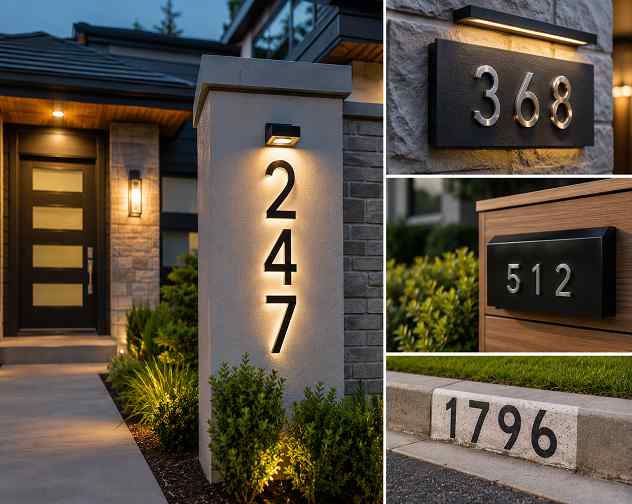
Distance is the single biggest factor in number sizing. The farther your home sits from the road, the larger the numbers need to be. This is because a driver at 25 miles per hour has about 1.5 seconds to read and process an address while passing. Numbers that are too small for that distance simply do not register in time.
Here is how setback distance maps to the minimum size you need:
| Setback Distance | Min. Height (1-in/10-ft Rule) | Min. IFC Height | Readable from Car at 25 mph |
| 20 feet | 2 inches | 4 inches | Yes (use IFC 4-inch minimum) |
| 30 feet | 3 inches | 4 inches | Yes (use IFC 4-inch minimum) |
| 50 feet | 5 inches | 4 inches | Yes |
| 80 feet | 8 inches | 4 inches (local may require 6+) | Yes |
| 100 feet | 10 inches | 4 inches (local may require 8+) | Yes |
| 150 feet | 12 to 15 inches | 4 inches (local may require 10+) | Borderline — add a secondary sign |
| 200 feet or more | 18 inches or a monument sign | Always add a secondary sign | No — secondary sign required |
When the setback exceeds 50 feet, placing a secondary sign at the driveway entrance is the most effective action you can take. A perpendicular sign at 3 to 4 feet above grade is visible from both directions of traffic as a car approaches. This works even when the home itself is not visible from the road.
Expert Note: Calculating whether a digit height is visually resolvable at a specific setback distance uses a precision angular resolution calculator that displays results in arc minutes. The digit cap height is first measured with a digital caliper set to 0.01mm jaw resolution, rated to ASTM E177 for dimensional measurement. The angular subtense is then compared against the 5-arc-minute minimum threshold set by ANSI/SEGD S1.0, which is the Standards for Environmental Graphic Design. This standard defines the minimum angular subtense for legible character identification in outdoor environments under standard daytime lighting conditions.
What Do Fire Codes Say About House Number Size?
IFC Section 505.1 is the national baseline for residential address identification in the United States. It sets the minimum standards every home must meet. Local jurisdictions can then add amendments that require larger sizes, reflective materials, or dedicated lighting.
Here are the core IFC Section 505.1 requirements:
| Requirement | IFC Minimum | Common Local Amendment |
| Digit height | 4 inches (102mm) | 6 to 12 inches for larger setbacks |
| Stroke width | 0.5 inch (12.7mm) | Same or stricter |
| Contrast | Must contrast with background | High-contrast or reflective required |
| Numeral format | Arabic only (1, 2, 3) | Same |
| Visibility | Plainly visible from the road | Illuminated or reflective for nighttime |
| Secondary sign | Required if building not visible from road | Perpendicular, 3 to 4 feet above grade |
[!IMPORTANT] The IFC 4-inch minimum is a national floor, not a full compliance guarantee. Always call your local fire marshal or building department before purchasing. Many areas require 6, 8, or even 12-inch digits depending on the distance from the road and local risk factors.
Expert Note: Verifying that a house number meets IFC Section 505.1 stroke width compliance uses a digital vernier caliper with 0.01mm jaw resolution. This tool measures the narrowest cross-section of each numeral’s stroke on the installed brushed aluminum digit plate, which is 5052-H32 alloy at 0.080-inch gauge per ASTM B209 specification. The measured value is compared against the 0.5-inch (12.7mm) minimum. Any reading below 12.7mm at any point on any stroke of any digit means that digit does not comply. It must be replaced with a bolder weight numeral or a larger size to meet IFC Section 505.1 and NFPA 1 Fire Code Section 10.9.
What Is the Correct Stroke Width for House Numbers?
Stroke width is the thickness of each line that forms a numeral. It is the most overlooked spec after digit height. A digit can reach the 4-inch height minimum and still be unreadable if the strokes are too thin.
IFC Section 505.1 requires a minimum stroke width of 0.5 inches. This is the thinnest acceptable line on any part of any digit. Thin ornamental and script-style numbers almost always fail this test. That is why decorative numeral styles are not suitable for outdoor residential address identification.
Here is how common number styles compare:
| Number Style | Typical Stroke Width | IFC Compliant | Best Use |
| Bold block (sans-serif) | 0.6 to 1.0 inch | Yes | All residential applications |
| Standard block (moderate weight) | 0.4 to 0.6 inch | Borderline — verify on product | Most residential applications |
| Slab serif (thick strokes) | 0.5 to 0.9 inch | Yes | Traditional or farmhouse homes |
| Thin or hairline sans-serif | 0.1 to 0.3 inch | No | Decorative use only |
| Script or cursive | Variable, usually 0.1 to 0.2 inch | No | Not suitable for address numbers |
| Open outline (hollow letters) | Variable | No | Not suitable for emergency use |
Also, stroke width needs to scale with digit size. A 12-inch digit with a 0.5-inch stroke looks weak and fades at distance. At 12 inches tall, the stroke should reach 1 to 1.5 inches to keep proper visual weight at 100 feet or more.
Expert Note: Measuring stroke width at the narrowest point of a powder-coated aluminum house number uses a toolmaker’s precision measuring microscope at 10x magnification with a 0.005mm stage resolution. This tool captures the stroke profile of the TGIC polyester powder-coated digit, which has a 68-micron finish coat meeting AAMA 2603 specification, at the thinnest point between any two letter curves. The measured width is compared against the IFC 505.1 minimum of 12.7mm. Digits measuring below 12.0mm at any cross-section point are flagged for replacement per the non-destructive measurement protocol under ASTM E1735, which is the Standard Test Method for Determining Relative Image Quality Response of Scanning Systems.
What Role Does Color Contrast Play in House Number Visibility?
Size and stroke width alone do not guarantee that someone can read your address. A correctly sized number in the wrong color combination can be harder to read than a smaller number in a sharp, high-contrast pairing. Color contrast is what makes the digits pop against the wall from a distance.
Here is how common color pairings perform:
| Background Color | Number Color | Contrast Performance | Daytime | Nighttime |
| White or cream wall | Matte black | Excellent | Excellent | Good (needs light) |
| Red brick | White or cream | Excellent | Excellent | Good (needs light) |
| Dark gray or charcoal | White or silver | Excellent | Excellent | Good (needs light) |
| Tan or beige stucco | Brushed bronze | Poor | Poor | Very poor |
| Natural wood | Black or dark green | Good | Good | Fair |
| Painted white | Brushed gold or brass | Poor | Poor | Very poor |
| Black or dark slate | White or cream | Excellent | Excellent | Excellent with reflective |
The worst-performing pairings are clear. Bronze and brass on tan, beige, or wood backgrounds look attractive from up close. From 40 to 60 feet away in daylight, they disappear. After dark, they become nearly invisible.
The best universal pairing is matte black on white or white on dark slate. Both work in all lighting conditions without a dedicated light source.
Expert Note: Measuring the contrast ratio between a house number digit and its wall surface in real conditions uses a portable luminance photometer with a 1-degree measurement spot and 0.01 cd per square meter resolution. This tool records the digit luminance and the background wall luminance in the same outdoor lighting conditions. The contrast ratio is calculated and compared against the 3:1 minimum threshold from ANSI/WCAG 2.1 Success Criterion 1.4.3, applied here to outdoor signage contexts in line with ANSI/SEGD S1.0 guidance on legibility contrast for property identification signage. Any pairing below 3:1 fails the contrast check and requires a color change before the installation is considered visible at road distance.
How High Should House Numbers Be Mounted on the Wall?
Mounting height controls who can see your address and from which approach angle. Numbers mounted too low get blocked by parked cars, shrubs, and raised curbs. Numbers mounted too high leave the natural reading zone of most drivers and pedestrians.
Here is the optimal mounting height by viewer type:
| Viewer Type | Optimal Number Height from Grade | Reason |
| Pedestrian on foot | 4 to 5 feet above grade | Eye level for a standing adult |
| Driver in a standard vehicle | 4 to 6 feet above grade | Driver sightline through the windshield |
| Delivery driver stepping from a van | 4.5 to 5.5 feet above grade | Line of sight from the vehicle step height |
| Emergency responder on foot | 4 to 6 feet above grade | Standard walking sightline |
| Emergency responder in a truck cab | 5 to 7 feet above grade | Elevated cab sightline |
The IFC does not specify an exact mounting height. Fire departments consistently recommend 4 to 5 feet above grade as the standard that works for the widest range of vehicles and viewer heights.
Numbers mounted above 7 feet lose effectiveness for pedestrians and most car drivers. Numbers mounted below 2 feet are often blocked by landscaping, parked vehicles, or grade changes along the curb.
Expert Note: Verifying the mounting height of house numbers above finished grade uses a digital laser distance measurer with a magnetic base mount and a self-leveling laser dot, rated to ASTM E2193. The tool is positioned at grade level directly in front of the installation surface. The laser projects a horizontal reference line to the center of the number’s vertical axis, and the display shows the vertical offset from grade. The target range of 1,219mm to 1,524mm, which equals 4 to 5 feet, is confirmed against ANSI/ICC A117.1, which is the Accessible and Usable Buildings and Facilities standard. This standard sets the maximum and minimum mounting heights for mounted identification elements at exterior building approaches.
Do You Need a Secondary Address Sign and What Size Should It Be?
A secondary sign is a separate address display placed at the driveway entrance when the primary house numbers are not readable from the road. The two most common triggers are a setback over 50 feet and trees or landscaping that blocks the direct line of sight to the house wall.
Here is when a secondary sign is required or strongly recommended:
| Situation | IFC Requirement | Secondary Sign Digit Height | Orientation |
| Setback under 50 feet, clear sightline | Not required | N/A | N/A |
| Setback 50 to 100 feet | Recommended | 4 to 6 inches | Perpendicular to road |
| Setback over 100 feet | Required in most jurisdictions | 6 to 8 inches | Perpendicular to road |
| Building not visible from road | Required — IFC 505.1 | 6 inches minimum | Perpendicular to road |
| Private driveway over 150 feet | Required | 6 to 8 inches minimum | Perpendicular at driveway entrance |
| Tree line or hedge blocks sightline | Required | 6 inches minimum | Perpendicular or monument style |
The secondary sign must be perpendicular to the road, not parallel to it. A parallel sign requires the driver to be exactly lined up with the sign face to read it. A perpendicular sign is visible from a moving vehicle approaching from either direction without the driver needing to slow down or turn their head sharply.
Mount the secondary sign with its center at 3 to 4 feet above grade. Use the breakaway post type recommended by FHWA so it yields on vehicle impact rather than causing damage.
Expert Note: Installing a secondary address sign post at a driveway entrance on soft ground uses a manual post driver with a 6kg drop weight and a 3-inch driver cap to seat a 2-inch diameter round Schedule 40 aluminum pipe post in 6061-T6 alloy, meeting ASTM B221 specification, to a minimum burial depth of 24 inches. No concrete footing is needed. The post above grade is trimmed to 48 inches using a pipe cutter rated for 1.5 to 3.5-inch pipe diameter before the sign bracket is mounted. This breakaway post design meets FHWA-SA-93-057, which is the Roadside Design Guide recommendation for mailbox and sign support structures. It requires posts to yield on vehicle impact rather than cause structural penetration of the vehicle.
What Are the Most Common House Number Size Mistakes?
These seven mistakes appear on the majority of residential house number installations that fail to do their job:
- Mistake 1: Choosing a digit size based on how it looks on the wall rather than how far it needs to be read. What looks good at 5 feet may be unreadable at 50 feet.
- Mistake 2: Using a thin or hairline numeral style that looks elegant up close but fails the 0.5-inch stroke width minimum under IFC 505.1.
- Mistake 3: Installing bronze or gold metallic numbers on a tan, beige, or natural wood background. This combination creates a contrast failure that makes the address nearly invisible at road distance.
- Mistake 4: Mounting numbers below 2 feet from grade and then planting foundation shrubs in front. This combination guarantees seasonal obstruction every spring.
- Mistake 5: Treating the IFC 4-inch minimum as the target size instead of the floor. The minimum keeps you legal. The 1-inch-per-10-feet rule keeps you findable.
- Mistake 6: Not adding a secondary sign when the setback exceeds 50 feet. Drivers miss long-setback properties at normal road speed even when the wall numbers are correctly sized.
- Mistake 7: Not testing visibility at night. A number that passes every daytime check can disappear after dark without reflective material or a light source.
Expert Note: Testing nighttime retroreflective performance of house number digits without a dedicated light source uses a handheld retroreflectometer calibrated to ASTM D4956 Type IV high-intensity prismatic sheeting standards, which require a minimum 250 cd per lux per square meter. The measurement is taken at a 0.2-degree observation angle from 50 feet. The reading is recorded for each digit against the retroreflective vinyl overlay film meeting ASTM D4956 Type III minimum at 70 cd per lux per square meter applied to the digit face. Any digit reading below 50 cd per lux per square meter at 50 feet fails the nighttime visibility threshold under FHWA-HRT-12-030, which covers Nighttime Visibility of Traffic Signs, adapted here for private property address identification.
How Do You Measure and Verify Your House Number Size Before Installing?
Verifying before installation prevents the two most common failures: numbers that are too small at road distance and digits that pass the wall test but fail after landscaping grows in around them.
Step 1: Measure Your Setback Distance
Use a laser distance measurer to record the straight-line distance from the road edge to the planned number location. If the road curves, measure from the closest point on the road that gives a direct sightline to the numbers.
Step 2: Apply the 1-Inch Rule
Divide the setback in feet by 10. Round up to the nearest whole inch. This is your minimum digit height. If the result is below 4 inches, use 4 inches to meet the IFC floor.
Step 3: Check Local Amendments
Call or check the website of your local fire marshal or building department. Many areas require 6 to 12-inch digits regardless of setback. This one call can save you from buying the wrong size twice.
Step 4: Print and Mock-Up at True Scale
Print your chosen digit height on paper at true scale. Tape it to the planned mounting location. Walk to the road and confirm the digits read clearly from both driving and walking approaches.
Step 5: Test at Night
Return after dark and check the same position. If the number disappears against the wall, add a reflective vinyl overlay to the digit face or install a downlight or uplight aimed directly at the numbers.
Here is a quick verification table to guide each step:
| Step | Tool Used | Pass Criterion |
| Setback measurement | Laser distance measurer | Distance recorded in feet |
| Digit height calculation | Setback divided by 10, round up | Result at or above 4 inches |
| Stroke width check | Digital caliper | Narrowest stroke at or above 0.5 inch |
| Contrast check | Luminance photometer | Contrast ratio at or above 3:1 |
| Mounting height check | Laser level | Center of digits at 4 to 5 feet above grade |
| Nighttime check | Retroreflectometer or visual drive-by | Digits readable from 50 feet without stopping |
Expert Note: Performing a full compliance dry-run before drilling uses a spirit level with a magnetic backing pad and millimeter graduation to confirm the printout template sits within 0.5 degrees of horizontal on the mounting surface, which is a painted fiber cement panel meeting ASTM C1186 Type A, Class 3 specification. The template position is photographed from street distance using a camera with a minimum 12MP sensor in RAW format to capture true-scale digit proportions. These proportions are reviewed against the IFC 505.1 minimum cap height and stroke width requirements before any anchor holes are drilled in the substrate.
Frequently Asked Questions
IFC Section 505.1 sets the national minimum at 4 inches of digit height with a minimum stroke width of 0.5 inches. Many local jurisdictions require 6 inches or more depending on setback distance and local fire risk factors. Always check with your local fire marshal before purchasing to confirm the specific requirement for your property.
Measure the distance from the road to the planned number location in feet. Divide that number by 10 and round up to the nearest whole inch. That is your minimum digit height. If the result is less than 4 inches, use 4 inches to meet the IFC minimum.
Only if your home is within 30 feet of the road and your local fire code allows it. The IFC national minimum is 4 inches. A 3-inch number placed at 30 feet technically falls below the IFC floor. Use 4 inches as your smallest option for any residential installation to stay on the safe side.
Matte black on white or white on dark slate gives the best visibility in all lighting conditions. Metallic finishes like bronze and brass on earth-tone or wood backgrounds are the worst-performing combinations at road distance. They look good from up close and become hard to read from 40 feet or more.
Not always required by the base IFC, but strongly recommended and often mandated by local amendments. The IFC requires numbers to be plainly visible. Many local fire districts interpret this to mean reflective material or a dedicated light source is required. Use retroreflective vinyl on the digit face or install a downlight or uplight positioned to illuminate the numbers directly.
Match the digit height of the primary wall numbers at minimum. Many jurisdictions require 6 inches for all secondary driveway signs regardless of the distance from the road to the sign. Mount the sign perpendicular to the road at a center height of 3 to 4 feet above grade so it is readable from both directions of traffic.
Explore Essential House Name Plate Guides & Tutorials
Browse our comprehensive handcrafted signage guides for material care, font selection, and architectural placement:
- Beach & Airbnb Signage Design & Weatherproofing Guide (2026)
- Complete Guide to Wood House Sign Sealing & Weather Maintenance
- Horizontal vs Vertical House Numbers Layout Comparison
- Hanging & Wall-Mounted Cottage Sign Installation Guide
- Round vs Rectangular Name Plaques for Modern Property Entrances
- Best Modern & Vintage Fonts for Cottage & Residential Signs