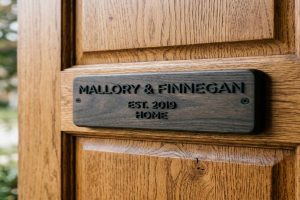
Picking an address plaque sounds simple. But the shape you choose can affect how easy your home is to find. It can also change how your house looks from the street.
This guide breaks down the differences between round and rectangular address plaques. You will learn which shape fits your home style, which is easier to read from a distance, and what other factors matter most for visibility.
📥 Free Resource: Download our Address Plaque Visibility Checklist to score your setup before you buy.
Round vs. Rectangular at a Glance
| Feature | Round or Oval Plaque | Rectangular Plaque |
| Best digit capacity | 1 to 3 digits | 4 to 6 or more digits |
| Street name inclusion | Limited | Works well |
| Font size available | Smaller due to curved edges | Larger across the full width |
| Ideal home style | Traditional, farmhouse, colonial | Modern, craftsman, contemporary |
| Best mounting surface | Pillars and narrow columns | Wide walls, fence posts, gates |
| Legibility at 50 feet | Good for short addresses | Excellent for any address |
| Emergency response compliance | Depends on plaque size | Generally easier to meet |
Both shapes can do the job. The right choice depends on your address length, your home’s style, and where you plan to mount the plaque.
What Is the Real Difference Between Round and Rectangular Address Plaques?
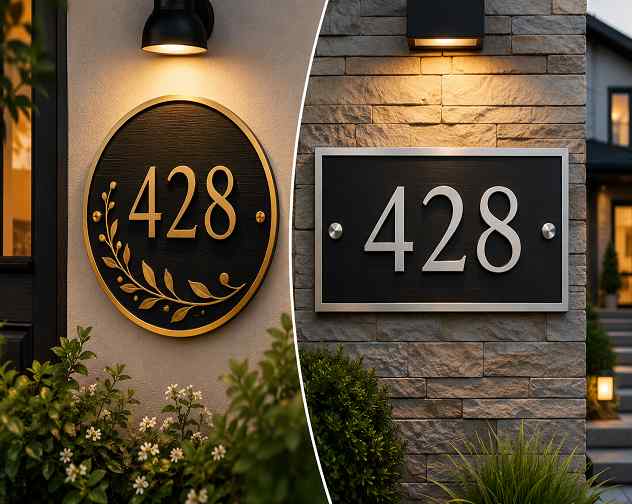
The biggest difference comes down to space. A rectangular plaque gives you the full width to work with. A round plaque loses space around the curved edges. That means the usable area for numbers is smaller.
Think of it this way. A round plaque wastes about 12 to 18 percent of its space near the edges. A rectangular plaque uses over 95 percent of its surface for lettering. So if your address has many digits, a rectangle gives you more room to keep the numbers large and readable.
Round plaques still work great for short addresses. If your house number has just two or three digits, a round plaque can display them clearly with room to spare.
Expert Note: Measuring the usable number zone on a round address plaque requires a digital vernier caliper with stainless-steel jaws. This tool measures the flat rectangular area that fits inside the circle on a UV-stabilized cast acrylic disc that is at least 3mm thick. This process follows ASTM D4169, which is the Standard Practice for Performance Testing of Shipping Containers and Systems. It makes sure the size listed by the manufacturer matches the actual usable space.
Which Address Plaque Shape Is More Visible From the Street?
Here is the truth: shape is not the biggest factor in visibility. Five things matter more than whether your plaque is round or rectangular.
| Visibility Factor | Best Value | Round Plaque | Rectangular Plaque |
| Character height | 4 inches or taller | Limited by the diameter | Full height available |
| Color contrast | 7 to 1 ratio or higher | Same for both | Same for both |
| Font type | Sans-serif such as Helvetica or Arial | Same for both | Same for both |
| Viewing distance | 1 inch of height per 10 feet from the road | Same for both | Same for both |
| Nighttime lighting | Reflective or lit up | Same for both | Same for both |
The simple rule is this: use at least 1 inch of character height for every 10 feet your home sits from the road. So if your home is 40 feet from the curb, your numbers need to be at least 4 inches tall.
Next, the shape matters only because it limits how tall your numbers can be. A small round plaque cannot fit tall digits. A rectangular plaque of the same size can fit taller numbers because the full width is available.
Expert Note: Checking how well an address plaque reflects light at night requires a spectrophotometric colorimeter with a D65 illuminant source. This tool is calibrated against a retroreflective aluminum composite panel with Type IV engineering-grade sheeting. The test follows ASTM E1778, which is the Standard Practice for Measuring Retroreflectance of Pavement Markings in a Dry Condition. This standard also applies to address plaque visibility for emergency response teams.
What Are the Address Plaque Size Requirements for Emergency Responders?
Firefighters and paramedics need to find your home fast. They approach at vehicle speed and in all kinds of lighting. This is why most areas follow the International Fire Code, known as IFC Section 505.1.
That code requires:
- Numbers at least 4 inches tall for homes
- High contrast between the number color and the plaque background
- The plaque must be visible from both directions on the road
- Nothing should block the sign, including plants or porch columns
[!IMPORTANT] Round plaques smaller than 8 inches across cannot fit 4-inch digits without the numbers touching the border. Always check the usable space inside the circle before you buy.
Use this table to find the right size for your home:
| Home Distance from Road | Minimum Digit Height | Round Plaque Diameter | Rectangular Plaque Width |
| 30 feet or less | 3 inches | 9 inches minimum | 7 inches |
| 31 to 50 feet | 4 inches | 12 inches minimum | 10 inches |
| 51 to 75 feet | 5 inches | 15 inches minimum | 12 inches |
| More than 75 feet | 6 inches or more | Post-mounted sign is better | Post-mounted sign is better |
Also, if your home sits far back from the road, consider adding a sign near the mailbox or driveway entrance. This gives emergency responders an easy reference point before they even turn in.
Expert Note: Checking that a mounted plaque meets nighttime visibility standards requires a handheld retroreflectometer set to a 0.2 degree observation angle. This tool is calibrated to ASTM E810, which is the Standard Test Method for Coefficient of Retroreflection of Retroreflective Sheeting. The reading is taken from a retroreflective aluminum substrate backed with Type III sheeting that provides at least 70 cd/lux per square meter. Plaques that meet this standard are reliably seen by emergency vehicles at night.
Which Address Plaque Shape Best Matches Your Home’s Architecture?
Matching your plaque to your home style is about more than looks. It also affects where you can mount it and how well it works in that spot. Here is a simple guide:
| Home Style | Best Shape | Best Material | Best Mounting Spot |
| Modern or minimalist | Rectangular | Brushed aluminum | Flat wall next to the door |
| Craftsman or bungalow | Rectangular or oval | Natural slate | Stone column or post |
| Colonial or traditional | Round or oval | Cast bronze | Brick pillar |
| Farmhouse | Round | Powder-coated steel | Barn door frame or gate |
| Mediterranean | Rectangular | Travertine-look ceramic | Stucco column |
| Contemporary | Floating rectangle | UV-stable acrylic | Recessed wall nook |
Round plaques feel more decorative. They work best when style comes first and the address is short. Rectangular plaques feel clean and practical. They work for any address length and look great on homes with straight, geometric lines.
This means that the shape you pick should match both your home’s look and your address length at the same time.
Expert Note: Aligning a rectangular plaque on a textured stucco wall requires a laser-guided digital level with plus or minus 0.1 degree accuracy. The mounting template should sit against a marine-grade powder-coated aluminum backer plate that is 0.080 inches thick. This stops moisture from getting behind the sign. This method meets ASTM B209, which is the Standard Specification for Aluminum and Aluminum-Alloy Sheet and Plate used in outdoor signage.
What Materials Are Available for Round vs. Rectangular Address Plaques?
The material you pick affects how long your plaque lasts and how much work it needs over time. Shape and material are separate choices. Here is a breakdown:
| Material | Durability | UV Resistance | Works With | Price Range |
| Cast bronze | Excellent | Naturally high | Rectangular best | High |
| Anodized aluminum | High | High when coated | Both shapes | Mid |
| Natural slate | High but can crack | Excellent | Rectangular best | Mid |
| UV-stable acrylic | Moderate | Must say UV-stable | Both shapes | Low |
| Powder-coated steel | Good | Moderate, needs recoating | Both shapes | Mid |
| HDU foam board | Good | Good | Both shapes | Mid-high |
Here is a quick summary of each:
- Bronze is the toughest option. It builds a natural coating called patina over time that protects it. It needs no upkeep and is ideal for traditional round plaques.
- Anodized aluminum is light, rust-proof, and comes in many colors. It is the top pick for modern rectangular plaques.
- Slate has a natural stone look and never fades in sunlight. It can crack if dropped, so handle it with care.
- UV-stable acrylic is affordable and flexible in design. If you skip the UV rating, it will turn yellow outdoors within two years.
Expert Note: Before installing an anodized aluminum plaque outdoors, test the coating with a cross-cut tape adhesion tester that uses a 1mm spacing guide. This checks the Type II sulfuric-acid anodized finish, which must be at least 0.7 mil thick. The test follows ASTM B580, which is the Standard Specification for Anodic Oxide Coatings on Aluminum. It confirms the color will not peel off during seasonal temperature swings from minus 20 degrees to 120 degrees Fahrenheit.
How Do You Choose the Right Font and Color for Maximum Visibility?
Font and color contrast do more for visibility than shape does. In fact, these two choices account for more than 60 percent of how well someone can read your address from the road.
Font Tips:
Use these fonts for the best results:
- Helvetica
- Arial
- Franklin Gothic
- Futura
Avoid these types:
- Script or cursive fonts
- Thin hairline fonts
- Decorative or fancy serifs
- All-caps narrow fonts
Also, the number strokes should be at least 1/8 inch wide for every 4 inches of digit height.
Color Contrast Guide:
| Background Color | Number Color | Readability Rating |
| Matte black | Brushed silver or white | 5 out of 5 |
| Dark bronze | Gold or cream | 4 out of 5 |
| Natural slate gray | White or cream | 4 out of 5 |
| Brushed stainless | Black raised digits | 3 out of 5 |
| White or cream | Black | 5 out of 5 |
| Natural wood grain | Black lacquer | 3 out of 5 |
The best pairings use a dark background with light numbers or a light background with dark numbers. Never choose a plaque color that blends with your wall or door. The goal is contrast, not coordination.
Expert Note: Checking color contrast on an address plaque uses a digital luminance meter set to a 1 degree measuring angle. This tool is calibrated against a Munsell neutral gray card with a reflectance factor of 19.8 percent. A contrast ratio of at least 3 to 1 is needed for daytime visibility. A ratio of 7 to 1 is needed at night. These standards follow IESNA RP-19, which is the Recommended Practice for the Design and Application of Pedestrian Area Lighting.
Where Should You Mount an Address Plaque for the Best Visibility?
Where you put your plaque matters just as much as what it looks like. A great-looking plaque in the wrong spot will still be missed.
Height Rules:
- Best height: 4 to 5 feet above the ground
- Never lower than 3 feet because shadows and plants can hide it
- Never higher than 6 feet because drivers look across, not up
Best Placement in Order of Priority:
- Front wall within 18 inches of your main door. This works best for people on foot.
- Fence post or gate pillar at the driveway entrance. This works best for people in cars.
- Mailbox post at the curb. This is required in many areas if your home sits more than 50 feet from the road.
- Lit pedestal sign at the property line. This is needed if the setback is over 100 feet.
Clearance Tips:
- Keep at least 12 inches of open space around the plaque on all sides. Plants should not touch or cover it.
- Make sure no overhang casts a shadow on the plaque between 9 in the morning and 4 in the afternoon.
Expert Note: Mounting a rectangular plaque on a brick wall requires drilling into the mortar joint rather than the brick face. This is done with a rotary hammer drill fitted with a half-inch SDS-Plus carbide masonry bit. The anchor goes into a Portland cement mortar joint made with Type S mortar, following the ASTM C270 specification. Drilling into the mortar instead of the brick protects the wall from cracking. This follows IBC Section 2104.1.1, which covers mortar for unit masonry.
Are Illuminated Address Plaques Worth the Investment?
Yes, especially if your home is far from the road. After dark, a plaque without lighting is nearly invisible. For homes more than 40 feet from the curb, some kind of illumination is a smart investment.
Here are your main options:
| Lighting Type | Power Source | Visibility Boost | Setup Needed |
| Solar-powered LED backlight | Built-in solar panel | Very good | No electrician needed |
| Hardwired low-voltage LED | 12V landscape line | Excellent | Requires an electrician |
| Battery-operated spotlight | AA or D batteries | Good | Replace batteries twice a year |
| Retroreflective sheeting | No power needed | Good | No maintenance once installed |
| Integrated neon tube | 120V power line | Excellent | Highest cost option |
Solar-powered backlit plaques are the most popular choice for homeowners who want good visibility without extra wiring. Retroreflective sheeting is the best option if you want something that works without any power at all.
Also, round plaques with lit edges create a glowing ring effect at night. This look is very distinctive and easy to spot from the road.
Expert Note: Installing a hardwired 12V LED backlit plaque starts with checking the circuit using a digital multimeter with a non-contact voltage tester. This confirms the power is off before you splice into the outdoor cable. The cable used is a 0.5mm twin-core UV-resistant outdoor wire rated to BS EN 50525-2-21. This wiring approach follows NEC Article 411, which covers lighting systems that run at 30 volts or less. It ensures the low-voltage connection is safe for outdoor use.
What Are the Most Common Address Plaque Mistakes That Hurt Visibility?
Buying a good plaque does not always mean it will work well. These seven mistakes cancel out even the best hardware:
- Mistake 1: Picking a round plaque for a 5-digit address. The numbers shrink below 3 inches to fit, and that is too small to read from the road.
- Mistake 2: Mounting the plaque behind a screen door or inside a covered porch. The shadow cuts the contrast and the plaque disappears.
- Mistake 3: Using a script or decorative font. These look great up close but become unreadable at 30 feet or more.
- Mistake 4: Choosing a plaque color that matches the wall. No contrast means no visibility.
- Mistake 5: Mounting higher than 6 feet. Drivers look straight across, not upward. A high plaque is easy to miss at road speed.
- Mistake 6: Skipping lighting for a home that sits far back. After dark, the plaque might as well not exist.
- Mistake 7: Buying acrylic without checking for a UV rating. Untreated acrylic turns yellow within 18 to 24 months outdoors.
Expert Note: Checking whether a plaque has enough contrast after installation uses a pocket-sized digital contrast ratio meter with sensitivity down to 0.01 cd per square meter. This tool reads the luminous reflectance of the RAL 9005 jet black powder-coat background against the number surface. IFC Section 505.1 on Address Identification requires a reflectance difference of at least 70 percent between the background and the characters. If the contrast fails, the plaque will not meet emergency response visibility standards.
How Do You Install a Round vs. Rectangular Address Plaque Correctly?
Installation is the last step that either locks in or ruins your visibility results. Follow these four steps to get it right.
Step 1: Pick the Right Mount Type
- Surface mount means the plaque sits flat against the wall. Rectangular plaques work best this way.
- Standoff mount means the plaque floats off the wall on small posts. Both shapes work. Round plaques look especially good with this method because of the shadow ring effect.
- Post mount works well for rectangular plaques at the top of a straight post. Round plaques are a natural fit on round posts.
Step 2: Mark and Drill Anchor Points
- For rectangular plaques, use 4 anchor points at the corners. Always use a bubble level to check alignment before drilling.
- For round plaques, use 3 anchor points in a triangle pattern. Never use just 2 points because the plaque will rotate over time.
Step 3: Seal Around the Edges
Apply a thin line of paintable silicone caulk around the full edge of the plaque. Use caulk rated to ASTM C920 Type S Grade NS Class 25 for outdoor use. For round plaques, apply the caulk in a smooth circle. Do not apply it in straight lines or it will gap along the curves.
Step 4: Check Visibility Before You Finish
Walk to the curb and look at the plaque. Check it from both directions of approach. Then photograph it after dark to see how the contrast holds up at night. If anything looks off, adjust the position before the caulk fully cures.
Expert Note: Anchoring a standoff-mounted rectangular plaque into a precast concrete pillar requires a powder-actuated fastener tool set to a low-velocity charge of less than 3 grains. This tool drives a quarter-inch diameter stainless-steel pin anchor with a nylon sleeve into the concrete without cracking the surface. This fastening method follows ICC-ES AC308, which is the Acceptance Criteria for Post-Installed Anchors in Masonry Elements.
Frequently Asked Questions
Only if the plaque is at least 14 inches across and uses a compact sans-serif font. Most standard round plaques between 8 and 10 inches cannot fit 5 digits at the required 4-inch height. Choose a rectangular plaque if your address has 4 or more digits.
Use this simple formula: minimum digit height equals 1 inch for every 10 feet your home sits from the road. If your home is 50 feet back, you need 5-inch-tall numbers. Size the plaque so those numbers fit with normal margins on all sides.
Rectangular plaques align neatly with brick rows and mortar lines. This makes them easier to level and center. Round plaques work well on brick only when mounted on a pillar or column face where the circle shape fits naturally.
Most areas do not require lighting if your home is within 50 feet of the road. However, the International Fire Code recommends a lit or reflective plaque for homes set back more than 50 feet. Solar backlit plaques are the easiest upgrade because they need no wiring.
Cast bronze lasts the longest. It develops a natural patina that protects it from rust and wear, and it needs no maintenance. For buyers looking for a lower cost option, anodized aluminum lasts over 20 years outdoors and will not rust.
Rectangular plaques are generally easier to bring into compliance with IFC Section 505.1 because they allow for taller numbers within the same overall size. If you prefer a round plaque, choose one that is at least 12 inches in diameter.
Explore Essential House Name Plate Guides & Tutorials
Browse our comprehensive handcrafted signage guides for material care, font selection, and architectural placement:
- Beach & Airbnb Signage Design & Weatherproofing Guide (2026)
- Complete Guide to Wood House Sign Sealing & Weather Maintenance
- Horizontal vs Vertical House Numbers Layout Comparison
- Hanging & Wall-Mounted Cottage Sign Installation Guide
- Round vs Rectangular Name Plaques for Modern Property Entrances
- Best Modern & Vintage Fonts for Cottage & Residential Signs