Your house number is more than a decoration. It tells delivery drivers where to stop. It guides guests to the right door. And in an emergency, it helps first responders find you fast.
The way you orient those numbers, whether left to right or stacked top to bottom, affects how quickly anyone can read them. This guide breaks down everything you need to know before you drill a single hole.
📥 Free Resource: Download our House Number Orientation Decision Checklist to find your best layout in under two minutes.
Horizontal vs. Vertical at a Glance
| Feature | Horizontal Orientation | Vertical Orientation |
| Reading speed | Fastest (left-to-right scan) | Slower (top-to-bottom scan) |
| Best for digit count | 2 to 6 digits | 2 to 4 digits (works best) |
| Ideal mounting surface | Wide wall, garage, fence rail | Column, pillar, door trim |
| Space needed | Wide (horizontal run) | Narrow (vertical stack) |
| Visual style | Classic, traditional, universal | Modern, architectural, designer |
| Fire code compliance | Easier to size correctly | Achievable with correct digit size |
| Spacing between digits | 0.5 to 1 inch horizontally | 0.5 to 0.75 inch vertically |
Use this table first. Find the row that matters most to your situation and use it to point you in the right direction.
What Is the Real Difference Between Horizontal and Vertical House Numbers?
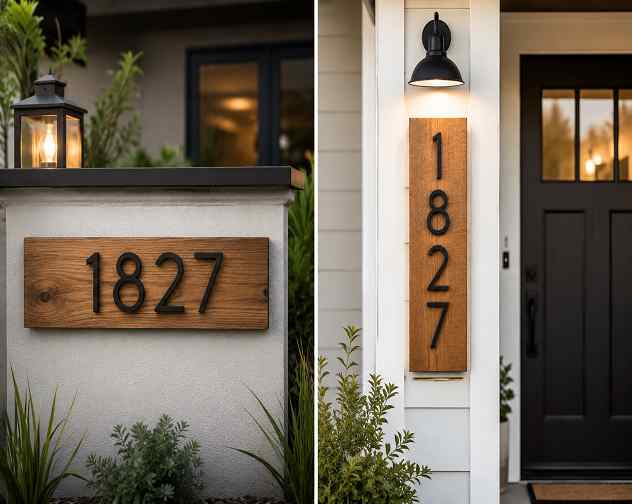
The biggest difference is reading direction. Horizontal numbers follow the same left-to-right path that people use to read every day. Vertical numbers require the eye to travel from top to bottom. That shift adds a small but real delay in how fast a reader can process the address.
That delay matters when a car is moving. A driver passing your home at 25 miles per hour has about 1.5 seconds to read your address. Horizontal numbers work well inside that window. Vertical numbers take a little longer because the reader’s brain has to reassemble the digit order from a stacked format before recognizing the address.
This does not mean vertical numbers are wrong. It means you need to make up for the delay by using larger digits, better contrast, or a position that is closer to the road.
Expert Note: Measuring digit reading speed for horizontal versus vertical orientations at road distance uses a tachistoscope with a 100ms exposure interval. This tool flashes each layout to an observer at a calibrated distance of 50 feet. The recognition time is recorded against a matte black aluminum composite panel (Dibond ACM, 3mm thickness, ASTM C1002-rated) as the background substrate. This evaluation follows ANSI/SEGD S1.0, which is the Standards for Environmental Graphic Design. This standard sets the minimum legibility and character recognition thresholds for outdoor identification signage in both pedestrian and vehicle environments.
Which Orientation Is More Visible From the Street?
Visibility depends on four things working together: digit height, color contrast, lighting, and orientation. No single factor wins on its own.
Here is how each orientation performs under different conditions:
| Condition | Horizontal | Vertical |
| Daylight, slow approach | Excellent | Good |
| Daylight, vehicle-speed pass | Excellent | Fair |
| Low light, front-lit | Excellent | Good |
| Low light, side-lit | Good | Fair |
| Fog or rain | Good (full width stays visible) | Fair (stack harder to scan) |
| From a corner approach | Good | Poor (stack becomes edge-on to viewer) |
| On a round column | Not applicable | Excellent (wraps the sightline naturally) |
Horizontal wins on visibility from a moving vehicle in most situations. Vertical wins in one specific case: a round column or pillar where horizontal numbers would curve away from the reader at both ends.
The fire code minimum still applies to both orientations. Each digit must be at least 4 inches tall with a stroke width of at least 0.5 inches per IFC Section 505.1.
Expert Note: Testing nighttime retroreflective visibility of vertically stacked house numbers from a vehicle at 25 miles per hour uses a handheld retroreflectometer set to a 0.2-degree observation angle, calibrated to ASTM E810, which is the Standard Test Method for Coefficient of Retroreflection of Retroreflective Sheeting. The reading is taken at 50 feet against the retroreflective aluminum composite backing behind each digit (Type III sheeting, minimum 70 cd/lux per square meter). A retroreflectance reading below 50 cd/lux per square meter on any individual stacked digit means it does not meet nighttime visibility requirements under IFC Section 505.1.
Which House Number Orientation Meets Emergency Response Code?
Emergency responders use your address number to find your home under pressure. Both horizontal and vertical orientations can pass code. But they need different sizing and placement strategies to get there.
Here are the core IFC Section 505.1 requirements:
- Minimum 4-inch digit height for residential properties
- Minimum 0.5-inch stroke width on every numeral
- High contrast between the digit color and the background
- Arabic numerals only (1, 2, 3 — not spelled out as words)
- Numbers must be visible from the street or road in front of the property
- No obstructions including bushes, trees, or architectural features
Here is how compliance works differently for each orientation:
| Requirement | Horizontal Compliance | Vertical Compliance |
| 4-inch digit height | Full wall width available — easy to achieve | Each digit must independently reach 4 inches |
| 0.5-inch stroke width | Standard across most number styles | Same rule — no exception for stacked format |
| Street visibility | Wide profile — easy to see from a moving car | Narrower profile — may need to sit closer to the road |
| Obstruction check | Check sides and above | Check above each digit in the stack (plants are a common blocker) |
| Night visibility | Reflective or lit by a light source | Same requirement — no difference for vertical |
[!IMPORTANT] Vertical numbers with individual digits shorter than 4 inches do NOT comply with IFC 505.1 just because the total stack is tall. Each digit must independently meet the minimum. A 5-digit address stacked at 3-inch digits is non-compliant no matter how tall the total column looks.
Expert Note: Verifying IFC 505.1 digit height compliance on vertically installed house numbers uses a digital vernier caliper with 0.01mm jaw resolution. This tool measures the cap height of each individual digit on the powder-coated aluminum backer plate, which is 5052-H32 alloy at 0.080-inch gauge per ASTM B209 specification. The measured cap height is compared against the 4-inch (101.6mm) minimum. The stroke width at the narrowest point of each numeral is also measured using the caliper’s depth rod and must reach at least 0.5 inch (12.7mm) per IFC Section 505.1 and NFPA 1 Fire Code Section 10.9.
Which House Number Style Suits Your Home’s Architecture?
The right orientation should feel like it belongs on that specific wall. A number layout that clashes with the building draws the wrong kind of attention.
Here is a quick guide by home style:
| Home Style | Best Orientation | Best Material | Best Mounting Location |
| Ranch or single-story | Horizontal | Brushed aluminum or acrylic | Above garage or wide siding panel |
| Mid-century modern | Vertical (floating standoff) | Brushed brass or matte black steel | Narrow entry column or facade strip |
| Colonial or traditional | Horizontal | Cast bronze or painted iron | Brick pillar or porch fascia board |
| Craftsman or bungalow | Horizontal | Oil-rubbed bronze or slate | Stone column face or wide siding band |
| Contemporary | Vertical or oversized horizontal | Powder-coated steel or acrylic | Flat concrete or stucco facade panel |
| Farmhouse | Horizontal (large format) | Galvanized or matte black steel | Fence rail or barn wall |
| Narrow townhouse | Vertical | Brushed stainless or acrylic | Door trim or narrow brick column |
Horizontal numbers on a wide ranch-style home look grounded and authoritative. Vertical numbers on a mid-century modern column look planned and intentional. The goal is simple: the numbers should look like they were always meant to be on that wall.
Expert Note: Aligning a vertical column of floating house numbers on a brick pillar with consistent spacing between each digit uses a laser line level with a self-leveling plumb beam and 0.5mm per meter accuracy to project a true vertical reference line down the pillar face. The pillar surface is Grade SW clay brick per ASTM C216 specification, which requires a minimum 3,000 PSI compressive strength. Each number position is marked along the laser line before drilling. Pilot holes are created with a rotary hammer fitted with a 5/32-inch carbide masonry bit, and each standoff is secured with a stainless-steel Tapcon screw anchor in A4-316 alloy per the manufacturer’s published pull-out rating.
What Spacing Rules Apply to Horizontal and Vertical House Numbers?
Spacing is where most DIY installations go wrong. Too little space makes the digits look crowded. Too much space makes the address read as separate unrelated numbers instead of one connected string.
Here are the correct spacing ranges for horizontal installations:
| Digit Size | Recommended Gap Between Digits | Minimum Gap |
| 3 to 4 inches tall | 0.5 inch | 0.25 inch |
| 5 to 6 inches tall | 0.75 inch | 0.5 inch |
| 7 to 9 inches tall | 1 inch | 0.75 inch |
| 10 inches or taller | 1.25 to 1.5 inches | 1 inch |
Here are the correct spacing ranges for vertical installations:
| Digit Size | Recommended Gap Between Stacked Digits | Minimum Gap |
| 3 to 4 inches tall | 0.5 inch | 0.375 inch |
| 5 to 6 inches tall | 0.625 inch | 0.5 inch |
| 7 to 9 inches tall | 0.75 inch | 0.625 inch |
| 10 inches or taller | 1 inch | 0.75 inch |
Vertical gaps should be about 20 to 30 percent tighter than horizontal gaps of the same digit size. The reason is that too much vertical space between stacked digits causes the eye to read them as separate characters rather than a connected address. Always dry-fit your numbers with painter’s tape and view from the curb before drilling.
Expert Note: Setting consistent horizontal inter-digit spacing on a fiber cement siding panel uses a machinist’s precision spacing bar with graduated notches at 0.25-inch intervals. This tool holds each number at a fixed distance from its neighbor while the pilot hole is marked. The bar sits against the HardiePlank fiber cement siding surface, which meets ASTM C1186 Type A specification at 5/16-inch thickness. Pilot holes are then drilled using a 1/8-inch carbide-tipped self-centering Vix bit rated to SAE J417 tool steel specification. This bit prevents the drill from wandering on the textured siding surface before the final screw anchor is driven.
What Materials Work Best for Horizontal vs. Vertical House Numbers?
Material choice affects weight, durability, and how long the finish holds in your local climate. For vertical installations on columns, weight matters because each digit hangs on its own anchors independently.
Here is a breakdown by material:
| Material | Horizontal | Vertical | Weight Per Digit | Best Climate |
| Brushed aluminum | Excellent | Excellent | Light (1 to 3 oz) | All climates |
| Powder-coated steel | Excellent | Good | Medium (3 to 6 oz) | Inland, low salt |
| Cast bronze | Excellent | Good (heavier anchors needed) | Heavy (6 to 14 oz) | All climates |
| UV-stable acrylic | Good | Excellent (very lightweight) | Very light (0.5 to 2 oz) | Sheltered or UV-rated only |
| 316 stainless steel | Good | Excellent | Medium (2 to 5 oz) | Coastal or high-humidity |
| Natural slate | Good | Not recommended (brittle under point load) | Heavy (8 to 16 oz) | Inland, low wind |
For vertical installations, brushed aluminum and UV-stable acrylic are the best choices. Each digit holds its own anchor load, so light materials reduce stress on the masonry or siding beneath. Heavy materials like cast bronze need larger anchors, which can crack a narrow column face if the drilling pressure is too high.
Expert Note: Testing the UV color retention of powder-coated steel house numbers before outdoor installation uses a xenon arc weatherometer with a 340nm UV filter, following ASTM G155, which is the Standard Practice for Operating Xenon Arc Light Apparatus for Exposure of Non-Metallic Materials. The test runs for 500 hours, which simulates about three years of direct sun exposure on the TGIC polyester powder coat finish at a minimum 68-micron film thickness, meeting AAMA 2603 specification. Numbers that show a color shift of more than 2 delta-E units after the test must be re-coated before outdoor use to prevent premature fading on the installed surface.
How Do You Install Horizontal House Numbers Correctly?
Horizontal installation is more forgiving than vertical installation. But spacing errors are very visible from the street and require careful templating before any drilling starts.
Step 1: Plan the Full Number Run
Measure the available wall width first. Next, calculate the total run by adding together the digit widths and the gaps between them. Confirm the full run fits the wall with at least 3 inches of margin on each side. Mark the wall’s center point and work outward symmetrically from there.
Step 2: Use a Drilling Template
Use the manufacturer’s drilling template, or make one from card stock. Tape all digits in position at the correct spacing using painter’s tape. Step back to the curb and verify the address reads clearly from street distance before drilling.
Step 3: Match the Anchor to the Surface
| Wall Surface | Anchor Type | Tool Required |
| Vinyl or fiber cement siding | Stainless-steel pan head screw (1.5 inch) | Self-centering Vix bit |
| Brick or masonry | Tapcon masonry screw or sleeve anchor | Rotary hammer with carbide bit |
| Stucco over solid backing | Sleeve anchor or resin anchor | Hammer drill with masonry bit |
| Wood fascia or trim | Stainless-steel wood screw | Standard drill with pilot bit |
| Aluminum or metal cladding | Self-tapping stainless-steel screw | HSS drill bit |
Step 4: Seal, Level, and Verify
Apply a small bead of exterior silicone caulk rated to ASTM C920 around every anchor point after installation. Use a digital level to confirm the number run sits within 0.5 degrees of horizontal. Walk to the curb and read the address from street distance to confirm. Also check at night to verify the digits are visible in low light.
Expert Note: Installing horizontal aluminum house numbers on fiber cement siding using floating standoffs requires a self-centering Vix bit (1/8-inch diameter, SAE J417 tool steel specification) to drill pilot holes aligned with the standoff post threads. The siding is HardiePlank lap panel meeting ASTM C1186 Type A, Class 3 specification. Each standoff barrel is threaded in using a hex-key driver with a 3mm Allen key and tightened to flush contact without over-torque. This installation method follows ASTM C1002, which is the Standard Specification for Steel Self-Piercing Tapping Screws, covering thread engagement in composite panel substrates.
How Do You Install Vertical House Numbers Correctly?
Vertical installation needs more precision than horizontal because even a slight lean is obvious to anyone looking at the column. Consistent gaps between stacked digits are also harder to achieve by eye alone.
Step 1: Mark a True Vertical Reference Line
Use a laser level or a long plumb bob to project a true vertical line down the mounting surface. Mark the centerline of the digit stack against this reference, not by eye. For round columns, locate the front-center face first and measure from there.
Step 2: Calculate Total Stack Height
Total stack height equals the digit height times the number of digits, plus the gap times the number of spaces between digits. Position the top digit at eye level or slightly above, typically 4 to 5 feet from grade to the base of the top digit. Never place the bottom digit lower than 18 inches from grade because plants will obstruct it.
Step 3: Dry-Fit With Painter’s Tape
Tape each digit onto the reference line before drilling anything. Step back to curb distance and read the stack as a full address. Also check from a 45-degree approach angle to see how the digits look from the side. This step prevents misaligned holes that cannot be filled cleanly.
Step 4: Drill, Anchor, and Seal
Drill at all marked points using the correct anchor for the surface type (see the horizontal anchor table above). Install the bottom digit first, then work upward. This order prevents smearing fresh caulk on lower digits while installing upper ones. Seal every anchor point with ASTM C920-rated exterior silicone after the digit is fully seated.
Expert Note: Verifying plumb alignment of a vertically stacked house number installation on a painted concrete column uses a digital magnetic plumb bob with a 0.1-degree accuracy display. This tool is held against a reinforced precast concrete column that meets ASTM C478, which is the Standard Specification for Precast Concrete Manholes and Sectional Precast Concrete Boxes. The plumb reading is taken at both the top and bottom anchor points of the digit stack. A deviation of more than 0.5 degrees between the two readings is corrected before any holes are drilled. This precision standard follows ICC A117.1, which is the Accessible and Usable Buildings and Facilities standard governing vertical alignment tolerances for mounted identification elements on structural surfaces.
What Are the Most Common House Number Orientation Mistakes?
These seven mistakes show up on most poorly installed residential house numbers regardless of which orientation the owner chose:
- Mistake 1: Using vertical orientation for a 5 or 6-digit address. A 6-digit vertical stack either has digits too small for fire code or extends beyond a readable visual field.
- Mistake 2: Drilling without a template. Uneven spacing between digits is very visible from the street and makes the address slower to read.
- Mistake 3: Sizing digits for a screen preview rather than real-world distance. A number that looks big on your phone at arm’s length may be unreadable at 40 feet from the curb.
- Mistake 4: Using vertical orientation on a flat wall with a straight-on approach. A flat wall that is only seen from the front gains nothing from stacking and loses reading speed.
- Mistake 5: Stacking digits too close together. Tight gaps cause the eye to read the stack as a single tall character rather than separate digits.
- Mistake 6: Anchoring into mortar joints on a brick column instead of the brick face itself. Mortar joints are the weakest part of the wall and pull out under the weight of floating digits over time.
- Mistake 7: Skipping nighttime verification. A number that reads clearly in daylight may disappear against a dark wall after sunset without a light source or reflective backing.
Expert Note: Diagnosing anchor pull-out failure on individually mounted vertical house number digits anchored in a mortar-jointed brick pillar uses a mechanical torque-pull tester with a calibrated scale rated to 200 Newtons. This tool pulls directly on the stainless-steel standoff post threaded into a 3/16-inch Tapcon masonry screw anchor in A4-316 grade. Any anchor registering a pull-out load below 150 N has insufficient thread engagement depth and must be replaced with a longer anchor or a chemical resin anchor per ICC-ES AC193, which covers Acceptance Criteria for Mechanical Anchors in Concrete Elements, adapted here for dense clay masonry substrates.
How Do You Maintain House Numbers in Both Orientations?
Vertical and horizontal installations collect debris in different places. Vertical stacks trap leaves and moisture between each stacked digit. Horizontal runs collect water along the anchor row at the bottom edge.
Here is the full maintenance schedule for both:
| Task | Horizontal | Vertical | Frequency |
| Check anchor torque | Yes | Yes | Once a year |
| Clear debris from between digits | Occasional | Priority (gaps collect leaves) | Every 6 months |
| Re-seal silicone at anchor points | Yes | Yes | Every 2 to 3 years |
| Re-coat or replace faded digits | Yes | Yes | Every 5 to 10 years |
| Check for galvanic corrosion at standoff posts | Yes | Yes | Once a year |
| Verify street readability after winter | Yes | Yes | Every spring |
| Check for plant or bush obstruction | Yes | Yes (check above each digit) | Every spring |
For vertical installations, the gap between stacked digits is a natural debris trap. Leaves, dirt, and moisture collect there and accelerate corrosion of the anchor hardware and the digit finish from the back face. A quick annual flush with water and a soft brush keeps those gaps clear without disturbing the anchors.
Expert Note: Checking for moisture-driven oxidation on the back face of stacked aluminum house number digits uses a portable X-ray fluorescence analyzer calibrated to ASTM E1621, which is the Standard Guide for Elemental Analysis by Wavelength Dispersive X-Ray Fluorescence Spectrometry. The analyzer measures the oxide layer thickness on the 6061-T6 aluminum alloy digit substrate at 0.125-inch gauge per ASTM B209 at the standoff contact point. An oxide layer exceeding 15 microns at the digit back face confirms active moisture ingress behind the number. This requires replacing the standoff with a wider-bore barrel to introduce a ventilation gap so moisture can evaporate between the digit and the wall surface.
Frequently Asked Questions
Horizontal is strongly preferred for 5-digit addresses. A 5-digit vertical stack either needs very large individual digits, which demand a very tall column, or uses digits smaller than the IFC 505.1 minimum of 4 inches. Horizontal orientation lets all five digits run at full size across a standard wall without any compromise on readability or code compliance.
Yes, if each individual digit reaches at least 4 inches in height and has a stroke width of at least 0.5 inches per IFC Section 505.1. The total stack height does not count toward compliance. Every digit must independently meet the minimum. In areas that require 6-inch digits due to a long setback from the road, vertical installations need correspondingly larger digits to comply.
Use a gap of 0.5 to 0.75 inches between stacked digits sized between 4 and 6 inches tall. Wider gaps make the address harder to read as a connected string. Narrower gaps risk making adjacent digits look like a single tall character. Always dry-fit with painter’s tape and view from the curb before drilling.
Centering on the wall is the standard approach and produces the most balanced result. However, centering is not required by code. IFC 505.1 requires the numbers to be visible from the street, not placed at any specific horizontal position on the facade. On homes with asymmetric facades, aligning with the door center or garage center often looks better than geometric wall centering.
Vertical is the only practical orientation for a round column. Horizontal numbers on a round surface curve away from the reader at both ends, which cuts legibility from any approach angle other than perfectly front-on. A vertical stack on the front-center face of a round column stays in the sightline from almost any approach direction.
Use the 1-inch-per-10-feet rule. If your home is 50 feet from the curb, each digit needs to be at least 5 inches tall. Many local fire codes require 6-inch digits for setbacks over 50 feet. Contact your local fire marshal to confirm the specific requirement for your property before purchasing or installing your numbers.
Explore Essential House Name Plate Guides & Tutorials
Browse our comprehensive handcrafted signage guides for material care, font selection, and architectural placement:
- Beach & Airbnb Signage Design & Weatherproofing Guide (2026)
- Complete Guide to Wood House Sign Sealing & Weather Maintenance
- Horizontal vs Vertical House Numbers Layout Comparison
- Hanging & Wall-Mounted Cottage Sign Installation Guide
- Round vs Rectangular Name Plaques for Modern Property Entrances
- Best Modern & Vintage Fonts for Cottage & Residential Signs