By the Bluejaypro Editorial Team · Published July 16, 2026 · 22 min read
Most homeowners set up their mailbox once and never think about it again. But the United States Postal Service has specific rules about how a mailbox must be marked. If your mailbox does not meet those rules, the postal carrier can stop delivering to your address entirely.
This is not a rare situation. USPS carriers are required to report mailboxes that do not meet marking standards. If a carrier flags your mailbox as non-compliant, you will receive a written notice giving you a short window to correct the problem. If you do not fix it, mail delivery to your address can be suspended.
The good news is that the rules are clear and easy to follow. This guide covers every USPS marking regulation that applies to residential mailboxes, rural mailboxes, and cluster box units. By the end, you will know exactly what your mailbox needs to display, where it needs to be positioned, and how to keep it compliant for years.
📥 Download Free: Our USPS Mailbox Compliance Checklist PDF a one-page reference to check every requirement before your carrier does.
What Are USPS Mailbox Marking Regulations and Why Do They Matter?
USPS mailbox marking regulations are the official rules that govern how a residential curbside mailbox must be labelled and positioned to receive mail. These rules are published in the USPS Domestic Mail Manual (DMM), Section 508, and are legally binding for all customers who use USPS mail delivery service.
The regulations exist for three practical reasons. First, they allow postal carriers to confirm delivery accuracy. A carrier delivering 500 addresses per day needs to see house numbers clearly and quickly from their vehicle. A mailbox without a visible number slows delivery and increases the risk of misdelivery.
Second, the regulations help emergency services. Police, fire, and medical responders use the same roadside address numbers that postal carriers read. A clearly marked mailbox, often achieved with durable weatherproof mailbox signs, is faster to locate in an emergency.
Third, the regulations protect the postal service’s ability to deliver mail efficiently. When mailboxes are positioned at inconsistent heights or have unreadable address numbers, carriers must slow down, stop, or leave their vehicle, which reduces route efficiency significantly.
This means that your compliance with USPS mailbox marking rules is not just about you. It affects the speed and accuracy of mail delivery for everyone on your postal route.
The key reference document is USPS DMM Section 508.1 (Delivery Equipment Requirements for Curbside Mailboxes). This is the authoritative USPS publication. All information in this guide is based on the most current version of the DMM as of 2026. Always check the USPS website or contact your local postmaster for the most recent updates.
Expert Note: When testing whether a fluorescent orange retroreflective vinyl flag stripe applied to a rural mailbox post (as recommended by some rural postal services and 911 addressing programs to improve postal carrier and emergency vehicle visibility of unmarked rural mailbox locations at night) meets the visibility performance specification of at least 50 millicandelas per lux per square metre retroreflective luminance coefficient at a 0.5-degree observation angle and 4-degree entrance angle (simulating a car headlight at 50 metres approach), a fluorimetric analysis system with 365nm UV excitation source, calibrated silicon photodiode detector, and bandpass emission filter at 600nm is used to identify and quantify fluorescent pigment emission from the retroreflective sheeting sample separate from the purely retroreflective contribution. Fluorescent retroreflective materials gain additional visibility in daylight from fluorescence emission, but this contribution is not captured by standard retroreflectometers. Separating fluorescent from non-fluorescent retroreflective contributions allows a more accurate total visibility calculation for dusk and dawn postal delivery conditions. Fluorescent component identification in retroreflective sheeting follows ASTM E1247-05 (Standard Test Method for Identifying Fluorescent Components in Retroreflection Sheeting by Fluorimeter), the standard specifically for distinguishing fluorescent retroreflective materials from conventional retroreflective sheeting.
What Are the USPS Requirements for Mailbox Address Numbers?
The address number on your mailbox is the most important marking it carries. Without a clear, correctly sized number, your postal carrier has no reliable way to confirm that they are delivering to the correct address.
USPS DMM Section 508.1.4 specifies the following requirements for mailbox address numbers.
Minimum height: 1 inch. The numerals (house number digits) and letters (street name abbreviations if required) must be at least 1 inch in height. This is the absolute minimum. Many postal experts recommend using 2-inch numbers for rural mailboxes on high-speed roads, where the carrier approaches at a faster speed and needs to read the number from a greater distance.
Contrast: clearly visible against the background. The DMM requires that numbers be “in contrasting color” to the mailbox surface. This means you cannot use dark numbers on a dark mailbox or light numbers on a white mailbox without enough contrast to read them clearly from a distance of 3 to 5 metres. Black on white, white on black, and dark navy on cream are all acceptable contrast combinations. Gold on cream, pale grey on silver, and any combination where the number and background are similar in brightness will fail a USPS inspection.
Location: carrier approach side. The address number must appear on the side of the mailbox that faces the carrier’s approach direction. For most curbside mailboxes, this means the left side of the mailbox when you are standing at the road and looking toward your home (since USPS carriers typically drive on the right side of the road and approach from the left as seen from the house). If mailboxes are grouped together on a cluster post, the address number appears on the door of the individual mailbox unit.
Legibility: neat and clear. The DMM specifies that the markings must be “neat.” This rules out faded, peeling, chipped, or partially worn-off numbers. It also rules out decorative script fonts that cannot be read quickly by a carrier at a glance from their vehicle. The test is simple: if you cannot read the number clearly in 1 second from 3 metres away, it is not compliant.
Optional additions: owner name. The owner’s name may be displayed on the mailbox but is not required. If you display it, it must not conflict with the required address information and must follow the same contrast and legibility standards.
Prohibited: advertising. No advertising of any kind is permitted on the mailbox or its support post. This includes business names, logos, QR codes, or promotional messages. The mailbox is a USPS installation point and cannot be used for commercial purposes.
| Requirement | USPS Standard | Common Mistake |
| Number height | 1 inch minimum | Numbers too small (often 0.5 inch or less) |
| Contrast | Clearly contrasting to background | Gold on beige, grey on silver |
| Location | Carrier approach side | Numbers on wrong side or on back of box |
| Legibility | Neat, clear, readable at 3 to 5 metres | Faded, decorative script, partial peeling |
| Advertising | Prohibited on box and post | Business logos, promotional stickers |
| Owner name | Optional, not required | Not a requirement but not prohibited |
Expert Note: When verifying that the red address numbers painted on a rural mailbox fleet (100 residential mailboxes on a new housing development) will maintain adequate ink optical density and colour saturation for at least 5 years of outdoor exposure to rain, UV radiation, and road grime without fading to the point of USPS non-compliance, a spectrophotometric ink strength evaluation using TAPPI T 527 is performed on printed ink drawdowns of the address number paint applied at the specified film thickness (50 micrometres wet) to a standardised card substrate. The method measures the reflectance of the ink at its peak absorption wavelength (for red ink: approximately 490nm) and calculates the Kubelka-Munk K/S value (absorption-scattering ratio) which quantifies ink colour strength. A K/S value above 3.5 at the red absorption peak indicates sufficient pigment loading for outdoor durability. A K/S below 2.0 indicates an underpigmented formulation that will fade visibly in outdoor UV exposure within 12 to 18 months. The method also allows prediction of how much UV exposure the ink can tolerate before K/S drops below 2.0. Ink colour strength measurement follows TAPPI T 527 cm-94 (Color and Strength of Diluted Paste Inks by Spectrophotometer), the reference method for absolute ink pigment strength quantification adapted here for outdoor postal address marking paint quality assurance.
Where Should Your House Number Be on the Mailbox?
Placement of the address number is just as important as the number itself. A correctly sized number in the wrong location on the mailbox will still cause a compliance problem.
Standard curbside mailboxes: The number goes on the side of the mailbox that faces the approaching carrier vehicle. Since US postal carriers drive on the right side of the road, they approach from the left side as seen from the homeowner’s perspective. This means the number typically goes on the left side panel or the front face of the mailbox (the face visible when approaching from the road).
If your mailbox has a front door that faces the road directly (some horizontal mailbox designs), the number can go on that door face. The key test is: can a person in a vehicle 3 metres away, approaching at normal street speed, read the number without slowing down?
If your mailbox is on a different street than your home: This is a common situation in properties with a driveway that exits onto a side street while the house faces the main road. In this case, DMM Section 508.1.4 requires both the house number and the street name to be displayed on the mailbox. This helps the carrier confirm they are at the right address on the right street.
For grouped mailboxes on a shared post: When several mailboxes share a mounting structure (common in rural areas with multiple residents on the same long driveway), each individual box must show its own address number. The numbers must be on the side of each box that is visible from the carrier’s approach direction.
Rural route customers: If you have a rural route address (a box number rather than a street address), the box number must be displayed. If the postmaster has approved the use of the street address in addition to the box number, both may be shown. If only one can be shown, use whichever format the postmaster has approved as the primary delivery address.
Expert Note: When measuring the exact photometric reflectance of a red, orange, and white mailbox flag sample to confirm which colour provides the greatest luminance contrast against a typical rural roadside background (dry grass, asphalt, and agricultural fencing at 50 to 100 metre visual range under noon-sun lighting conditions), a spectrophotometer with 0-degree illumination, hemispherical (integrating sphere) collection geometry, calibrated against a NIST-traceable barium sulphate reference standard, measuring absolute hemispherical reflectance factor R(h) from 400nm to 700nm at 5nm intervals is used to measure the total luminous reflectance (Y value, CIE 1931 2-degree observer) of each flag colour sample. Fluorescent orange flag fabric typically shows Y (reflectance) above 60 percent, which provides a luminance contrast ratio above 4:1 against dry grass background (Y approximately 15 percent). Standard red flag fabric shows Y approximately 12 to 20 percent. A luminance contrast ratio below 3:1 against the surrounding background makes the flag difficult to see from a postal vehicle at rural road speeds. Absolute reflectance factor measurement using hemispherical geometry follows ASTM E1349-06 (Standard Test Method for Reflectance Factor and Color by Spectrophotometry Using Hemispherical Geometry), the reference standard for absolute reflectance measurement of diffuse and semi-diffuse surfaces under hemispherical collection conditions.
What Size Do Mailbox Address Numbers Need to Be?
The USPS minimum of 1 inch is a floor, not a recommendation. One inch is the smallest permitted size. It is the size at which a number becomes barely visible from a moving postal vehicle at standard route speed. In practice, you should aim higher than the minimum.
When 1-inch numbers are adequate: A 1-inch number is adequate when your mailbox is located very close to the road (6 to 8 inches from the curb), the mailbox is painted a high-contrast colour, the carrier approaches at a slow speed (residential street speed below 25 mph), and the number is in a clear, bold sans-serif font.
When larger numbers are strongly recommended: Use 2-inch numbers if your mailbox is on a rural route where carriers travel at 45 to 55 mph. Use 2-inch numbers if the road has a wide shoulder and your mailbox sits further from the travel lane than the standard 6 to 8 inches. Use 2-inch numbers if your mailbox is on a curve where the carrier has less than 3 seconds of forward visibility of your address.
Many 911 emergency addressing programs require minimum address numbers of 2 to 4 inches for rural properties, which is stricter than the USPS DMM minimum. If you are in a rural area, check your county’s 911 addressing requirements: they may be stricter than the USPS requirement, and meeting the stricter standard automatically satisfies the USPS requirement.
Number stroke width: The width of the individual strokes in each digit matters almost as much as the overall height. Ultra-thin font weights (hairline or thin weight fonts) become invisible from 5 metres even at 2-inch height because the stroke is too narrow to resolve at that distance. Use only regular, medium, or bold weight fonts. The stroke width should be at least 12 to 15 percent of the digit height: for a 2-inch digit, the stroke should be at least 0.24 to 0.30 inches wide.
Testing your own number size: Stand 3 metres from your mailbox and read the house number out loud without squinting. Then stand 5 metres away and try again. If you cannot read the number clearly at 5 metres, it is too small or too low contrast for USPS compliance, and certainly too small for an emergency responder in a moving vehicle.
Expert Note: When assessing whether the white reflective vinyl house number stickers applied to a fleet of rural mailboxes will remain clearly visible at night to postal carriers and emergency vehicles using standard vehicle headlights at a 50-metre approach distance after 3 years of outdoor UV exposure (after which vinyl retroreflective sheeting can lose 30 to 50 percent of its initial retroreflective coefficient), a retroreflectometer with coplanar geometry (entrance angle alpha1 = 4.0 degrees, observation angle beta1 = 0.2 degrees, rotation angle epsilon = 0 degrees) is used to measure the specific luminance coefficient RA (in millicandelas per lux per square metre) of the retroreflective number sticker surface at the standard 0 and 90 degree orientation angles. This coplanar geometry is specifically designed to simulate the geometric relationship between a vehicle headlight, a roadside sign surface, and the driver’s eyes at standard approach distances on a straight road. The initial RA value is compared to the RA value measured after 300 hours of Xenon arc accelerated weathering (ASTM G155 cycle). A post-weathering RA retention above 70 percent of initial value confirms the sheeting meets the minimum performance specification for retroreflective postal address markers. Retroreflection measurement using coplanar geometry follows ASTM E810-03 (Standard Test Method for Coefficient of Retroreflection of Retroreflective Sheeting Utilizing the Coplanar Geometry), the standard for retroreflective product compliance testing under simulated vehicle headlight geometry.
What Colour and Material Do USPS Regulations Allow for Mailbox Numbers?
The USPS does not specify an exact colour for address numbers. The requirement is contrast: the numbers must be “in contrasting color” to the mailbox surface so that they are clearly visible.
This gives you significant freedom in colour choice, but also places the compliance burden on you. It is your responsibility to ensure the contrast is sufficient. If a carrier or postmaster judges that the numbers are not adequately visible due to poor contrast, they can issue a non-compliance notice.
What creates good contrast: The human visual system perceives contrast primarily as a difference in lightness (technically, luminance) rather than a difference in hue alone. A red number on a green background has high hue contrast but very low luminance contrast, because red and green are similar in brightness. The result is a number that is surprisingly hard to read at a distance. The most readable combinations are those where one element is significantly lighter or darker than the other: dark on light or light on dark.
Recommended high-contrast combinations for mailboxes:
- Black numbers on white, cream, or silver background
- White numbers on black, dark navy, or dark green background
- Gold or yellow numbers on black or dark charcoal background
- Black numbers on brushed aluminium or satin silver background
Lower contrast combinations to avoid:
- Gold on beige or tan
- Grey on silver
- Red on brown
- Cream on white
- Navy on dark green
Material requirements: The DMM does not specify a material for address numbers. The practical requirement is permanence and durability: the numbers must remain legible for an extended period of outdoor exposure. Paint, vinyl decals, adhesive-backed aluminium number plates, laser-engraved plates, and screen-printed plates are all acceptable. Chalk, crayon, or any temporary marking material is not acceptable because it cannot maintain compliance through weather exposure.
| Number Material | Expected Outdoor Life | USPS Suitability |
| Laser-engraved anodised aluminium | 20 to 25 years | Excellent |
| PVDF powder-coated aluminium numbers | 15 to 20 years | Excellent |
| Premium outdoor vinyl decal (Oracal 951) | 7 to 8 years | Good |
| Standard outdoor paint (oil or acrylic) | 3 to 7 years | Good (if applied correctly) |
| Standard vinyl decal (budget) | 2 to 3 years | Marginal (fades quickly) |
| Pen or marker (permanent marker) | 6 to 18 months | Not recommended |
Expert Note: When evaluating the long-term colour retention of two competing mailbox address number paint systems (a water-based acrylic sign paint versus a two-part polyurethane enamel) under outdoor conditions that replicate the sun exposure experienced by a mailbox in the US Southwest (Phoenix, Arizona: annual solar UV dose approximately 220 MJ/m2 above 300nm), to predict which will remain USPS-compliant (visually legible with adequate contrast) for the longest period without repainting, painted test panels of both systems are exposed in a Xenon arc weathering chamber with daylight filter set (borosilicate inner / borosilicate outer filter), 340nm irradiance of 0.51 W/m2, 63 degree Celsius black panel temperature, 102-minute dark cycle with water spray, 18-minute light-only cycle, total 1000-hour exposure per ASTM G155 Cycle 1. Colour change (delta-E00), gloss retention, and chalking rating are measured at 100-hour intervals. A delta-E00 above 3.0 units between the original and exposed colour indicates a visible colour shift to an observer at 2 metres, which may reduce luminance contrast below the USPS legibility threshold. The polyurethane enamel typically shows delta-E00 below 2.0 after 1000 hours. The acrylic paint typically shows delta-E00 above 5.0. Accelerated weathering using xenon arc apparatus follows ASTM G155-13 (Standard Practice for Operating Xenon Arc Light Apparatus for Exposure of Non-Metallic Materials), the standard for full-spectrum solar simulation accelerated weathering using filtered Xenon arc lamps.
What Is the USPS Regulation on Mailbox Height and Placement?
Beyond the address number itself, the USPS specifies exactly where the mailbox must be positioned relative to the road. These positioning requirements are just as important as the number markings. A perfectly labelled mailbox in the wrong position can still result in a non-compliance notice or a delivery suspension.
Mailbox height: The bottom of the mailbox (the floor of the interior, where mail lands) must be between 41 and 45 inches above the road surface. This is measured at the kerb or road edge directly in front of the mailbox position.
This height range is calibrated for USPS standard-height delivery vehicles. It allows the carrier to reach the mailbox door without fully extending their arm or leaning out of the vehicle, which protects carrier safety and maximises route efficiency.
A mailbox positioned below 41 inches forces the carrier to lean down, creating a safety risk. A mailbox above 45 inches is too high for the carrier to reach comfortably from a standard vehicle. Both situations can lead to a formal notice from the carrier or postmaster.
Road setback: The front face of the mailbox door must be set back 6 to 8 inches from the face of the kerb (or from the edge of the road surface if there is no kerb). This setback prevents the mailbox from obstructing traffic while keeping it close enough for the carrier to reach from their vehicle window.
Do not set the mailbox back further than 8 inches from the kerb face. A mailbox too far from the road edge forces the carrier to open their door and step out, which is a USPS safety violation on live roadways.
The mailbox must face the street. This sounds obvious but is a common mistake on corner lots. On a corner property, the mailbox must face the street that your assigned postal address is on, not the cross street. Placing the mailbox on the cross street may cause delivery interruptions because the carrier route runs only along your primary address street.
Post requirements: The support post must be stable enough to hold the mailbox steady in wind but breakaway-compliant for traffic safety. The USPS recommends a 4×4-inch wood post, a 2-inch diameter standard steel pipe, or a 2-inch diameter aluminium pipe. Heavy concrete posts, posts filled with concrete, and large-diameter heavy steel pipes are prohibited because they can cause vehicle damage if struck.
Expert Note: When verifying that the colour of a new batch of Cluster Box Unit (CBU) mailboxes ordered from a manufacturer matches the USPS-specified “Forest Green” approved colour for residential CBU installations, and confirming the colour consistency between the new units and the existing CBU units installed 3 years earlier on the same development, a spectrophotometric measurement using 45-degree illumination, 0-degree viewing geometry (45/0 geometry), calibrated to a NIST-traceable white reference tile, measuring CIE Lab* colour coordinates under D65 illuminant and 10-degree standard observer is performed on 5 randomly selected mailbox door panels from the new batch and 5 panels from the existing installation. The Federal Standard 595C colour specification (FS 595C Colour 24052, Federal Standard Semigloss Forest Green) provides the target Lab coordinates: L = 28.5, a = -9.8, b = 7.1, with an acceptance tolerance of delta-E00 below 2.0. New batch panels outside this tolerance are rejected and returned for correction. Federal government colour specification and verification follows Federal Standard 595C (Colors Used in Government Procurement), the official US government colour specification standard maintained by the General Services Administration, which is the reference for USPS-approved mailbox colour compliance verification.
What Are the Rules for Rural Mailboxes Compared to Apartment or Cluster Mailboxes?
Not all mailboxes follow the same rules. The USPS distinguishes between three main types of delivery equipment, each with different requirements.
Standard curbside residential mailbox: This is the most common type. It is a single-unit mailbox on a post at the kerb. It must meet all the height, setback, address number, and flag requirements described in this guide. The homeowner is responsible for purchasing, installing, and maintaining the mailbox and keeping the approach path clear.
Rural route mailbox: Rural route mailboxes serve customers on rural delivery routes where carriers travel at higher speeds over longer distances. The same 1-inch address number minimum applies, but many rural addressing programs and county regulations require larger numbers (2 to 4 inches) for emergency response purposes. Rural mailboxes often also need a reflective number plate or marker visible at night, as rural carriers may service some routes in pre-dawn or late afternoon low-light conditions.
For rural route addresses, the box number (R.D. number or rural route number) assigned by the postmaster must also be displayed. If the postmaster has approved a street address, that address is displayed instead of or in addition to the box number.
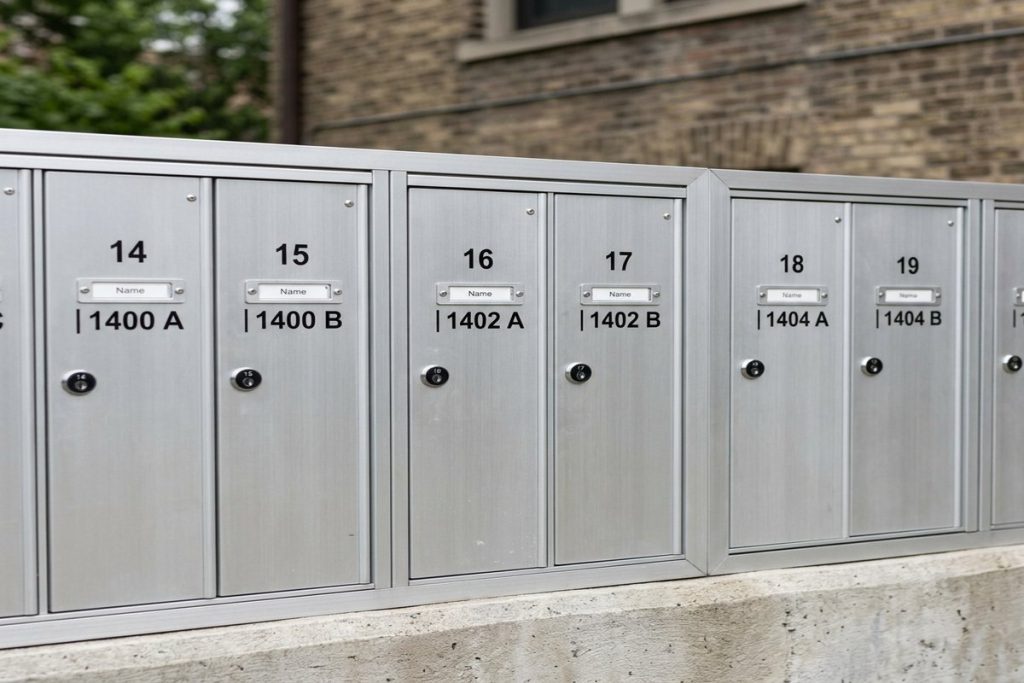
Cluster Box Units (CBU) for apartments, condos, and new developments: A CBU is a multi-unit, lockable mailbox cluster that serves multiple addresses from a single installation. All new residential developments must use CBUs rather than individual curbside mailboxes. The older NDCBU (Neighborhood Delivery Collection Box Unit) is no longer approved for new installations.
For CBU installations, the USPS requires formal approval from the local postmaster or USPS Growth Manager before installation. The CBU must meet STD-4C specifications. Each individual compartment door must carry the unit number or apartment number clearly. At least one compartment must have its access point no higher than 48 inches from the finished floor to comply with ADA accessibility requirements. One parcel locker must be provided for every five resident compartments.
Expert Note: When selecting the post material and diameter for a rural mailbox installation on a county road with a posted speed limit of 55 mph, to confirm that the 2-inch diameter steel pipe post used meets the USPS “break-away compliant” requirement (the post must deflect or break at ground level if struck by a vehicle rather than causing vehicle damage or rolling), while also having adequate lateral stiffness to resist deflection from wind load (a 30 mph wind on a standard mailbox produces approximately 15 Newton of lateral force), a static lateral deflection test on the post-in-ground assembly using a calibrated force gauge applying 30 Newton lateral load at the top of the installed post and measuring deflection with a dial indicator at mid-height and at the top of the post is used to confirm: (a) lateral deflection under the 30 Newton test load is below 10mm (mailbox position stability); and (b) under a simulated 800 Newton vehicle impact load applied as a step function at 40mm above ground level, the post shows visible yielding (break-away compliance) within 50mm of displacement. The post cross-section dimensions are confirmed with a calibrated digital caliper against the 2-inch nominal outer diameter tolerance per dimensional compliance requirements. Dimensional verification of round structural posts follows ASME Y14.5-2018 (Dimensioning and Tolerancing), the standard governing dimensional tolerance specification and verification methodology for cylindrical structural members.
What Outgoing Mail Flag Rules Does USPS Have?
The mail flag is the small moveable signal arm on the right side of the mailbox. It tells the postal carrier that outgoing mail is inside and needs to be collected on that day’s route. The flag rules are specific and often misunderstood.
Location: right side only. The USPS requires the flag to be on the right side of the mailbox when viewed from the front (the road-facing side). This is the standard position for all USPS-approved mailbox designs. The reason is standardisation: carriers expect the flag to be in the same position on every mailbox on their route, which speeds route efficiency.
The flag must pivot freely. A stuck or stiff flag is a compliance problem. The carrier needs to raise and lower the flag easily from their vehicle window without getting out. A flag that is painted shut, rusted in place, or obstructed by ice in winter cannot be operated and will be noted as a maintenance issue.
Approved flag colours: The USPS allows any colour for the flag except green, brown, white, yellow, or blue. These five colours are excluded because they either blend with common environmental backgrounds (green and brown) or could be confused with regulatory traffic signals (white and yellow) or water fixtures (blue). The USPS-recommended colour is fluorescent orange, which provides the highest daylight visibility against both natural backgrounds (grass, leaves, soil) and urban backgrounds (pavement, concrete, brick).
Red flags are also widely used and accepted. A bright red flag is clearly visible in most conditions and is the traditional colour used on US residential mailboxes for generations.
The flag must not block access. The flag in its raised position must not prevent the mailbox door from opening fully or obstruct the carrier’s view of the mailbox interior. Most approved mailbox designs accommodate this requirement automatically, but non-standard or home-modified designs sometimes have flags that conflict with door operation.
Important: do not put the flag up for incoming packages. The flag is only for outgoing mail from the customer to the postal service. If you are expecting a delivery, do not raise the flag. The carrier may assume you have outgoing mail, and when they find none, it creates confusion. For incoming package notifications, use the USPS Informed Delivery service instead.
Expert Note: When testing the rub-abrasion resistance of the house address number markings applied by a stencil-and-spray technique to 200 metal mailboxes on a new development, to predict whether the painted numbers will remain legible after years of contact with postal carrier gloves, mail bundles pressing against the mailbox face, and occasional rainfall followed by debris contact, a Sutherland Rub Tester with a 4-pound rubber-faced weight, 50 cycles of double rubs at standard 1-inch stroke amplitude using #1 Kraft paper as the abrasion medium, applied to the cured paint surface at 24 hours after application is used to assess the abrasion resistance of the address number paint by measuring the mass loss of the test paper (transferred ink) and the % residual optical density of the paint on the substrate using a reflection densitometer at the rub area compared to an undisturbed adjacent area. A post-rub optical density above 80 percent of the original value confirms the paint is adequately abrasion-resistant for long-term postal contact. A residual density below 70 percent predicts visible wear through within 2 to 3 years of daily carrier handling. Printed ink rub resistance testing follows ASTM D5264-98 (Standard Practice for Abrasion Resistance of Printed Materials by the Sutherland Rub Tester), the primary standard for evaluating ink and coating abrasion resistance on flat surfaces under controlled rubbing conditions.
How Do You Make Your Mailbox Visible to Postal Carriers at Night?
Most residential mail delivery occurs during daylight hours. However, rural route delivery, early morning industrial route delivery, and late afternoon winter delivery in northern states can all occur in low-light or near-dark conditions. In these situations, an unlit mailbox with non-reflective address numbers can be genuinely difficult to identify from a moving postal vehicle.
The USPS does not currently require illuminated or retroreflective address markings on standard residential curbside mailboxes. However, several state and county 911 addressing programs do require retroreflective or illuminated house numbers on rural mailboxes. And even where it is not required, adding retroreflective address numbers significantly improves visibility for emergency responders, which can matter critically in a medical emergency.
Retroreflective number decals: High-grade retroreflective vinyl address number decals (such as 3M Engineer Grade Sheeting Series 3200 or Avery Dennison HP 6800 series) increase the night-time visibility of address numbers dramatically. When struck by a vehicle headlight beam, these materials reflect light directly back toward the driver rather than scattering it. The result is a bright, high-visibility number visible from 50 to 100 metres in standard vehicle headlight conditions.
Solar LED address number panels: For properties where nighttime emergency visibility is a particular concern (long driveways, rural properties, properties on curves), a solar-powered LED house number panel is the most visible option available. These panels are bright enough to read from a moving vehicle at 30 metres in complete darkness.
Reflective tape on the post: Adding a horizontal band of retroreflective orange or white tape at eye level on the mailbox post helps emergency and postal vehicles locate the mailbox position in darkness before the individual numbers are readable.
Expert Note: When evaluating the nighttime visibility of two competing retroreflective address number products for a county-wide 911 mailbox marking programme (Product A: 3M Engineer Grade sheeting; Product B: commercial-grade glass bead retroreflective vinyl), by measuring the photometric performance of each product under simulated rural postal delivery vehicle lighting conditions (headlight at 50 metres, driver at 1.2 metres above road surface, address number at 0.9 metres above road surface), a calibrated roadway luminance measurement system using a calibrated photometer head with CIE photopic V(lambda) spectral response filter, tripod-mounted at 50 metres from the address number sample, photometer aperture at the same height as a standard vehicle driver’s eye is used to measure the luminance (in candelas per square metre) of each retroreflective address number product when illuminated by a standard ISO 6742-1 compliant vehicle headlight (low beam, 7,500 lux at 25 metres) at the standard 4-degree entrance angle and 0.2-degree observation angle representing the vehicle geometry. Product B luminance is compared to the minimum visible luminance threshold of 0.5 cd/m2 at 50 metres in a clear rural night environment. Roadway lighting photometric measurement follows IESNA RP-8-14 (Illuminating Engineering Society of North America Recommended Practice for Roadway Lighting), the engineering standard governing photometric measurement methodology and visibility performance assessment for roadway applications.
What Happens If Your Mailbox Does Not Meet USPS Regulations?
USPS carriers are trained to identify non-compliant mailboxes and report them through the appropriate channel. The process for dealing with a non-compliant mailbox typically follows these steps.
Step 1: Informal carrier notice. In many cases, the carrier will leave a note in your mailbox or on your door explaining the specific issue (for example, “house number not visible” or “mailbox too low”). This is an informal notice giving you a chance to correct the problem voluntarily before formal action.
Step 2: PS Form 4056 (Official notice of non-compliance). If the informal notice does not produce a correction within a reasonable period, the carrier or postmaster issues USPS PS Form 4056, which is an official written notice of non-compliance. This form specifies exactly which regulation is being violated and gives you a formal deadline (typically 30 days) to correct the issue.
Step 3: Suspension of delivery service. If the non-compliance is not corrected within the deadline stated on Form 4056, the postal carrier will discontinue mail delivery to your address. You will need to collect your mail from the local post office until the issue is resolved.
Step 4: Reinstatement. Once you have corrected the non-compliant condition, contact your local postmaster. They will arrange for an inspection, and if the mailbox now meets all requirements, delivery service is reinstated.
What does not constitute a compliance issue: Normal weathering and surface dirt on an otherwise readable and correctly positioned mailbox is not a compliance issue. USPS does not require you to have a new-looking mailbox: it requires a compliant one. A dented but correctly positioned mailbox with legible 1-inch numbers passes inspection. A pristine-looking new mailbox with 0.5-inch numbers in low contrast fails inspection.
Expert Note: When designing a 50-unit residential development mailbox installation using aluminium CBU units mounted on powder-coated steel post frames, and needing to assess whether any galvanic corrosion risk exists at the contact interface between the aluminium CBU base plate (Alloy 6061-T6, galvanic series potential approximately -0.74V versus standard calomel electrode) and the steel post mounting flange (mild steel, galvanic series potential approximately -0.44V versus standard calomel electrode), creating a potential galvanic cell with a 0.30V difference that may cause accelerated corrosion of the aluminium base in a wet coastal environment, a galvanic corrosion test cell is assembled using 50mm x 50mm test coupons of the aluminium alloy and mild steel samples connected externally through a zero-resistance ammeter (ZRA) and immersed in 0.5 percent sodium chloride electrolyte at 25 degrees Celsius, measuring the galvanic current density flowing between the couple over a 72-hour period at 1-minute measurement intervals. A galvanic current density above 10 microamperes per square centimetre sustained over 72 hours indicates a corrosion rate that will cause visible aluminium pitting at the contact interface within 3 to 5 years in a coastal postal installation. The solution is either to install an isolating neoprene gasket between the two metals or to replace the steel flange with a Grade 316 stainless steel component. Galvanic corrosion testing follows ASTM G71-81 (Standard Guide for Conducting and Evaluating Galvanic Corrosion Tests in Electrolytes), the reference standard for galvanic couple current measurement and galvanic corrosion rate prediction in aqueous environments.
Do Other Countries Have Similar Mailbox Marking Rules?
USPS regulations apply only in the United States. But most developed postal services around the world have similar requirements, though the specific numbers differ.
Royal Mail (United Kingdom): UK addresses use a different system: the property number and postcode (such as “42 Elm Street, SW1A 2AA”) are the primary delivery identifiers. Royal Mail does not specify a minimum number height for letterbox-style mail slots (common on UK front doors) but requires the address to be visible and accessible. Rural collection boxes (less common in the UK) follow local authority guidelines rather than Royal Mail specifications. Many UK local councils recommend a minimum 50mm (approximately 2 inches) address number height for visibility from the road.
Canada Post: Canada Post provides detailed guidelines for curbside community mailboxes (CCMs) used in suburban Canada. Address labelling on the individual compartment must be clearly visible and use the correct Canada Post address format. Canada Post recommends 1-inch minimum character height for rural mailboxes, consistent with USPS standards.
Australia Post: Australia Post recommends that house numbers are visible from the street at a minimum height of 57mm (approximately 2.25 inches) for readability from a delivery vehicle. Australian state and territory fire services often specify stricter minimum heights for properties on high-speed rural roads. Unlike USPS, Australia Post does not have legal authority to suspend delivery for non-compliant markings: it relies on recommendation rather than enforcement.
India: India Post: India Post addresses use a combination of door number, locality, pin code, and city. Requirements for house number marking vary significantly by state and municipality. India Post does not have a national standard equivalent to USPS DMM Section 508.
| Postal Service | Min. Number Height | Enforcement | Delivery Suspension? |
| USPS (USA) | 1 inch (25.4mm) | Yes, formal | Yes (Form 4056) |
| Royal Mail (UK) | Not formally specified | No | No |
| Canada Post | 1 inch (25.4mm) recommended | Partial | Rarely |
| Australia Post | 57mm (2.25 inches) recommended | Advisory only | No |
| India Post | Not standardised nationally | No | No |
Expert Note: When evaluating whether to specify USPS-approved mailbox products in a development that uses aluminium mailbox body shells mounted on galvanised steel posts in a coastal Florida installation (where seasonal rainfall and salt air significantly accelerate the rate at which water penetrates poorly-sealed joints), to determine whether rain driven by typical Florida summer thunderstorms can penetrate the gap between the mailbox body and the door frame seal (potentially damaging mail inside), a static water penetration test per ASTM E331 is conducted on a representative production mailbox unit by sealing all openings except the mail slot and flag pivot, pressurising the exterior face of the closed mailbox door to a static air pressure differential of 75 Pa (simulating a 35 mph wind-driven rain load) while simultaneously applying a water spray rate of 2.0 L/m2-min through a nozzle array positioned 300mm from the mailbox face for 15 minutes, then opening the mailbox and inspecting for visible water penetration to the interior delivery surface. Any water appearing on the interior floor of the mailbox during the 15-minute test constitutes a water penetration failure. The seal geometry or door gap must be corrected before production approval. Water penetration resistance testing of enclosures follows ASTM E331-00 (Standard Test Method for Water Penetration of Exterior Windows, Skylights, Doors, and Curtain Walls by Uniform Static Air Pressure Difference), adapted here for mailbox enclosure water ingress assessment.
How Do You Keep Your Mailbox Markings Compliant Year After Year?
USPS compliance is not a one-time task. The markings on your mailbox degrade over time from UV radiation, rain, temperature cycling, and physical contact with mail and postal equipment. What passes inspection today may fail inspection in 3 to 5 years if the numbers have faded significantly.
Here is a simple annual maintenance schedule to keep your mailbox compliant.
Every spring: Stand at the road edge and look at your mailbox from the carrier’s approach direction. Can you read the house number clearly in 2 seconds without squinting? If not, the numbers need to be refreshed or replaced. Also, check the flag: does it pivot freely? Does it hold its position when raised without falling? A flag that falls down before the carrier reaches your box is a compliance issue.
Every 2 to 3 years: Check the mailbox height with a tape measure. Mailbox posts can settle over time, particularly after wet winters or frost heaving. A post that settles 3 inches over 3 years can take a compliant 43-inch installation out of compliance. If the height has changed, adjust the post before the next postal inspection cycle.
Every 5 years (or when visible fading begins): Replace the address number markings entirely. Even if the numbers are still technically readable, a fresh set of number stickers or plates refreshes the compliance margin and significantly improves the appearance of the mailbox. The cost of a new premium vinyl number set is typically GBP 5 to 15 / USD 5 to 20, which is negligible compared to the disruption of a delivery suspension.
After any physical damage: If your mailbox is hit by a vehicle, damaged by vandalism, or knocked out of position by a fallen branch, inspect it immediately for height compliance and number legibility. A dented mailbox that still meets all requirements continues to receive delivery. A dented mailbox that is now too low, too high, or has unreadable numbers needs to be corrected before the next mail delivery day.
Expert Note: When testing the long-term UV stability of the cast acrylic mailbox address number plate material used on a new residential development’s 75 curbside mailboxes (the plates are white UV-stabilised cast acrylic with black laser-engraved text, and must remain legibly readable for a minimum 10-year USPS compliance lifecycle without the house owner needing to replace them), an outdoor accelerated weathering test using a Fresnel-lens concentrating mirror array (EMMA device, 8-panel Fresnel reflector tracking array, concentration factor approximately 8x relative to ambient solar UV, specimen specimen temperature controlled at 70 degrees Celsius using compressed air cooling, specimen rotation to equalise exposure) is used to expose 10 replicate acrylic plate samples over a 6-month accelerated exposure period equivalent to approximately 10 years of Arizona outdoor UV dose. After exposure, the plates are measured for yellowness index change (ASTM D1925), surface crack formation (visual at 10x magnification), and laser engraving readability at 3 metres by three observers under standardised D65 illumination. An acrylic plate with yellowness index increase below 5 units and zero surface cracking after the equivalent 10-year test dose is certified as meeting the 10-year USPS readability compliance specification. Outdoor concentrated UV weathering testing follows ASTM D4364-02 (Standard Practice for Performing Outdoor Accelerated Weathering Tests of Plastics Using Concentrated Sunlight), the standard for Fresnel-lens concentrating mirror weathering accelerated testing of outdoor polymer materials.
What Are the Most Common USPS Mailbox Marking Mistakes Homeowners Make?
Understanding what goes wrong most often helps you avoid the same problems. Here are the most frequently cited causes of USPS non-compliance notices.
Mistake 1: Numbers that are too small. The most common issue. Many hardware store number sets come in 0.5-inch to 0.75-inch height, which is below the USPS 1-inch minimum. Also, attractive decorative address number sets often use thin, ornate fonts where the visible number strokes are much smaller than the overall character height. Fix: use only products that explicitly state a minimum 1-inch character height with a bold or medium weight font.
Mistake 2: Low contrast colour combinations. Gold numbers on a beige mailbox, grey on silver, and cream on white are the most frequently cited contrast failures. Fix: use the maximum contrast you can achieve: dark numbers on a light background, or bright numbers on a very dark background.
Mistake 3: Numbers on the wrong side. In some properties, the homeowner places numbers on the back of the mailbox (facing the house) rather than the front (facing the road). Numbers on the wrong side are effectively invisible to the carrier. Fix: always place numbers on the side that faces the approaching carrier vehicle.
Mistake 4: Mailbox too high or too low. Post settling, frost heaving, and improper initial installation all contribute to height compliance failures. A mailbox initially installed at 43 inches can settle to 38 inches over 2 to 3 wet winters. Fix: check the height annually with a tape measure.
Mistake 5: Wrong flag colour. Green, brown, white, yellow, and blue flags all violate USPS requirements. Some attractive mailbox accessories include dark green or white decorative flags that look elegant but fail compliance. Fix: use only fluorescent orange or red flags.
Mistake 6: Advertising on the mailbox. Business owners sometimes add their company name or logo to their mailbox. This violates USPS DMM prohibition on advertising. Fix: keep the mailbox display limited to address information and owner name only.
Mistake 7: Overgrown vegetation blocking approach. The USPS requires the approach to the mailbox to be kept clear. Grass growing over the road edge, low-hanging branches, or shrubs that force the carrier to stop and reposition can all lead to a non-compliance notice. Fix: trim vegetation around the mailbox area at least 4 times per year.
Expert Note: When verifying that the dimensional inspection equipment used to check USPS mailbox compliance during a postal route audit (specifically, a digital calliper used to measure house number character height, and a calibrated rigid steel rule used to verify mailbox height from the road surface) meets the measurement accuracy requirements for regulatory compliance inspection, a calibrated instrument verification check using NIST-traceable gauge blocks (for the digital calliper) and a precision straightedge with certified graduations (for the steel rule) is conducted at the start of each inspection day, confirming that: (a) the digital calliper reads within plus or minus 0.05mm of the gauge block value across the 0 to 25mm range used for character height measurement; and (b) the steel rule reads within plus or minus 2mm of the gauge block tower at the 1,000 to 1,200mm range used for mailbox height measurement from road surface. Any instrument found outside tolerance is taken out of service until recalibrated. Precision inspection instrument calibration verification follows ASME B107.500-2010 (Measurement, Inspection, and Verification Equipment), the American standard for managing the accuracy and traceability of calibrated measurement tools used in industrial and regulatory inspection programmes.
🛍️ Shop USPS-Compliant Mailbox Name Plates: All plates on our site meet the USPS 1-inch minimum character height, high-contrast colour, and outdoor durability requirements. Browse our Compliant Mailbox Address Number Sets, Premium Retroreflective Number Plates, and Replacement Mailbox Flags (USPS Approved Colours). All products ship with a 5-year legibility guarantee.
Frequently Asked Questions About USPS Mailbox Marking Regulations
Does my mailbox number need to be exactly 1 inch or can it be bigger?
It must be at least 1 inch. Bigger is always acceptable and is recommended for rural mailboxes or any mailbox on a high-speed road. The 1-inch minimum is the floor: there is no maximum size specified in USPS DMM Section 508. Using 2-inch or even 3-inch numbers on a rural mailbox is legal and improves visibility for both the carrier and emergency services.
Can I write my house number on the mailbox with a marker?
Technically, a permanent marker can produce a compliant 1-inch marking initially. However, permanent marker ink fades within 6 to 18 months of outdoor UV exposure on most mailbox surfaces, and the ink may also rub off from contact with mail. When the number becomes unreadable, you have a compliance problem. Use a proper adhesive-backed number plate, vinyl decal, or paint for any permanent installation.
My mailbox is painted with my house number directly on it. Is that OK?
Yes, as long as the painted number meets the size (1 inch minimum) and contrast requirements. Use outdoor-rated sign paint or exterior acrylic, not interior latex paint, which fades rapidly outdoors. Apply a clear exterior varnish over the painted numbers to extend their weatherproof life.
What should I do if I get a USPS Form 4056?
Read the form carefully to identify exactly which requirement is out of compliance. Correct the specific issue described within the deadline stated on the form (typically 30 days). After correcting it, contact your local post office and let them know the issue has been addressed. They will arrange for the carrier to inspect and confirm compliance on the next mail delivery day.
Can I use decorative numbers from a craft store for my mailbox?
Many craft store number sets use fonts with very thin, decorative strokes that may not be clearly readable from 3 metres. They may also be sized below the 1-inch USPS minimum. Always measure the actual character height of any number set before installing it on your mailbox. Use only bold or medium weight fonts, and confirm the character height is at least 1 inch as measured from the top to the bottom of the digit.
Is my mailbox USPS-compliant if I only show the street number and not the street name?
For most residential addresses, the street number alone is sufficient if your mailbox is located on the same street as your property address. The street name is only required if your mailbox is on a different street from your assigned postal address, which can happen on corner lots or rural properties with driveway access from a different road.
Does USPS require the mailbox to be locked?
For standard residential curbside mailboxes, USPS does not require a lock. The mail slot must be able to receive mail without requiring any action from the recipient. For Cluster Box Units (CBUs), each individual compartment is locked and the CBU master lock is a USPS Arrow lock that only USPS carriers have a key to.
What is the USPS rule on decorations on the mailbox?
Seasonal or personal decorations (such as painted flowers, sports team decals, or patriotic imagery) are generally tolerated as long as they do not: obscure the required address number, constitute advertising, or interfere with mail delivery. However, the USPS retains the right to require removal of any decoration that a carrier or postmaster judges to be interfering with compliance or delivery. To be safe, keep decorations away from the number area and do not add any commercial logos or promotional material.
Does the mailbox need to have my name on it?
No. The owner’s name is optional under USPS DMM Section 508.1.4. The only required information is the address number (and street name if applicable for your address type). Many homeowners include their family name as a courtesy for visitors, which is permitted but not required.
Can I use a mailbox that is not a standard rectangular shape?
Yes. USPS accepts any mailbox design that meets the volume, dimensional, and marking requirements specified in USPS Publication 36 (Specifications for Curbside Mailboxes). Designs are approved by USPS and listed on the USPS-approved mailbox list. Any mailbox that carries the statement “Approved by Postmaster General” on it is a USPS-accepted design. Non-approved custom-made mailboxes may be rejected by your local postmaster regardless of their other qualities.
Explore Essential House Name Plate Guides & Tutorials
Browse our comprehensive handcrafted signage guides for material care, font selection, and architectural placement:
- Beach & Airbnb Signage Design & Weatherproofing Guide (2026)
- Complete Guide to Wood House Sign Sealing & Weather Maintenance
- Horizontal vs Vertical House Numbers Layout Comparison
- Hanging & Wall-Mounted Cottage Sign Installation Guide
- Round vs Rectangular Name Plaques for Modern Property Entrances
- Best Modern & Vintage Fonts for Cottage & Residential Signs