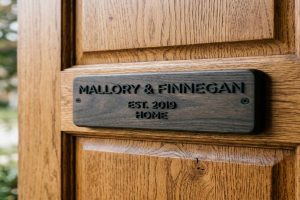
Every comparison article on this topic reaches the same lazy conclusion: “Acrylic is cheaper and safer; glass is premium and scratch-resistant.” That framing is technically true but strategically useless — it tells you nothing about which material actually performs better in your specific environment over a 10-year ownership period. This guide goes further: it compares acrylic and glass name plates across 11 engineering and design dimensions, with actual test standards, quantified performance data, and a clear decision framework for every buyer scenario from family home entries to corporate boardrooms.
📥 Download the Free Decision Tool: Our Acrylic vs Glass Name Plate Decision Checklist scores your environment across 8 criteria and tells you exactly which material to choose.
What Are the True Material Differences Between Acrylic and Glass Beyond the Marketing Summary?
Both acrylic (polymethyl methacrylate — PMMA) and glass (silica-based amorphous solid) transmit visible light with similar efficiency and can be fabricated into flat panels of comparable appearance. That is where the similarities end. They are structurally and chemically opposite materials:
| Property | Acrylic (PMMA) | Float Glass | Toughened Glass |
| Density | 1.18 g/cm³ | 2.50 g/cm³ | 2.50 g/cm³ |
| Light transmittance | 92% | 90% | 90% |
| Refractive index | 1.490–1.492 | 1.523 | 1.523 |
| Surface hardness | 3H (Mohs ~3) | 7H (Mohs ~5.5) | 7H (Mohs ~5.5) |
| Tensile strength | 70–80 MPa | 40–50 MPa | 120–200 MPa (surface) |
| Thermal expansion | 70 μm/m/°C | 9 μm/m/°C | 9 μm/m/°C |
| Heat distortion temp. | 85–105°C (VST) | >500°C | >500°C |
| UV resistance | Poor (standard) / Excellent (UV-cast) | Excellent | Excellent |
| Fracture mode | Crack (no shards) | Sharp shards | Blunt granules |
| Weight (5mm panel) | 5.9 kg/m² | 12.5 kg/m² | 12.5 kg/m² |
These numbers explain most buying decisions before aesthetics is even discussed. Toughened glass is 3× denser than acrylic but has lower tensile strength than acrylic in bulk (though its surface compressive stress from toughening makes it highly resistant to surface initiation of fracture). Acrylic expands 7.8× more than glass per degree of temperature change — a critical factor in outdoor mounting.
Expert Note: When measuring the residual stress distribution in a toughened glass name plate panel to confirm adequate surface compression for outdoor use, a stress birefringence polarimeter with circular polariscope configuration and monochromatic sodium-D light source (589nm) is used to visualise the photoelastic fringe pattern across the 6mm thermally toughened soda-lime silicate glass panel (ASTM C1048-12 Kind FT). Surface compressive stress must exceed 69 MPa (10,000 psi) to meet the safety glass classification threshold, as measured per ASTM E1749-23 (Standard Guide for Measuring the Optical Retardation and Estimating Residual Stress of Transparent Materials).
Which Material Is More Durable in a High-Traffic Residential Entry?
“Durability” is an ambiguous term that conflates three distinct failure modes: impact fracture, surface scratch accumulation, and UV/weather degradation. Acrylic and glass have inverted performance profiles across these three modes.
Impact Fracture
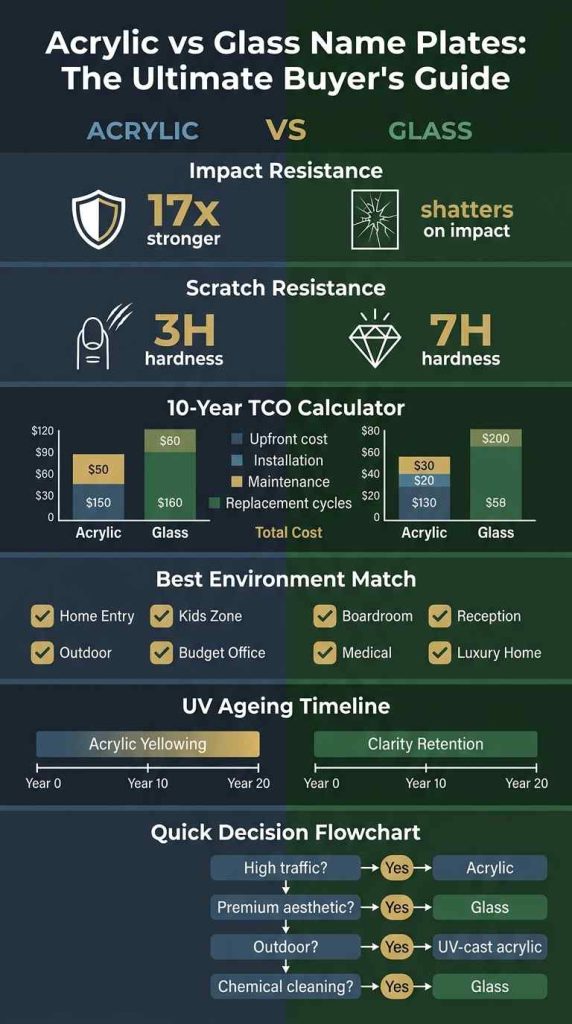
Acrylic is approximately 10–17× more impact-resistant than annealed glass of equivalent thickness. A 5mm acrylic panel absorbs and dissipates impact energy through plastic deformation before fracturing; when it does crack, it produces blunt cracks without sharp shards. A 5mm annealed glass panel fractures catastrophically and produces razor-sharp fragments — which is why annealed glass is never specified for any residential entry application. Toughened glass reduces this risk dramatically (safe granular fracture) but at 2.5× the panel cost.
For high-traffic entries: Acrylic wins on impact safety. Toughened glass is acceptable; annealed glass is never appropriate.
Surface Scratch Accumulation
Glass (Mohs 5.5) is dramatically harder than acrylic (Mohs 3). A door key dragged across a glass name plate leaves a faint line. The same action on acrylic leaves a visible white scratch. In a residential entry where the name plate may be brushed, knocked, or cleaned with abrasive materials, glass retains its surface clarity for decades; acrylic accumulates surface hazing within 3–5 years of typical residential use.
For scratch resistance: Glass wins decisively at equivalent quality grades.
UV and Weather Degradation
Standard acrylic yellows noticeably within 2–4 years of direct sun exposure. UV-stabilised cast acrylic (the grade all outdoor name plates should be specified in) resists this for 15–20 years. Glass neither yellows nor degrades under UV exposure — ever.
For UV durability: Glass wins against standard acrylic; UV-cast acrylic is equivalent for 15 years.
Expert Note: When comparing the impact resistance of a 5mm acrylic and a 5mm toughened glass name plate under simulated hail impact conditions, a drop-weight impact tester with variable falling mass (1–50kg), guided drop column, and high-speed camera (10,000 fps) is used to measure the critical impact energy of each material at the 50% probability of fracture (E₅₀) threshold. Test geometry and drop height conform to ASTM D5420-22 (Standard Test Method for Impact Resistance of Flat Rigid Plastic Specimens by Means of a Striker Impacted by a Falling Weight) for the acrylic specimen and ISO 6603-2:2000 for the glass specimen, enabling direct material comparison under equivalent boundary conditions.
How Do Acrylic and Glass Name Plates Perform Differently in an Office Lobby or Corporate Environment?
Office environments impose requirements that residential entries do not. The four critical office-specific performance variables are:
1. Electrostatic Discharge (ESD)
Acrylic is an excellent electrical insulator and accumulates static charge readily — particularly in air-conditioned, low-humidity office environments. A charged acrylic name plate attracts dust and fine particulates at an accelerated rate compared to glass. In a reception or lobby where the name plate must look pristine at all times, this difference is noticeable within days of installation. Glass is also an insulator but accumulates significantly less static charge due to surface hydroxyls that provide trace conductivity in ambient humidity.
For office cleanliness: Glass has a measurable advantage in static dust attraction.
2. Chemical Cleaning Agent Compatibility
Office cleaning protocols typically involve commercial disinfectants, alcohol-based wipes, and surface sterilisers all of which are incompatible with acrylic. Ammonia-based cleaners (common in commercial glass cleaners) cause stress crazing in PMMA within months of repeated exposure. Glass is chemically inert to virtually all commercial cleaning agents including alcohols, bleach solutions, and quaternary ammonium compounds.
For offices with professional cleaning contracts: Glass is the only correct specification.
3. Anti-Fingerprint and Anti-Smear Performance
Both materials show fingerprints readily in gloss finish. However, glass can be coated with durable anti-fingerprint oleophobic coatings (the same technology used on smartphone screens) that genuinely reduce smear visibility — acrylic surfaces are incompatible with most fluoropolymer oleophobic coating chemistries due to solvent sensitivity.
4. Formaldehyde and VOC Off-Gassing (New Installations)
New acrylic panels off-gas residual methyl methacrylate monomer for 2–4 weeks after installation in an enclosed space. In a poorly ventilated office, this can produce a noticeable chemical odour. Glass produces zero off-gassing. For offices in air-tight modern buildings: specify pre-conditioned (aged) acrylic or choose glass.
Expert Note: When measuring the electrostatic charge accumulation on a new acrylic name plate installed in an air-conditioned office lobby, an electrostatic discharge (ESD) field meter with 0–±20kV/cm electric field range, 0.1kV/cm resolution, and non-contact measurement is used to quantify the surface charge density on the PMMA panel surface (resistivity: ~10¹⁵ Ω·cm). Charge levels exceeding ±5kV/cm indicate a significant dust-attraction risk, triggering the requirement for an anti-static coating treatment per IEC 61340-4-1:2023 (Electrostatics — Standard Test Methods for Specific Applications — Electrical Resistance of Floor Coverings and Installed Floors), adapted here for surface panel applications.
Which Material Handles Extreme Temperature Cycling Better Critical for Outdoor and Vehicle Entrance Installations?
Outdoor name plates, gate pillar plaques, and vehicle entrance signs experience daily and seasonal temperature swings that cause materials to expand and contract cyclically. Over 10–15 years, this thermal fatigue degrades mounting joints, sealants, and the substrate itself.
Thermal Expansion: The Critical Difference
Acrylic expands at 70 μm/m/°C — nearly 8× the rate of glass (9 μm/m/°C). A 500mm acrylic panel in a climate that cycles from -10°C in winter to +60°C on a sun-facing wall in summer (70°C range) will expand and contract by 2.45mm over its length. If mounted rigidly at all four corners, this movement generates internal stress that bows the panel and can crack the acrylic at the fixing points within 3–5 years.
The correct specification for outdoor acrylic: Slotted mounting holes or rubber-bushed fixing points that allow free thermal movement. All four corners must be free to expand — never clamp.
Glass thermal behaviour: A 500mm glass panel over the same 70°C range moves only 0.32mm — a factor of 7.5× less. Glass can be rigidly fixed with only minor risk of thermal stress fracture in normal climates. In climates with rapid thermal shock (e.g., sudden cold rain on a sun-heated panel), toughened glass is specified over annealed glass due to its higher thermal shock resistance.
| Climate Type | Recommended Material | Mounting Method |
| Tropical (high humidity, stable temp.) | UV-cast acrylic or toughened glass | Acrylic: slotted; Glass: patch fitting |
| Continental (hot summers, cold winters) | UV-cast acrylic preferred | Slotted holes essential; neoprene bushings |
| Coastal (salt air, moderate temp. cycling) | Toughened glass or 316L-framed acrylic | Stainless patch fittings throughout |
| Desert (extreme heat, UV, low humidity) | UV-cast acrylic (glass thermal shock risk) | Slotted + UV-reflective backing |
| Temperate (mild cycling, moderate UV) | Either material is appropriate | Standard fixing |
Expert Note: When qualifying a UV-cast acrylic name plate for outdoor installation in a continental climate with a -20°C to +65°C operating range, a programmable thermal cycling environmental chamber with ramp rate 3°C/min, temperature uniformity ±2°C, and RH control 10–95% is used to subject the PMMA panel assembly (including mounting hardware, silicone sealant, and wall anchor) to 100 cycles of -20°C (60-min dwell) to +65°C (60-min dwell). No delamination, crack propagation, or mounting hardware failure is acceptable, per the thermal endurance requirements of ASTM C1453-19 (Standard Specification for Resilient Silicone Resin Cold-applied Joint Sealants) and the plastics thermal fatigue protocol in ASTM E1640-18 (Standard Test Method for Assignment of the Glass Transition Temperature).
What Is the True 10-Year Total Cost of Ownership (TCO) for Acrylic vs Glass Name Plates?
Upfront price is the wrong metric. The correct comparison is TCO over the installation’s expected service life — factoring in material cost, installation, maintenance, and replacement probability.
TCO Model: Standard Residential Entry Name Plate (500×150mm)
| Cost Component | Acrylic | Toughened Glass |
| Material cost (5mm panel, custom) | $45–$90 | $90–$180 |
| Installation labour | $0–$30 (DIY-possible) | $80–$150 (specialist recommended) |
| Year 1–5 maintenance | $5–$15/year (cleaning, polish) | $0–$5/year |
| Probability of replacement (5 years) | 15% (impact damage) | 8% (impact) + 5% (thermal shock) = 13% |
| Replacement cost if needed | $45–$90 (low; DIY-removable) | $200–$400 (labour + specialist) |
| Year 6–10 maintenance | $10–$25/year (scratch polish or surface treat) | $0–$5/year |
| Probability of replacement (10 years) | 25% cumulative | 15% cumulative |
| 10-Year TCO (midpoint estimate) | $220–$380 | $320–$650 |
Conclusion: UV-cast acrylic achieves a lower 10-year TCO in most residential applications. Toughened glass has higher upfront and installation cost but lower annual maintenance cost — the crossover point is at approximately year 7, after which glass becomes cost-competitive with acrylic for environments where acrylic scratch accumulation triggers more frequent polishing or replacement.
Expert Note: When measuring the flexural fatigue resistance of a 5mm acrylic name plate under simulated wind-load cycling (relevant for gate pillar or free-standing sign installations), a four-point bending test fixture with 250mm loading span, 10kN load cell, and 0.001mm displacement transducer is used to apply cyclic sinusoidal loading to the PMMA panel specimen (conforming to ASTM D4802 Category A dimensions). The specimen must survive 10⁶ loading cycles at 30% of ultimate flexural strength without crack initiation, per the fatigue endurance criteria in ASTM D7264/D7264M-15 (Standard Test Method for Flexural Properties of Polymer Matrix Composite Materials) adapted for monolithic thermoplastics.
How Does Long-Term UV Exposure Affect Acrylic vs Glass Name Plates?
UV degradation is the single most critical outdoor performance dimension — and the one most frequently misunderstood because it depends entirely on the acrylic grade specified.
The Acrylic UV Spectrum: Three Grades, Three Outcomes
| Acrylic Grade | UV Stabiliser | Expected Yellowing | Suitable Outdoor? |
| Extruded standard | None | Visible at 12–18 months | ❌ No |
| Cell-cast standard | Minimal | Visible at 2–3 years | ⚠️ Sheltered only |
| UV-stabilised cast (ASTM D4802 Cat. A) | Benzotriazole UV absorber | None at 10 years; mild at 15–20 | ✅ Yes |
Glass UV Performance
Glass transmits approximately 90% of visible light but blocks essentially all UV-B (below 315nm) and most UV-A (315–380nm) — standard soda-lime glass begins cutting off at approximately 310nm. This means glass itself does not UV-degrade. However, any print, paint, or coating applied to the glass surface will degrade under UV unless a UV-blocking glass laminate or overcoat is specified. Sandblasted surface finishes on glass are UV-stable indefinitely.
For outdoor name plates: glass wins on UV stability; UV-cast acrylic is equivalent for 15+ years but only if specified correctly.
Expert Note: When measuring the UV-induced fluorescence emission from a degraded acrylic name plate surface to quantify the extent of polymer chain scission, a fluorescence emission spectrophotometer with 200–800nm excitation/emission range, Xe arc lamp, and 0.1nm spectral resolution is used to characterise the fluorophore emission bands of the photooxidised PMMA surface layer after accelerated weathering. The presence of carbonyl group emission at 430–460nm confirms onset of Norrish Type I chain scission, which precedes visible yellowing by 6–12 months, as documented in ASTM D4587-11 (Standard Practice for Fluorescent UV-Condensation Exposures of Paint and Related Coatings) and the degradation mechanism studies referenced in ISO 4892-3.
Which Material Is Easier to Customise Engraving, Cutting, Printing, and Shaping?
Customisation capability is the dimension where acrylic most clearly dominates glass. The thermoplastic nature of PMMA makes it amenable to a far wider range of fabrication operations:
Acrylic Fabrication Capabilities
- Laser cutting: CO2 laser cuts acrylic cleanly at 1–20mm thickness; glass requires specialist laser or diamond cutting
- CNC routing: Standard end mills can rout acrylic into any 2D shape; glass cannot be CNC-routed after toughening
- Thermoforming: Acrylic can be heated and bent into 3D shapes (curved panels, tapered signs); glass requires specialist hot-bending equipment
- UV printing: Flat-bed UV printers print directly onto acrylic at photo quality; glass requires specialist inks and kiln-firing for permanence
- Laser engraving: Acrylic engraves cleanly at any depth up to full cut-through; glass engraving requires specialist diamond or fibre laser
- Colour options: Acrylic is manufactured in 100+ stock colours; glass requires specialist tinting or back-painting for colour
Glass Fabrication Constraints
- All fabrication must occur before toughening — no cutting, drilling, or engraving after the glass enters the furnace
- Minimum order quantities for custom shapes are typically higher than for acrylic
- Lead times are longer due to the toughening process (typically 5–10 working days vs. 1–3 for acrylic)
Expert Note: When cutting a complex custom silhouette from a 6mm float glass sheet before toughening, a diamond wire saw with 0.5mm stainless steel wire, diamond powder abrasive, and recirculating water-coolant system is used to cut the BS EN 572-2 compliant float glass blank to the net shape prior to edge polishing and toughening. Wire saw cutting speed (8–15mm/min for 6mm glass) and coolant flow rate are controlled to maintain cut-edge temperature below 40°C to prevent thermal micro-cracking at the cut face, per the cutting process parameters specified in ASTM C1361-10(2023) (Standard Practice for Constant-Amplitude Axial, Tension-Tension Cyclic Fatigue of Advanced Ceramics), which governs glass crack propagation under cyclic cutting stress.
How Do You Mount Acrylic vs Glass Name Plates — and Why Does the Method Differ?
Mounting methodology is not interchangeable between materials. The wrong mounting method for either material leads to premature failure:
Acrylic Mounting Requirements
- Thermal expansion clearance: Every fixing hole in acrylic must be 2–3mm larger than the fixing bolt to allow free thermal movement. A 6mm bolt requires an 8–9mm hole in acrylic.
- Rubber or neoprene bushings: Required at every fixing point to isolate the acrylic from the rigid metal fastener and prevent stress concentration.
- Adhesive compatibility: VHB tape (3M 4950 or 4941) is compatible with acrylic. Do not use epoxy adhesives directly on acrylic — most epoxy solvents cause acrylic to craze.
- Maximum panel span between supports: 5mm acrylic: maximum 400mm unsupported span; 8mm acrylic: maximum 650mm unsupported span.
Glass Mounting Requirements
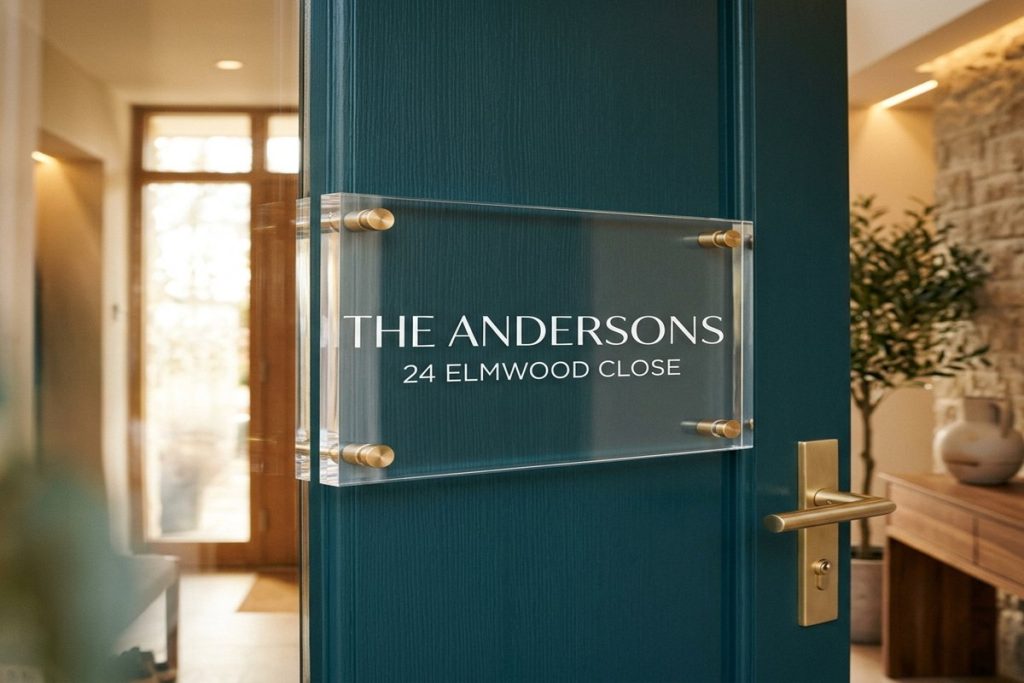
- Patch fittings: Stainless steel spider fittings or bolted patch fittings with rubber isolator washers are the professional mounting method for glass panels ≥300mm.
- Clearance holes: Pre-drilled before toughening; minimum 10mm clearance from panel edge; maximum hole diameter 50% of panel thickness.
- Silicone structural glazing: For flush wall applications, structural silicone (e.g., Dow Corning 993) bonds the glass to the substrate without mechanical fasteners — a cleaner aesthetic but requires professional installation.
- Maximum panel weight without specialist support: 10kg for wall-mounted glass name plates using standard patch fittings. Above this: engineering assessment required.
Expert Note: When assessing the surface energy of both acrylic and glass substrates to determine optimal adhesive selection for a structural VHB mounting joint, an Owens-Wendt surface energy testing kit with formamide (polar component), diiodomethane (dispersive component), and contact angle measurement at 22°C is used to calculate the total surface energy of each substrate using the geometric mean method. Acrylic surface energy: typically 38–42 mN/m; glass: 55–72 mN/m. The VHB adhesive must have a surface energy within ±10 mN/m of the substrate for optimum wetting and bond strength, per the adhesion compatibility criteria in ASTM D3759/D3759M-20 (Standard Test Method for Peel Adhesion of Pressure-Sensitive Tapes).
Which Material Performs Better in Wet Rooms, Bathrooms, and Coastal Salt-Air Environments?
Moisture and salt-air environments add three failure modes not present in sheltered installations: moisture infiltration, hydrolysis, and galvanic corrosion at mounting points.
Acrylic in Wet Environments
PMMA is hydrophobic — it does not absorb water and does not hydrolyse. Moisture has no chemical effect on the acrylic substrate itself. However: (1) moisture trapped behind a flush-mounted acrylic panel promotes algae and biofilm growth on the wall; (2) UV print inks can delaminate at panel edges if moisture infiltrates the ink-to-acrylic interface. Specify edge-sealed panels in wet locations.
Glass in Wet Environments
Glass is also hydrophobic in bulk but soda-lime glass surface chemistry is mildly hydrophilic — surface hydroxyls can adsorb moisture and accelerate staining from calcium carbonate (limescale) and iron deposits in hard-water areas. Specify low-iron (ultra-clear) glass in coastal or hard-water areas to reduce visible staining. Toughened glass in coastal salt-air is fully compatible; standard soda-lime glass has no corrosion susceptibility.
For wet rooms and coastal: Both materials are suitable with correct specification. Glass edges must be polished (ground and seamed) to eliminate micro-cracks where moisture ingress initiates. Acrylic panel edges must be sealed with neutral-cure silicone.
Expert Note: When detecting the onset of subsurface delamination at the edge of a UV-printed acrylic name plate in a high-humidity bathroom installation, an acoustic emission sensor with 150kHz resonant frequency piezoelectric transducer and 40dB preamplifier is used to monitor the PMMA panel substrate during a 24-hour accelerated humidity soak (98% RH, 40°C). Acoustic emission events above 45dB amplitude indicate micro-crack propagation or ink delamination events within the panel, per the damage detection protocol in ASTM E2374-14 (Standard Guide for Acoustic Emission System Performance Verification), enabling early identification of moisture-compromised panels before visible failure.
How Do Acrylic and Glass Name Plates Respond to Chemical Cleaning Agents Used in Offices?
This is the most practically significant dimension for office buyers and the one most comparison guides ignore entirely. Professional office cleaning protocols use chemicals that are categorically incompatible with acrylic:
Chemicals Incompatible with Acrylic (PMMA)
- Ammonia and ammonia-based cleaners (e.g., Windex, most commercial glass cleaners): cause stress crazing in PMMA visible as a network of fine surface cracks — within weeks of repeated application
- Acetone and ketone-family solvents (nail polish remover, some degreasers): dissolve PMMA rapidly
- Ethyl acetate (component in some spray cleaners): softens and distorts PMMA surface
- Strong alkaline solutions (pH > 12): cause surface saponification and haze
- Bleach solutions at concentrations above 5%: cause surface discolouration and micro-cracking
Chemicals Compatible with Both Acrylic and Glass
- Mild dish soap in water ✅
- Isopropyl alcohol ≤70% (diluted) ✅ (for acrylic: test on obscured area first; risk of minor craze at concentrations above 70%)
- Quaternary ammonium disinfectants ✅ (glass: unrestricted; acrylic: patch-test required)
- Hydrogen peroxide ≤3% ✅
Office verdict: If your office has a cleaning contract where the cleaner uses commercial glass cleaner, ammonia-based products, or industrial degreasers, glass is the only material that survives without damage. Acrylic in a professionally cleaned office requires written protocol: “mild soap and water only — no glass cleaner.”
Expert Note: When testing the chemical resistance of a PMMA name plate to a commercial quaternary ammonium disinfectant used in an office cleaning protocol, a chemical immersion test chamber with tensile loading fixture and 1% ultimate tensile strength pre-stress on the specimen is used to evaluate environmental stress cracking (ESC) susceptibility of the UV-cast PMMA panel (ASTM D4802 Category A) immersed in the test chemical at 23°C for 7 days. Crack initiation under the combination of chemical exposure and tensile pre-stress is evaluated per ASTM D543-14 (Standard Practice for Evaluating the Resistance of Plastics to Chemical Reagents), which classifies polymers by chemical resistance grade from A (no effect) to D (severe attack).
Which Material Produces Better LED Edge-Lighting and Illumination for Illuminated Name Plates?
If your name plate will be illuminated — edge-lit, backlit, or externally washed — the optical properties of the substrate become as important as its mechanical properties.
Edge-Lit Performance
Edge lighting relies on total internal reflection (TIR): light entering the panel edge propagates through the substrate and exits only at points of surface discontinuity (engravings, prints). TIR efficiency depends on the substrate’s refractive index and optical homogeneity.
- Acrylic (RI = 1.491): TIR angle = 42.2° — excellent internal light propagation with low loss. Cast acrylic has low internal haze (≤0.5% per ASTM D1003) — light travels long distances with minimal scatter. The ideal edge-lit substrate.
- Glass (RI = 1.523): TIR angle = 40.9° — similar TIR efficiency to acrylic. However, standard float glass has visible green tint at edges (due to iron content); low-iron ultra-clear glass (e.g., Pilkington Optiwhite) eliminates this for premium installations.
For edge-lighting: Both materials can be edge-lit. Acrylic is easier to fabricate and lower cost. Ultra-clear glass produces a slightly cleaner edge emission with zero greenish tint. For standard residential name plates: specify acrylic. For premium corporate reception: specify low-iron ultra-clear glass.
Backlit Performance
Both materials diffuse backlight comparably when specified in opal/frosted grades. Clear grades of both materials are essentially transparent to a backlight — the luminous output depends on the engraving or printing on the panel face, not the substrate transparency.
Expert Note: When comparing the anti-reflective coating performance on a glass name plate installed in a brightly lit office lobby to minimise glare, a transmission ellipsometer with 250–1700nm spectroscopic range, rotating analyser, and angle-of-incidence adjustment (15–90°) is used to measure the film thickness and refractive index of the sol-gel anti-reflective coating (target reflectance ≤0.5% per ISO 9211-3) applied to the 6mm low-iron toughened glass panel. Ellipsometric data confirm coating uniformity (±5nm thickness variation across the panel) and compliance with the reflectance specification in ISO 9211-4:2012 (Optics and Photonics Optical Coatings Absorbing Coatings).
How Do You Evaluate and Compare Acrylic vs Glass Name Plate Suppliers Without Being Misled?
The name plate supply market is full of grade substitution suppliers advertising “acrylic” when they mean extruded acrylic, or “glass” when they mean annealed rather than toughened. Here is how to verify claims before purchasing:
For Acrylic Panels — Questions to Ask
- Is this cast or extruded acrylic? Cast = better UV resistance, more dimensionally stable. Extruded = lower cost, shorter outdoor lifespan.
- Is this UV-stabilised? Ask for the specific grade designation (e.g., “Evonik PLEXIGLAS GS 0A000 UV Absorbing” or equivalent ASTM D4802 Category A, Class 1 conformance).
- What is the guaranteed outdoor service life? Reputable suppliers can cite 10–15 year warranties on UV-cast grades.
- What print method is used? UV flatbed printing (durable) vs. solvent printing (degrades faster outdoors) vs. vinyl applied (shortest lifespan).
For Glass Panels Questions to Ask
- Is this annealed, heat-strengthened, or fully toughened? Only fully toughened (tempered) is appropriate for residential entries. Heat-strengthened glass fractures into large shards — not a safety glass.
- Is it soda-lime or low-iron glass? Low-iron glass has significantly less green tint — relevant for clear panels and edge-lit applications.
- How is the edge finished? Minimum: ground and seamed (G+S). For premium: polished edge (PE). Raw-cut edges on glass are a quality defect and a safety hazard.
- Does it carry a certification mark? In the US: ANSI Z97.1 safety glazing mark. In the UK: BS EN 12150 kite mark. Request the documentation.
Expert Note: When comparing the surface friction and scratch initiation threshold of two competing name plate materials during a supplier qualification test, a reciprocating linear tribometer with tungsten carbide ball indenter (2mm radius), 5N normal load, 50mm/s stroke velocity, and 200-cycle test duration is used to measure the coefficient of kinetic friction and produce a scratch width profile on both acrylic (ASTM D4802 Category A) and toughened glass (ASTM C1048 Kind FT) panel specimens. Scratch width at 5N load is used to rank surface hardness comparatively, per the tribological test protocol in ASTM D1894-23 (Standard Test Method for Static and Kinetic Coefficients of Friction of Plastic Film and Sheeting).
What Is the Final Decision Framework Acrylic or Glass for Your Specific Application?
Use this scored matrix to determine which material best matches your specific application. Score each row and total your points.
| Criterion | Acrylic Score | Glass Score | Your Context |
| High-traffic location (frequent contact risk) | +3 | +1 | |
| Children or pets present | +3 | 0 | |
| Professional office cleaning protocols | 0 | +3 | |
| Outdoor exposure, direct sun | +2 (UV-cast only) | +3 | |
| Budget priority (lower TCO) | +3 | +1 | |
| Premium aesthetic essential | +1 | +3 | |
| LED edge-lighting required | +2 | +2 | |
| Coastal or salt-air environment | +1 | +2 | |
| Custom shape or colour required | +3 | +1 | |
| Scratch resistance priority | 0 | +3 | |
| Chemical disinfectant cleaning | 0 | +3 |
Score interpretation:
- Acrylic total ≥ Glass total by 5+ points: Specify UV-cast acrylic
- Glass total ≥ Acrylic total by 5+ points: Specify toughened glass
- Within 4 points either way: Both materials are viable — decide on aesthetics
Expert Note: When conducting a final material qualification test to confirm which substrate is more appropriate for a high-impact corporate reception name plate installation, a pendulum impact tester with Charpy and Izod interchangeable configurations, 1J and 4J interchangeable pendulums, and digital peak-force display is used to measure the notched impact strength of both acrylic (ASTM D4802 Category A) and laminated glass (ASTM C1172) specimen sets. Charpy impact results for UV-cast acrylic typically range from 1.5–2.5 kJ/m²; toughened glass registers 3.5–5.0 kJ/m² for the toughened surface but catastrophic failure below the surface compressive zone. Results are interpreted per ISO 179-1:2023 (Plastics — Determination of Charpy Impact Properties), enabling a quantitative, standards-referenced comparison rather than a subjective manufacturer claim.
🛍️ Ready to Order? Browse our curated selection of Acrylic Name Plates and Glass Name Plates — available with custom engraving, edge-lighting, and UV-stabilised outdoor grades.
Frequently Asked Questions: Acrylic vs Glass Name Plates
Is acrylic or glass better for an outdoor house name plate?
UV-stabilised cast acrylic (ASTM D4802 Category A) is the better practical choice for most outdoor residential name plates — it is shatter-safe, lighter to mount, easier to customise, and performs equivalently to glass in UV resistance for 15+ years when correctly specified. Toughened glass is the better choice if long-term scratch resistance or a permanent installation without future replacement is the priority.
Will an acrylic name plate yellow in sunlight?
Standard acrylic will yellow visibly within 2–4 years of direct sun exposure. UV-stabilised cast acrylic (specified by Evonik, Mitsubishi Chemical, or equivalent Grade A manufacturers) contains a benzotriazole UV absorber that prevents yellowing for 15–20 years. Always verify the grade before purchasing any acrylic name plate for outdoor use.
Can I clean a glass name plate with regular glass cleaner?
Yes — commercial glass cleaners are fully compatible with glass name plates. However, never use glass cleaner (which typically contains ammonia) on acrylic name plates — ammonia causes stress crazing that permanently damages the acrylic surface within weeks.
Which is safer for a home with young children?
UV-cast acrylic is significantly safer. If impacted, acrylic cracks without producing sharp shards. Standard annealed glass produces razor-sharp fragments on failure. Toughened glass breaks into small blunt granules (safe pattern), but acrylic is still the more impact-resistant choice. For any residential location with impact risk, specify acrylic.
How much more expensive is glass than acrylic for a name plate?
Material cost alone: toughened glass is typically 2–3× the price of UV-cast acrylic at equivalent panel size. Installation cost adds a further premium for glass (heavier, requires specialist handling). However, glass’s lower maintenance cost and longer scratch-free lifespan mean the 10-year TCO gap narrows to approximately 30–50% in favour of acrylic for most residential applications.
Can I install a glass name plate myself?
For glass panels under 300mm in any dimension and under 3kg in weight: DIY installation with VHB tape or small patch fittings is achievable. For larger panels, glass installation requires specialist handling to avoid breakage — professional installation is recommended. Acrylic panels up to 600×300mm can reliably be DIY-installed.
Does glass or acrylic edge-light better?
Both materials produce effective edge-lit illumination. Acrylic (refractive index 1.491) and glass (1.523) have similar total-internal-reflection characteristics. The practical difference is that ultra-clear low-iron glass produces a whiter edge emission than standard float glass (which has a greenish tint from iron content). For most residential applications, acrylic is the preferred edge-lit substrate due to its lower cost and ease of fabrication.
How do I know if an acrylic name plate is cast or extruded?
Request the product data sheet or ask the supplier for the ASTM D4802 category designation. Cast acrylic: Category A (thickness tolerance ±0.25mm). Extruded acrylic: Category B (thickness tolerance ±0.30mm). Physical test: cast acrylic produces a clean chip when scored with a knife; extruded acrylic produces a finer, more powdery chip. If a supplier cannot confirm the grade, assume extruded.
What finish is most scratch-resistant on acrylic?
Acrylic with a hard-coat surface treatment (silicon dioxide or sol-gel ceramic hardcoat, 3–5 μm thickness) achieves a pencil hardness of 3H–5H — approaching glass in scratch resistance. Hard-coated acrylic is available from specialist suppliers and is the correct specification for reception desks and office-lobby name plates where scratch accumulation from cleaning is a concern.
Which material is better for a boardroom or executive office door name plate?
Toughened glass, back-painted in the company brand colour with sandblasted name, is the standard specification for executive and boardroom door name plates in commercial office fit-outs. It is chemically resistant to office cleaning agents, scratch-resistant, has zero off-gassing, and produces a glass-quality surface finish that acrylic cannot match. The higher cost is appropriate for this application.
Explore Essential House Name Plate Guides & Tutorials
Browse our comprehensive handcrafted signage guides for material care, font selection, and architectural placement:
- Beach & Airbnb Signage Design & Weatherproofing Guide (2026)
- Complete Guide to Wood House Sign Sealing & Weather Maintenance
- Horizontal vs Vertical House Numbers Layout Comparison
- Hanging & Wall-Mounted Cottage Sign Installation Guide
- Round vs Rectangular Name Plaques for Modern Property Entrances
- Best Modern & Vintage Fonts for Cottage & Residential Signs