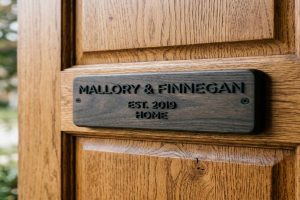
A name plate is one of the first things people see at your home. It tells them your name, your house number, or the name of your property. When it is made from the right material, it looks great and lasts for many years.
Stone and ceramic are two of the most popular choices for name plates today. They both look premium. They both hold up well outdoors. But they are very different materials with different strengths.
This guide explains each material clearly. It covers durability, finish options, outdoor performance, customisation, and care. By the end, you will know exactly which material suits your home and your budget.
📥 Download Free: Use our Stone and Ceramic Name Plate Decision Checklist PDF to find the right material in just five minutes.
What Are Ceramic and Stone Name Plates and Why Are They So Popular?
Ceramic and stone name plates have been used for centuries. They were in ancient homes long before plastic or metal became popular. Today, they are still the most trusted materials for long-lasting, outdoor name plates.
Why they are so popular:
- They look natural and timeless
- They hold up well against rain, sun, frost, and wind
- They do not rust, fade, or warp like metal or wood
- They can be carved, engraved, or printed with names and designs
- They add real character and identity to a home entrance
Stone name plates are cut from natural rock. Each one is slightly different because natural stone has unique patterns. This means that no two stone name plates look exactly the same.
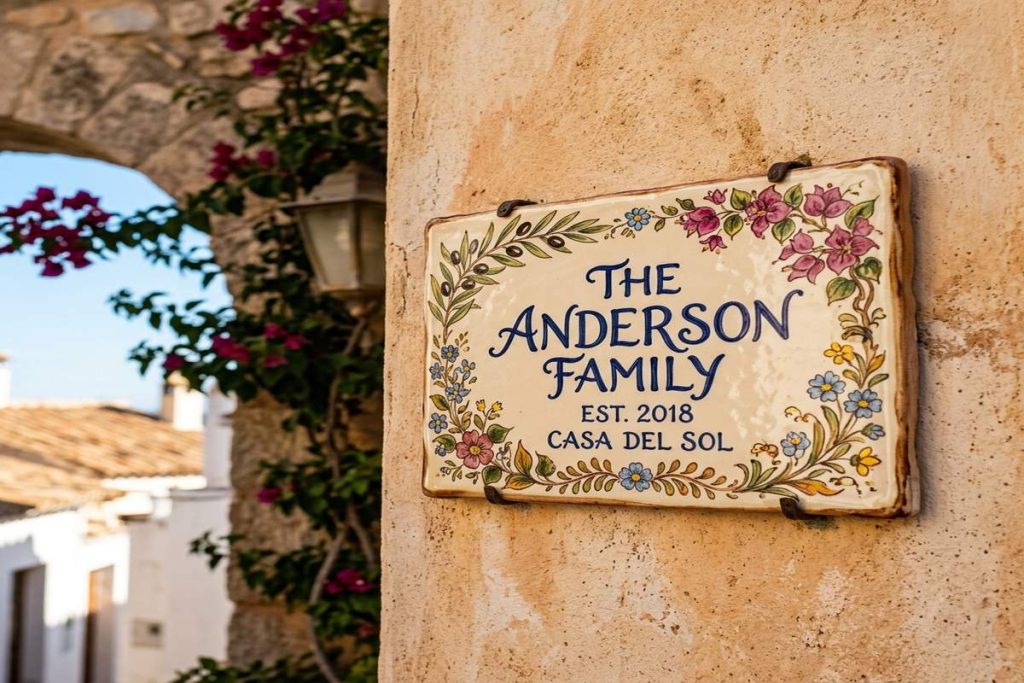
Ceramic name plates are made from clay that has been shaped and fired at very high temperatures. Also, they can be glazed in hundreds of colours. This makes them the most flexible material for colourful and artistic designs.
Next, let us look at the different types of stone used for name plates.
Expert Note: When identifying the mineral composition of a natural stone sample before specifying it for an outdoor name plate, a petrographic polarizing light microscope with rotating stage, 4x to 40x objective lenses, and transmitted light illumination is used to examine a thin section of the stone specimen in cross-polarised light. Each mineral grain shows a unique interference colour pattern under polarised light. For example, quartz appears grey to white, feldspar shows polysynthetic twinning, and mica shows bright second-order interference colours. Mineral identification follows the petrographic classification methods in ASTM C170-17 (Standard Test Method for Compressive Strength of Dimension Stone), which requires thin-section petrography as part of the stone characterisation report before commercial specification.
What Types of Stone Are Used to Make Name Plates?
There are five main types of natural stone used for name plates. Each one has a different look, feel, and level of durability.
Granite Granite is the hardest natural stone used for name plates. It forms deep underground from cooled magma. This process makes it very dense and strong. Granite resists scratches, stains, and extreme weather. It is a top choice for outdoor home name plates that need to last 30 years or more.
Granite comes in many natural colours: black, grey, pink, red, and white. The surface can be polished to a high shine or sandblasted to a matte finish.
Slate Slate is a fine-grained rock that splits easily into flat layers. This makes it ideal for thin, flat name plates. It has a natural dark grey or blue-grey colour. Also, its surface has a slight texture that gives it a classic, natural look.
High-quality slate (like Welsh or Brazilian slate) is very dense. It handles rain and frost well. It does not absorb much water. This means it will not crack in freezing temperatures.
Marble Marble is formed when limestone is subjected to extreme heat and pressure underground. It has a smooth, elegant surface with natural veining patterns in white, grey, gold, or green. Marble looks luxurious and is popular for formal home entrances.
However, marble is softer than granite and more porous. This means it can stain from acidic rain, bird droppings, or algae if it is not sealed regularly. Marble is best for sheltered or semi-sheltered outdoor locations.
Sandstone Sandstone is a sedimentary rock made from compressed sand grains. It has a warm, earthy look in tones of cream, brown, and tan. It is popular for heritage-style and rural properties.
Sandstone is softer and more porous than granite or slate. It absorbs water easily. In areas with freezing winters, water inside the stone can freeze and expand, causing cracks. Sandstone must be sealed before outdoor use.
Limestone Limestone is a soft, pale stone with a smooth, chalky texture. It is used for heritage homes and cottage-style properties. Like sandstone, it is porous and needs sealing for outdoor use. It is not suitable for harsh or wet climates without protection.
| Stone Type | Mohs Hardness | Water Absorption | Outdoor Rating | Best For |
| Granite | 6 to 7 | Less than 0.2% | Excellent | Any climate, any style |
| Slate | 4 to 5 | Less than 0.5% | Excellent | Cool and temperate climates |
| Marble | 3 to 4 | 0.5 to 2% | Good (needs sealing) | Sheltered, formal entrances |
| Sandstone | 2 to 3 | 5 to 15% | Moderate (seal required) | Rural and heritage styles |
| Limestone | 2 to 3 | 5 to 20% | Moderate (seal required) | Heritage and cottage styles |
Expert Note: When measuring the water absorption of a slate name plate sample to confirm it is suitable for outdoor use in a frost-prone climate, a vacuum water absorption apparatus with 25mm Hg vacuum pressure chamber and 24-hour immersion cycle is used to test the slate specimen (100mm by 100mm by 10mm). The vacuum removes air from the stone pores before water enters, giving a true measurement of the stone’s total open porosity. A water absorption value below 0.5 percent confirms the slate is suitable for frost-exposed locations without sealing. This test follows ASTM C97-02(2009) (Standard Test Methods for Absorption and Bulk Specific Gravity of Dimension Stone), which defines water absorption testing for all dimension stone types used in building applications.
What Types of Ceramic Are Used for Name Plates?
Ceramic is a broad category. Not all ceramics perform the same outdoors. The key difference is the firing temperature and the clay body used.
Standard Ceramic (Earthenware) This is low-fired ceramic, typically fired at 900 to 1100 degrees Celsius. It is porous and absorbs water easily. Standard earthenware tiles are NOT suitable for outdoor name plates in wet or frosty climates. However, they work well indoors or in fully sheltered outdoor locations.
Stoneware Stoneware is fired at higher temperatures (1200 to 1300 degrees Celsius). The high temperature vitrifies (fuses) the clay particles. This makes the ceramic dense, strong, and water-resistant. Stoneware is a reliable outdoor ceramic for most climates.
Porcelain Porcelain is the best ceramic for outdoor name plates. It is fired at 1250 to 1400 degrees Celsius. This makes it very dense and almost non-porous. Water absorption is typically below 0.5 percent. Porcelain resists frost, UV fading, and staining. It is as durable outdoors as slate.
Also, porcelain can be digitally printed in full colour before firing. This makes it the only material that allows photo-quality images and complex colour designs on a name plate.
Terracotta Terracotta is traditional fired clay. It has a warm, red-orange colour. It is porous and absorbs water. Terracotta name plates are suitable for Mediterranean and warm climates. In cold or wet climates, they must be sealed each year.
| Ceramic Type | Firing Temp | Water Absorption | Frost-Proof | Best For |
| Earthenware | 900 to 1100°C | 10 to 20% | No | Indoors or fully sheltered |
| Stoneware | 1200 to 1300°C | 1 to 5% | Usually | Temperate outdoor climates |
| Porcelain | 1250 to 1400°C | Below 0.5% | Yes | All outdoor climates |
| Terracotta | 950 to 1150°C | 8 to 15% | No | Warm, dry climates only |
Expert Note: When verifying the mineral phase composition of a porcelain ceramic name plate blank after kiln firing to confirm full vitrification, an X-ray diffractometer with Cu Ka radiation source at 40kV and 40mA and powder diffraction mode is used to analyse the crushed ceramic specimen. Full vitrification at 1300 degrees Celsius converts kaolin, feldspar, and quartz into mullite (3Al2O3.2SiO2) and amorphous glass phase. A high mullite peak intensity in the diffraction pattern confirms the ceramic has reached the density and impermeability required for outdoor use. Phase identification follows the reference patterns in the ICDD PDF-4 database and firing quality criteria in ASTM C326-09(2014) (Standard Test Method for Drying and Firing Shrinkage of Ceramic Whiteware Clays).
How Do You Compare Stone and Ceramic by Durability?
Durability means how well a material holds up over time and under difficult conditions. Both stone and ceramic are durable, but in different ways.
Scratch resistance Granite is the most scratch-resistant material in this guide (Mohs 6 to 7). Porcelain ceramic comes close (Mohs 6 to 7 for unglazed surface). Slate and marble are slightly softer but still resist normal outdoor scratching. Sandstone and earthenware scratch more easily.
Impact resistance Natural stone is very resistant to impact because of its mass and density. A heavy stone name plate is hard to break unless it is dropped from height. Ceramic is harder but more brittle. This means ceramic resists surface scratching well but can crack or chip if hit hard by a stone or a ball.
UV fade resistance Stone does not fade under UV light. It is a mineral and UV radiation has no effect on mineral colour. Ceramic with a fired glaze also resists UV fading very well. Ceramic with digital printing under a clear glaze or vitrified surface also holds colour for 20 or more years outdoors.
Chemical resistance Granite and slate resist most chemicals including mild acids, cleaning products, and fertilisers. Marble and limestone are sensitive to acid. Acidic rain, lemon juice, or vinegar can etch marble and remove its polish over time. Glazed ceramic resists most chemicals. Unglazed ceramic (earthenware) absorbs chemicals into its pores.
Weight Stone is heavy. A 250mm by 150mm granite name plate (15mm thick) weighs about 1.5 to 2kg. This is important for mounting. It needs a strong fixing method. Ceramic plates of the same size weigh slightly less (about 1 to 1.5kg) but still need secure mounting.
Expert Note: When measuring the flexural strength of a ceramic porcelain name plate blank before printing and glazing to confirm it meets the structural requirement for wall mounting with standoff fixings, a three-point flexural strength test apparatus with 200mm loading span and 1kN load cell is used to test the porcelain tile specimen (200mm by 100mm by 10mm) at a crosshead speed of 1mm per minute. The breaking strength must exceed 600N (60kg of force) to meet the Class 3 breaking strength category for ceramic tiles. This test follows ISO 10545-4:2014 (Ceramic Tiles: Determination of Modulus of Rupture and Breaking Strength), the international standard for structural performance of all ceramic tiles used in building applications.
Which Stone or Ceramic Name Plate Works Best Outdoors?
The best outdoor material depends on your local climate and the position of the name plate.
Here is a simple guide by climate type:
| Climate Type | Best Stone | Best Ceramic | Avoid |
| Temperate (UK, northern Europe) | Slate or granite | Porcelain stoneware | Sandstone (needs sealing), earthenware |
| Coastal salt air | Granite | Porcelain | Limestone (reacts with salt) |
| Frost and freeze (Canada, northern US) | Granite | Porcelain | Marble, sandstone, terracotta |
| Desert and dry heat (Middle East, Arizona) | Granite or marble | Porcelain | Sandstone (sand abrasion) |
| Tropical (humid, high rainfall) | Granite or slate | Porcelain | Sandstone, limestone |
| Mediterranean (warm, mild) | Marble, slate, or granite | Any ceramic | None (all options work) |
For most homes in the UK, northern Europe, or northern North America, granite or high-quality slate is the first choice for stone. Porcelain is the first choice for ceramic. Both handle frost, rain, and UV without needing annual sealing.
For homes in warm or Mediterranean climates, marble, sandstone, and terracotta all become valid options. The risk of frost cracking is low. Staining from acid rain is reduced.
Also, the position of the name plate matters. A plate on a south-facing wall in full sun needs a material that handles heat and UV. A plate in a sheltered porch needs less weather resistance. Adjust your material choice to match where the plate will actually be placed.
Expert Note: When testing the frost resistance of a slate name plate intended for a garden wall installation in a climate with 50 or more freeze-thaw cycles per year, a salt crystallization test chamber with 14 percent sodium sulphate solution cycling at 20 degrees Celsius soak and minus 15 degrees Celsius freeze is used to run 15 cycles on the slate specimen (100mm by 100mm by 10mm). After 15 cycles, the specimen is examined for surface scaling, edge cracking, and mass loss. A mass loss below 1 percent confirms the slate is suitable for frost-exposed outdoor use. This test follows ASTM C88-18 (Standard Test Method for Soundness of Aggregates by Use of Sodium Sulfate or Magnesium Sulfate), adapted for dimension stone durability assessment in frost-prone climates.
How Does a Stone Name Plate Hold Up Against Rain, Frost, and Heat?
Rain, frost, and heat all affect stone differently. Understanding how each type of stone responds helps you make a better choice.
Rain and moisture Water enters stone through its open pores. Dense stones like granite and slate have very few pores. This means water cannot get in easily. Soft stones like sandstone and limestone have many pores. Water soaks in quickly. When a porous stone is always wet, it grows algae and moss on the surface. Over time, acidic water can also dissolve the minerals that hold the stone together.
Frost When water inside stone freezes, it expands. This expansion puts enormous pressure on the stone from inside. Over many freeze-thaw cycles, this pressure creates cracks. This is called spalling. Dense stones (granite, slate) resist this because they absorb so little water. Porous stones (sandstone, limestone) are vulnerable to frost spalling unless they are sealed before winter.
Heat Natural stone handles heat very well. Granite can be heated to hundreds of degrees without damage. In summer, a south-facing stone name plate in direct sun may reach 50 to 60 degrees Celsius on its surface. This does not damage granite or slate. Marble with a polished surface can expand slightly under heat. If it is rigidly fixed with no room to expand, this can cause stress at the fixing points. Always use flexible sealant around the edges of mounted stone plates.
UV light UV light does not affect the mineral colour of stone. A granite name plate in direct sun will look the same in 20 years as it did on day one. Sealer coatings and stone-protection products applied on top of the stone may fade or peel under UV, though. Reapply sealers every 3 to 5 years on sealed stones.
Expert Note: When comparing the thermal expansion behaviour of granite versus porcelain ceramic name plate materials to predict which will be better suited for a south-facing wall with high summer solar gain, a thermal expansion dilatometer with alumina push rod, linear variable differential transducer, and 25 to 1000 degrees Celsius measurement range is used to measure the coefficient of linear thermal expansion of each material specimen. Granite has a typical coefficient of 7 to 9 micrometres per metre per degree Celsius. Porcelain ceramic has 6 to 8 micrometres per metre per degree Celsius. These values are used to calculate the thermal movement of the panel over the expected temperature range and size the mounting clearance accordingly. Thermal expansion measurement follows ASTM E228-17 (Standard Test Method for Linear Thermal Expansion of Solid Materials with a Push-Rod Dilatometer).
What Finishes Are Available for Ceramic and Stone Name Plates?
The finish of a name plate controls its texture, shine, and how it looks in different lighting. Both stone and ceramic offer several distinct finish options.
Stone finishes:
Polished: The stone surface is ground and buffed to a mirror-like shine. This brings out the colour and veining of the stone very clearly. Best for granite and marble. Polished surfaces show fingerprints and water marks more easily than other finishes.
Honed: The stone is ground to a flat, smooth surface but without the final high-polish step. The result is a satin matte look. Honed finishes are warmer and less formal than polished. They are practical and popular for entrance name plates.
Sandblasted: The stone surface is blasted with fine sand or grit under high pressure. This creates a consistent matte, slightly rough texture. Sandblasted stone resists fingerprints well. It is the standard finish for most engraved slate and granite name plates.
Flamed: The stone surface is briefly exposed to a flame at very high temperature. This causes the surface minerals to expand and spall at a micro level, creating a rough, non-slip texture. Flamed granite is popular for outdoor paving and some exterior name plates.
Ceramic finishes:
Gloss glaze: A glassy, shiny coating applied before the final firing. This creates a bright, reflective surface. It also makes the ceramic fully waterproof at the surface level.
Matt glaze: A non-reflective glaze that produces a softer, modern look. It reduces glare in bright outdoor lighting.
Full-body colour: For porcelain, the colour runs all the way through the body of the tile, not just the surface. This means chips do not show a different colour inside.
Digital print: A full-colour image or design is printed onto the ceramic tile before a clear glaze coat is applied. This allows photos, crests, hand-painted style artwork, and complex designs.
Expert Note: When verifying the surface hardness of the glaze on a newly produced porcelain name plate to confirm it meets the wear resistance requirement for outdoor use, a micro-Vickers hardness tester with 0.5kg load, diamond pyramid indenter, 10-second dwell time, and calibrated eyepiece micrometer is used to measure the Vickers hardness (HV0.5) of the fired glaze layer on the porcelain substrate. A good outdoor-grade ceramic glaze must achieve a minimum HV0.5 of 600 (approximately 7 on the Mohs scale). Values below 500 HV indicate a soft glaze that will show surface scratches from grit and cleaning. Glaze hardness measurement follows the Vickers microhardness test in ISO 4516:2002 (Metallic and Other Inorganic Coatings: Vickers and Knoop Microhardness Tests), applied here for ceramic glaze characterisation.
How Do You Choose the Right Size and Shape for a Stone or Ceramic Name Plate?
Size and shape are about matching the name plate to your home. The plate should be easy to read from the street and look proportionate to the wall or gate it is mounted on.
Standard sizes for home name plates:
| Application | Recommended Size | Minimum Text Height |
| Small house nameplate | 200 x 100mm | 25mm |
| Standard house nameplate | 250 x 150mm | 30mm |
| Large house nameplate | 300 x 200mm | 40mm |
| Gate pillar plaque | 400 x 250mm | 50mm |
| Driveway entrance (large) | 500 x 300mm | 60mm |
Also, the thickness of the stone matters. A 10mm thick stone plate is standard for most wall-mounted name plates. A 15 to 20mm thick plate is used for heavy outdoor plaques and gate pillar installations where a more substantial, architectural appearance is needed.
Shape options:
- Rectangle: The most common and formal shape. Works with any home style.
- Square: A modern, balanced look. Works well with minimalist architecture.
- Oval or arch top: A traditional, decorative shape. Popular with heritage and cottage homes.
- Custom silhouette: Some suppliers can cut stone or ceramic to a unique shape (an outline of a dog, a tree, or a home motif). This is more expensive but creates a truly unique plate.
For gate pillars, the name plate must be proportionate to the size of the pillar. As a guide, the plate should cover no more than one-third of the pillar face width.
Expert Note: When checking the slip resistance of a ceramic porcelain name plate installed horizontally on a low entry step (where the plate also functions as a step marker), a British pendulum slip resistance tester with calibrated rubber slider 96 IRHD hardness and 0.5kg pendulum bob is used to measure the Pendulum Test Value (PTV) of the glazed porcelain surface under wet conditions. A PTV of 36 or above indicates a low slip risk. A PTV below 25 requires immediate attention. This test follows EN 14157:2004 (Natural Stone Test Methods: Determination of the Resistance to Abrasion) and the slip resistance classification in BS 7976-2:2002 (Pendulum Testers: Method of Operation), which governs slip resistance evaluation for installed stone and ceramic surfaces in public locations.
How Are Names and Designs Added to Ceramic and Stone Name Plates?
The method used to add text and artwork affects how the finished plate looks and how long the design lasts. There are four main methods.
1. Sand-carving (sandblasting) A stencil of the design is applied to the stone surface. High-pressure grit or sand blasts away the exposed stone, cutting the design into the surface. The result is a deep, clean groove that can be left natural or painted with coloured infill paint.
Sand-carving is the most durable method for stone name plates. The engraved groove is as hard as the stone itself. The infill paint may fade after 10 to 15 years outdoors, but the groove remains. It can be repainted easily.
2. Laser engraving A laser beam burns the design into the stone or ceramic surface to a precise, shallow depth. Laser engraving gives very fine detail and is excellent for complex fonts, small text, and detailed artwork. It works on all stone types but is less deep than sand-carving.
For outdoor use, laser-engraved stone should have a painted infill for best readability. Without infill, shallow laser marks can be harder to read in low light.
3. Digital printing on ceramic A high-resolution digital image is printed directly onto the ceramic tile surface using specialist ceramic inks. A protective clear glaze is then applied on top and the tile is fired in a kiln. This fuses the colour into the ceramic permanently.
Digital printing allows full-colour photographs, coats of arms, hand-painted style artwork, and gradients that no other name plate method can replicate.
4. Hand painting Traditional hand-painting on ceramic is still available from specialist artists. Each name plate is painted by hand. No two are identical. Hand-painted ceramic name plates have a warmth and character that mass-produced plates cannot match. They are also the most expensive customisation method.
Expert Note: When testing the bond strength of a coloured infill paint applied to a sandblasted engraving in a granite name plate before outdoor installation, an adhesion cross-cut tester with multi-blade cutter, 1mm cut spacing, and ISO 2409 classification chart is used to evaluate the paint adhesion to the sandblasted granite substrate. The infill paint system must achieve a cross-cut classification of 0 or 1 (no detachment or less than 5 percent detachment) to qualify for outdoor use. A classification of 2 or above indicates insufficient paint-to-stone adhesion, which will result in premature peeling in freeze-thaw conditions. This adhesion test follows ASTM C482-02(2019) (Standard Test Method for Bond Strength of Ceramic Tile to Portland Cement Paste), adapted here for paint adhesion assessment on natural stone substrates.
How Do You Mount and Fix a Ceramic or Stone Name Plate to a Wall?
Stone and ceramic name plates are heavy. They need a secure, well-planned mounting system. A poorly fixed plate is a safety risk as well as a visual problem.
Method 1: Epoxy or two-part stone adhesive This is the most common method for flat-back stone and ceramic plates mounted to brick, rendered walls, or stone pillars. A specialist stone or tile adhesive (two-part epoxy) is applied to the back of the plate and it is pressed firmly onto the wall surface. This method creates a very strong, permanent bond.
For this to work, the wall surface must be clean, dry, and free from loose paint or render. Any contamination will weaken the adhesive bond.
Method 2: Stainless steel standoff bolts This method works well for thicker stone plates (15mm or more). Holes are pre-drilled in the stone by the supplier before delivery. Stainless steel standoff bolts are fixed to the wall. The stone plate is then placed over the bolts and secured with caps.
Always specify 316-grade stainless steel for outdoor coastal use. Standard 304-grade stainless can corrode in salt air after a few years.
Method 3: Mechanical fixing with resin-bonded anchors For very heavy gate pillar plaques (2kg and above), use stainless steel M8 threaded rods set into the pillar with two-component resin anchors. The rods protrude from the pillar and the stone plate is mounted over them and secured.
Mounting tips for stone and ceramic:
- Always use flexible neutral-cure silicone around the perimeter after mounting to prevent water ingress
- Do not use acetoxy silicone (vinegar smell) near stone. Acetic acid stains limestone and marble
- Use rubber spacers between metal fixings and stone to prevent vibration damage
- Check the load capacity of the wall before mounting. Very heavy plaques on old brick walls may need a structural fixing assessment
Expert Note: When measuring the true density and open porosity of a sandstone name plate blank to determine if it requires sealing before adhesive mounting, a helium gas pycnometer with 135 cm3 cell volume, 100 psi test pressure, and temperature-stabilised measurement chamber is used to measure the skeletal (true) density of the sandstone specimen by gas displacement. The true density, combined with the bulk density measured by mercury immersion, gives the open porosity percentage. An open porosity above 10 percent means the stone will absorb adhesive into its pores, reducing the bond strength of the adhesive system. The stone must be primed with a penetrating consolidant before adhesive application. True density measurement follows ASTM C567-14 (Standard Test Method for Determining Density of Structural Lightweight Concrete), adapted here for the gas pycnometry measurement of natural stone specimens.
How Do You Clean and Maintain a Ceramic or Stone Name Plate?
Stone and ceramic are both low-maintenance materials. But the wrong cleaning product can damage them permanently. Here are the rules for each material.
Cleaning natural stone (granite, slate, marble, sandstone):
Use these:
- Warm water with a small amount of pH-neutral stone cleaner or mild dish soap
- A soft cloth or natural bristle brush for scrubbing grout lines or textured surfaces
- A garden hose rinse for outdoor plaques once a month
Avoid these:
- Bleach: it can lighten and pit natural stone surfaces
- Vinegar or lemon juice: the acid etches marble and limestone permanently
- Any cleaner with ammonia: can damage stone sealers
- Pressure washers at high pressure: can erode the surface of soft stones like sandstone
Sealing stone plates:
- Granite and slate: apply a penetrating impregnator sealer every 3 to 5 years
- Marble and sandstone: seal every 1 to 2 years for outdoor exposure
- After sealing, water should bead on the surface. When water no longer beads, the sealer needs renewing
Cleaning ceramic name plates:
- Glazed ceramic: use any mild household cleaner. Glass cleaner also works well.
- Digital print ceramic: avoid abrasive pads. The print is protected by the glaze but sharp scratching can damage the clear coat
- For stubborn marks: apply a small amount of cream ceramic cleaner with a soft cloth
Also, check the fixing points once a year. Look for any silicone sealant that has cracked or peeled away at the edges. Reapply a fresh bead of neutral-cure silicone if needed to keep moisture out.
Expert Note: When checking whether a granite name plate has developed carbonation at the surface that could affect sealer adhesion after 10 years of outdoor exposure, a phenolphthalein carbonation depth indicator solution at 1 percent in isopropyl alcohol with spray applicator is used to detect the carbonation front depth in a freshly cut cross-section of the granite specimen. Carbonated zones (pH below 9) remain colourless when sprayed. Uncarbonated zones (pH above 9) turn bright pink-purple. Carbonation depth greater than 2mm at the surface of a polished granite plate indicates the surface has been slightly weakened by CO2 in rainwater. The phenolphthalein indicator test is specified in BS EN 14630:2006 (Products and Systems for the Protection and Repair of Concrete Structures: Determination of Carbonation Depth in Hardened Concrete by the Phenolphthalein Method), applied here for natural stone carbonation depth assessment.
How Do You Spot a High-Quality Stone Name Plate Before You Buy?
Not all stone name plates are equal. Some suppliers use inferior stone grades. Others use poor engraving methods that fade quickly. Here is how to tell the difference.
For natural stone plates:
Ask about the stone grade first. A quality supplier will be able to name the specific quarry or region of origin. For example: Welsh slate, Indian Black granite, or Carrara marble. Generic descriptions like “grey stone” or “dark stone” are a warning sign.
Check the thickness. A proper outdoor name plate should be at least 10mm thick. Plates thinner than 8mm are fragile and may crack during shipping or from vibration after mounting.
Check the edges. Quality stone plates have polished, chamfered, or bevelled edges. Raw-cut edges are a sign of a lower-grade product. They also collect dirt and look unfinished.
Ask about the engraving depth. Good sand-carved engravings are at least 2mm deep. Ask the supplier to confirm the engraving depth. Shallow laser marks under 0.5mm deep may fade quickly outdoors, especially without infill paint.
For ceramic name plates:
Ask if the ceramic is porcelain or standard earthenware. Only porcelain is suitable for outdoor use in wet or frosty climates. Check the water absorption value on the product data sheet. It should be 0.5 percent or below for outdoor-grade porcelain.
Check if the print is under a glaze or on top. A print under a protective glaze layer is fused permanently into the ceramic during firing. A print on top of the glaze is much less durable and will fade or scratch outdoors within 2 to 3 years.
Expert Note: When verifying whether a ceramic name plate sample is true porcelain (below 0.5 percent water absorption) or standard earthenware (above 3 percent water absorption) before approving it for an outdoor installation, a muffle furnace with programmable temperature ramp rate (5 degrees per minute), 1300 degrees Celsius maximum temperature, and chromel-alumel thermocouple control is used as part of the ceramic production verification process to confirm that the kiln firing cycle reached the full vitrification temperature. Post-firing weight, then post-water-soak weight, is compared to calculate the water absorption percentage per ASTM C373-14a (Standard Test Method for Water Absorption, Bulk Density, Apparent Porosity, and Apparent Specific Gravity of Fired Whiteware Products, Ceramic Tiles and Glass Tiles), which is the definitive standard for ceramic water absorption classification.
Which Material Is Right for You? A Simple Stone vs Ceramic Decision Guide
Use these questions to find your ideal material. Work through the list and your answer will become clear.
Question 1: Do you want full colour or photos on your name plate? If yes, choose porcelain ceramic with digital printing. Stone cannot produce full-colour photo-quality images.
Question 2: Do you live in a climate with cold winters and frost? If yes, choose granite, dense slate, or outdoor-grade porcelain. Avoid sandstone, limestone, terracotta, and standard earthenware ceramic.
Question 3: Is your name plate going in a salt-air coastal location? If yes, choose granite or porcelain. Avoid limestone and marble (reactive to salt). Use 316-grade stainless steel fixings only.
Question 4: Do you want a natural, unique look with no two plates alike? If yes, choose natural stone. Each stone slab has its own pattern and grain. Ceramic is manufactured and more uniform in appearance.
Question 5: Is budget a primary concern? Ceramic porcelain is generally the most cost-effective outdoor option. Standard ceramic can cost 50 to 70 percent less than an equivalent granite plate. For the best value outdoor plate, choose porcelain stoneware.
Question 6: Does your home have a heritage, rural, or traditional style? If yes, choose slate, sandstone, or hand-painted ceramic. These materials have a warm, artisan character that suits older and traditional homes.
Question 7: Do you want a name plate that lasts 25 to 30 years with minimal maintenance? If yes, choose granite or outdoor porcelain. Both are proven long-life materials. Granite needs no sealing. Porcelain needs no sealing.
Expert Note: When comparing the surface hardness of five candidate name plate materials for a buyer who prioritises scratch resistance from grit and daily outdoor contact, a Schmidt rebound hammer with N-type impact plunger, spring energy 2.207 Nm, and digital display is used to measure the surface rebound hardness of polished specimens of granite, slate, marble, sandstone, and porcelain ceramic. The rebound value (R value) is higher for harder materials. Granite typically returns R values of 50 to 65. Slate returns 40 to 55. Marble returns 35 to 50. Sandstone returns 20 to 35. These field measurements complement laboratory hardness data and allow rapid comparative testing of candidate materials on site. Schmidt rebound testing for natural stone is conducted per the procedure in ASTM C805-18 (Standard Test Method for Rebound Number of Hardened Concrete), applied here for dimension stone surface hardness comparison.
🛍️ Shop Stone and Ceramic Name Plates: Browse our full range of Granite Name Plates, Slate Name Plates, and Ceramic Name Plates. Custom sizing, engraving, and hand painting available.
Frequently Asked Questions About Ceramic and Stone Name Plates
Which stone is best for an outdoor name plate in the UK?
Slate and granite are the best choices for the UK climate. Both handle rain, frost, and UV well without annual sealing. High-quality Welsh or Brazilian slate is particularly popular for UK homes. It has a natural grey-blue colour, resists frost, and looks at home on both modern and traditional properties.
Does a stone name plate need to be sealed?
Granite and dense slate do not need sealing for basic outdoor use. However, sealing extends their life and keeps them cleaner. Marble, sandstone, and limestone must be sealed before outdoor use to prevent water absorption, staining, and frost damage.
Is ceramic as durable as stone for an outdoor name plate?
Outdoor-grade porcelain ceramic has similar water absorption, frost resistance, and UV stability to granite and slate. It is slightly more brittle under impact (a hard knock can chip it where stone would not crack). In most other durability measures, high-quality porcelain performs as well as natural stone.
Can I get a photo or full-colour image on a stone name plate?
No. Natural stone cannot hold a photo-quality colour image directly. The only material that allows full-colour photo printing for an outdoor name plate is porcelain ceramic with a digitally printed under-glaze design, kiln-fired at 1250 degrees Celsius or above.
How long does a granite name plate last outdoors?
A well-made granite name plate lasts 30 to 50 years or more without losing its structural integrity. The sand-carved engraving lasts indefinitely. The paint infill in the engraving may need repainting every 10 to 15 years. Granite is one of the most permanent materials available for home signage.
What is the most affordable outdoor name plate material?
Standard stoneware or porcelain ceramic is usually the most affordable outdoor-suitable option. Prices for a 200mm by 150mm porcelain name plate typically start at 20 to 50 percent below the equivalent granite plate. For coloured designs, ceramic is even more cost-effective because colour printing on stone requires specialist inlay techniques.
Can I install a stone name plate myself?
A small stone plate (under 1kg) can be installed with a two-part epoxy adhesive if the wall is solid, flat, and dry. Heavier plates (over 1kg) should use mechanical fixings (standoff bolts or resin-bonded anchors). Always check the manufacturer’s adhesive load rating before installing. For gate pillar plaques over 2kg, professional installation is recommended.
Why does marble stain outdoors?
Marble is made partly from calcite, which reacts with weak acids. Acidic rain, bird droppings, and some airborne pollutants etch the polished surface of marble over time. This creates dull patches called etching. Also, marble’s pores absorb coloured liquids (like rust from nearby metal) if it is not sealed. Sealing marble every 1 to 2 years prevents most staining outdoors.
What is the difference between sandblasting and laser engraving on stone?
Sandblasting cuts deeper into the stone (typically 2 to 5mm) using high-pressure grit through a stencil. Laser engraving burns the surface to a shallower depth (typically 0.3 to 1mm) using a focused laser beam. Sandblasted engravings are more visible from a distance and more durable outdoors. Laser engravings offer finer detail and are better for small text and complex designs.
How do I clean algae or moss off a stone name plate?
Mix one part bleach with ten parts water in a spray bottle. Spray onto the stone surface and leave for 10 minutes. Scrub gently with a soft natural bristle brush and rinse thoroughly with clean water. For regular maintenance, a diluted stone cleaner with algae inhibitor keeps green growth from returning. Note: do not use bleach on marble or limestone as it can cause surface discolouration over time. Use a pH-neutral stone cleaner on calcium-based stones instead.
Explore Essential House Name Plate Guides & Tutorials
Browse our comprehensive handcrafted signage guides for material care, font selection, and architectural placement:
- Beach & Airbnb Signage Design & Weatherproofing Guide (2026)
- Complete Guide to Wood House Sign Sealing & Weather Maintenance
- Horizontal vs Vertical House Numbers Layout Comparison
- Hanging & Wall-Mounted Cottage Sign Installation Guide
- Round vs Rectangular Name Plaques for Modern Property Entrances
- Best Modern & Vintage Fonts for Cottage & Residential Signs